
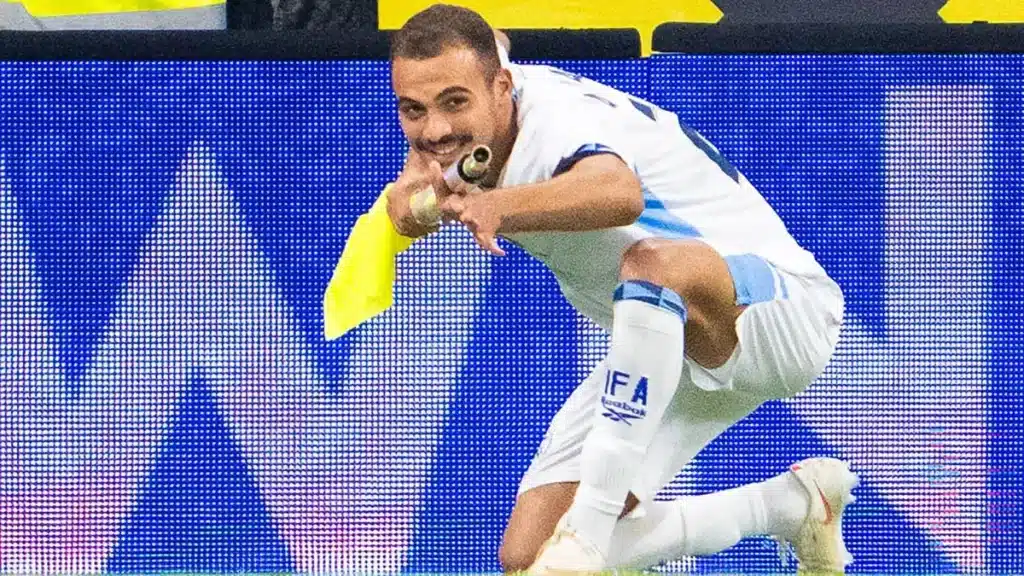
Israel forward Saied Abu Farchi was sent off moments after scoring against Austria in one of the most unusual refereeing incidents of the opening UEFA Nations League fixtures.
The 20-year-old headed Israel level in the 55th minute at the Raiffeisen Arena in Linz, then went towards the corner flag as part of his celebration. Abu Farchi removed the flag and held it horizontally, making a gesture widely interpreted and reported as imitating the firing of a gun.
Bulgarian referee Georgi Kabakov responded by showing Abu Farchi a yellow card. The problem for the Israel forward was that he had already been cautioned in the 51st minute for a foul. The celebration therefore resulted in a second yellow card followed by a red, reducing Israel to ten players shortly after they had made it 1-1.
Austria eventually won 3-1, with Phillipp Mwene restoring the hosts’ lead in the 90th minute before Saša Kalajdžić added another in stoppage time. But was Kabakov actually required to caution Abu Farchi? The answer is more interesting than simply saying that players are not allowed to celebrate with the corner flag.
Why did Saied Abu Farchi receive a second yellow card?
The relevant section is Law 12 of the IFAB Laws of the Game: Fouls and Misconduct.
The 2026/27 Laws allow players to celebrate goals, provided the celebration does not become excessive. However, Law 12 specifically states that a player must be cautioned for certain forms of celebration, including when the player acts in a “provocative, derisory or inflammatory” way.
That is the most important wording when analysing Abu Farchi’s dismissal. The issue was not necessarily the fact that he celebrated with the corner flag. It was the nature of the gesture he performed with it.
Abu Farchi took the flag, crouched down and held it in a position that numerous reports interpreted as resembling a rifle. Reuters reported the celebration as Abu Farchi using the corner flag to simulate firing a gun.
There has also been some debate over exactly what the player intended to imitate, with some observers suggesting the movement could have resembled another action, such as using a pool cue. His precise intention has not been publicly established.
For the referee, however, intent is not the only consideration. Kabakov had to judge what the action represented in the context of the match and whether it crossed the Law 12 threshold of being provocative or inflammatory.
Once he decided that it did, a caution was available under the Laws. Because Abu Farchi was already on a yellow card, that caution automatically became his second of the match.
Does removing the corner flag automatically mean a yellow card?
This is where some explanations of the incident have been misleading.
There is not a simple IFAB rule stating that any player who removes a corner flag during a goal celebration must automatically receive a yellow card. Law 17 does state that a corner flagpost must not be moved when dealing with the procedure for a corner kick.
But the specific section of Law 12 dealing with goal celebrations does not list “touching the corner flag” or “using the corner flag as a prop” as an automatic caution in the same way that it explicitly lists removing the shirt, covering the face with a mask or acting provocatively.
That distinction matters. If a player briefly interacted with a corner flag during an otherwise harmless celebration, it would not necessarily follow that a mandatory yellow card must be shown solely because the flag was involved.
In the Austria-Israel incident, the stronger justification for Kabakov’s decision is therefore the nature of Abu Farchi’s gesture, rather than simply the removal of the flag.
Was the Abu Farchi red card correct?
From a Laws of the Game perspective, Kabakov had a credible basis to issue the second caution. Law 12 specifically requires referees to caution goal celebrations considered provocative, derisory or inflammatory.
A celebration involving what appears to be a weapon-firing gesture can reasonably fall within that category. That does not mean every unusual or controversial celebration must automatically produce a yellow card. The referee still has to interpret the action.
If Kabakov believed Abu Farchi’s gesture was merely harmless choreography, the Law would not automatically demand a caution just because a corner flag had been used. But if he interpreted the gesture as simulating the firing of a weapon and therefore considered it provocative or inflammatory, Law 12 supports the yellow card.
The distinction is important because Abu Farchi did not receive a straight red card for the celebration. He received a yellow card for the celebration, which became a red only because it was his second caution.
Could VAR have overturned Abu Farchi’s second yellow card?
There is another particularly interesting refereeing detail because the VAR protocol has changed for the 2026/27 Laws of the Game.
UEFA appointed Portuguese official Tiago Martins as VAR, with Bulgaria’s Nikola Popov as assistant VAR. Kabakov’s assistant referees were Martin Margaritov and Martin Venev, with Radoslav Gidzhenov as fourth official.
Historically, one of the most familiar limitations of VAR was that second yellow cards could not normally be reviewed simply because they resulted in a sending-off.
The latest IFAB protocol now contains an important change. Under the 2026/27 VAR provisions, VAR can assist the referee in the case of a clearly incorrect second caution. IFAB even provides an example in which a player receives an incorrect second yellow and VAR intervention leads to that caution, and therefore the red card, being cancelled.
That does not mean VAR should re-referee every second yellow. The threshold remains high: it must be clearly incorrect.
In Abu Farchi’s case, there is no indication in the publicly available match reporting that the decision was overturned or that an on-field review took place. Given that Law 12 provides a legitimate basis for Kabakov to regard the celebration as provocative or inflammatory, this would also be difficult to classify as an obvious case in which the referee had no basis for showing the card.
The referee: Georgi Kabakov
The man responsible for the decision was Bulgarian international referee Georgi Kabakov. UEFA appointed Kabakov to lead the Austria-Israel Nations League fixture alongside assistant referees Martin Margaritov and Martin Venev.
The presence of experienced VAR Tiago Martins also meant that this was a fully equipped UEFA refereeing team rather than a decision made without video support. Kabakov’s handling of the celebration became the major refereeing talking point of the evening.
It was also a decision with enormous consequences. Abu Farchi had just brought Israel level at 1-1 when he was dismissed. Israel then had to protect the draw with ten players for more than half an hour.
They survived until the final minute of normal time before Mwene made it 2-1, with Kalajdžić completing Austria’s 3-1 victory shortly afterwards. That does not establish that the red card caused the defeat, but it clearly changed the circumstances in which the remainder of the match was played.
The VAR Verdict
The second yellow card is supportable under IFAB Law 12.
The strongest justification is not simply that Abu Farchi removed or used the corner flag. Instead, it is the referee’s interpretation of a celebration widely perceived as mimicking the firing of a weapon.
Law 12 specifically instructs referees to caution players who celebrate in a provocative, derisory or inflammatory manner. If Kabakov interpreted Abu Farchi’s gesture that way, showing the yellow card was consistent with the Laws.
Because the forward had already been cautioned only minutes earlier, Kabakov then had no discretion over the consequence: the second yellow had to be followed by a red card.
There is still room to debate whether the celebration itself reached the threshold of being provocative or inflammatory. That is a judgement decision rather than a purely factual one.
What should be avoided, however, is the simpler claim that Abu Farchi was automatically sent off because “players cannot touch the corner flag.” That is not an accurate explanation of the relevant Law.
The real refereeing question is whether the celebration crossed the behavioural threshold established by Law 12. On that basis, Kabakov’s decision has a clear foundation in the 2026/27 Laws of the Game.
Law reference: IFAB Laws of the Game 2026/27, Law 12 – Fouls and Misconduct
Reviewed: September 25, 2026

0 Comments
Join the conversation with respect. Comments are moderated and must follow our community rules.
Want to join the discussion?
Please log in or create an account to comment and reply. This keeps the conversation cleaner and safer.