
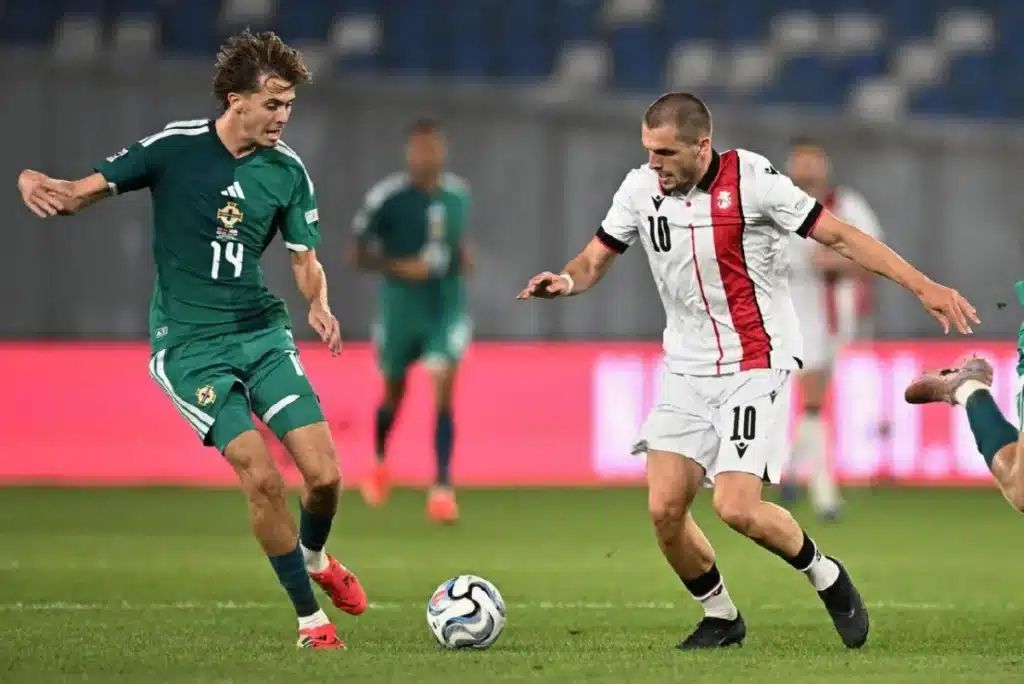
Northern Ireland left Tbilisi with a historic 1-0 Nations League victory over Georgia, but the result did not stop manager Michael O’Neill from questioning several major refereeing decisions.
Israeli referee Orel Grinfeeld found himself at the centre of the controversy after awarding Georgia a second-half penalty following a VAR review, before Northern Ireland later had a penalty appeal of their own waved away.
Georgia captain Khvicha Kvaratskhelia failed to convert the penalty, with Pierce Charles producing a crucial save, before his brother Shea Charles scored a dramatic winner in the 99th minute. The victory gave Northern Ireland their first away win in the Nations League.
But from a refereeing perspective, the match left several important questions. Was Daniel Ballard’s challenge on Luka Lochoshvili really enough for a penalty? Did VAR have sufficient evidence to overturn Grinfeeld’s original decision? And should Northern Ireland have received a spot kick when Shea Charles went down at the other end?
Here is The VAR Verdict’s analysis of the major incidents.
Who was the referee for Georgia vs Northern Ireland?
Israeli official Orel Grinfeeld refereed the Nations League match between Georgia and Northern Ireland in Tbilisi.
His officiating team included:
- Referee: Orel Grinfeeld
- Assistant referees: Roy Hassan and Idan Yarkoni
- Fourth official: Snir Levy
- VAR: Eli Hacmon
- Assistant VAR: Gal Leibovitz
It was the video team that became heavily involved in the biggest refereeing decision of the night. Grinfeeld initially allowed play to continue following the incident involving Daniel Ballard and Luka Lochoshvili. VAR then recommended an on-field review.
After watching the incident again at the pitchside monitor, Grinfeeld changed his original decision and awarded Georgia a penalty. That sequence is critical when assessing whether VAR was used correctly.
Why was Georgia awarded a penalty?
The controversial incident came midway through the second half. A ball was delivered into the Northern Ireland penalty area, where Daniel Ballard and Luka Lochoshvili were competing for position.
There was physical contact between the pair as the Georgian attacker attempted to move towards the incoming ball. Grinfeeld’s initial decision was to allow play to continue, which meant his on-field judgement was effectively no penalty.
However, VAR Eli Hacmon reviewed the incident and recommended that Grinfeeld look at the replay himself. After a lengthy on-field review, the referee reversed his decision and pointed to the penalty spot. Ballard was also shown a yellow card.
Kvaratskhelia stepped up to take the penalty, but Pierce Charles guessed correctly and made the save. Northern Ireland survived. But the missed penalty does not change the refereeing question: should VAR have intervened in the first place?
Was Ballard’s challenge on Lochoshvili a penalty?
Under IFAB Law 12, holding or other illegal physical contact can result in a direct free kick, or a penalty when committed by a defender inside their own penalty area. However, not every instance of contact is an offence.
Football allows physical competition for position. For holding to become punishable, the contact must actually impede the opponent’s movement. That distinction is particularly important during crosses and set-piece situations, where attackers and defenders regularly use their bodies and arms while competing for space.
The referee must decide whether the contact is normal football contact or whether one player illegally prevents the opponent from moving.
In the Ballard-Lochoshvili incident, the key question is therefore not simply: “Was there contact?” There clearly was. The correct question is: “Was Ballard’s contact sufficiently illegal and consequential to constitute a foul?” That is a considerably higher standard.
The biggest question is the VAR intervention
Even if someone believes the incident could support a penalty, that does not automatically mean VAR was correct to intervene. This is the most important part of the controversy.
Grinfeeld had already seen the challenge in real time and allowed play to continue. Under the VAR protocol, an original decision should normally be changed only when there has been a clear and obvious error.
VAR is not designed to ask, “Could this possibly be a penalty?” Instead, when the referee has given no penalty, the question should effectively be, “Is the original no-penalty decision clearly wrong?” Those are very different standards.
There are many penalty-area incidents where both decisions could be defensible. One referee might consider the contact enough for a foul. Another might view it as ordinary physical competition. VAR should generally not intervene simply because the video referee prefers the alternative interpretation. There must be strong evidence that the original decision cannot reasonably stand.
Why Michael O’Neill was unhappy
Northern Ireland manager Michael O’Neill made his frustration clear after the game. He described the penalty decision as extremely harsh and questioned whether Lochoshvili was realistically capable of reaching the ball.
That second point requires some clarification from a refereeing perspective. An attacker does not necessarily have to be guaranteed to reach the ball for a foul to exist. If a defender illegally holds, trips or pushes an opponent while the ball is in play, a foul can still occur.
However, the attacker’s realistic possibility of becoming involved in the play can help the referee assess the impact and consequence of the contact. If both players are engaged in relatively minor physical contact and the attacker has little realistic opportunity to play the cross, it becomes more difficult to justify VAR intervention as correcting a clear and obvious mistake.
That appears to be the central argument behind Northern Ireland’s frustration.
The VAR Verdict on Georgia’s penalty
Based on the available evidence and the way the incident developed, the penalty itself is arguable, but the threshold for VAR intervention is the more questionable element.
There is enough physical contact for a referee to consider whether an offence occurred. That means describing the final penalty decision as completely impossible would go too far.
However, Grinfeeld’s original decision was no penalty. For VAR to reverse that judgement, the replay should demonstrate clearly that Ballard illegally impeded Lochoshvili rather than the two players simply engaging in a physical contest for position.
If the replay requires repeated slow-motion viewing and extensive interpretation to decide whether the contact crossed that line, that naturally raises questions about whether the original decision was truly a clear and obvious error.
Preliminary verdict: Debatable penalty, questionable VAR intervention.
The penalty can be supported if Ballard’s action is judged to have clearly impeded Lochoshvili. The more controversial issue is whether the original no-penalty call was sufficiently wrong to justify VAR stepping in.
Should Northern Ireland have received a penalty?
The controversy did not end with Georgia’s missed spot kick. In the 88th minute, Northern Ireland had their own penalty appeal when Shea Charles went down inside the Georgian penalty area. Grinfeeld allowed play to continue. This time there was no on-field review.
That immediately created a consistency question. Northern Ireland had already seen a relatively subjective penalty-area incident upgraded to a penalty following VAR intervention at the other end. When Charles then appeared to receive contact inside Georgia’s box, supporters and the Northern Ireland bench naturally expected the incident to receive the same level of scrutiny.
It is important to clarify one point: the absence of an on-field review does not mean VAR ignored the incident. VAR checks potential penalty situations in the background. If the video referee concludes that the original decision is not clearly and obviously wrong, the referee will not be sent to the monitor.
Therefore, the key question again becomes one of thresholds.
Why consistency matters more than simply giving two penalties
Refereeing consistency does not mean: “Georgia received a penalty, therefore Northern Ireland must also receive one.” Every incident must be judged independently. Two challenges that look superficially similar can have important differences in force, direction, point of contact and consequence.
But the threshold for what constitutes a foul should remain recognisable throughout the match. And the threshold for VAR intervention should remain consistent as well.
If relatively limited contact was enough for VAR to recommend an on-field review for Georgia’s penalty, then a similar level of contact in the Northern Ireland penalty appeal deserves close examination.
That does not automatically mean Charles should have received a penalty. But it explains why O’Neill and Northern Ireland felt the two incidents were treated differently.
The late Ceadach O’Neill incident added to the frustration
There was another flashpoint late in the match. Substitute Ceadach O’Neill went down following a challenge, but Grinfeeld allowed play to continue. Georgia then attacked from the resulting phase.
During that sequence, Daniel Ballard suffered a hamstring injury while trying to recover defensively. Michael O’Neill was particularly angry about the original challenge, believing Northern Ireland should have received a free kick before Georgia were allowed to counter.
The Ballard injury does not determine whether the earlier challenge was a foul. Referees must judge the challenge itself rather than what happens several seconds later.
But from Northern Ireland’s perspective, it added to the feeling that several borderline decisions had gone against them during the second half.
Shea Charles’ winner also required a VAR check
There was still time for VAR to become involved again. Deep into stoppage time, Shea Charles scored the winning goal, finishing from close range after Georgia failed to fully clear a Northern Ireland attack.
The goal prompted a VAR check for a possible offside. This time the check ended without intervention and the goal stood.
Charles’ strike in the 99th minute gave Northern Ireland a dramatic 1-0 victory. From a refereeing perspective, this was a more straightforward use of VAR. Offside situations connected to goals are automatically checked, and once the video team established there was no reason to disallow the goal, the original decision was confirmed.
Orel Grinfeeld’s overall refereeing performance
A referee’s performance should never be judged solely on whether one team agrees with his decisions. Nor should the final result influence the assessment.
Northern Ireland won the match, but Michael O’Neill was still highly critical of Grinfeeld’s officiating. That is significant because his frustration was not based on trying to explain away a defeat. The major concern was consistency.
The Georgia penalty required VAR to convince Grinfeeld that his initial judgement was clearly wrong. Later, Northern Ireland’s own penalty appeal was allowed to stand without an on-field review. A further challenge on Ceadach O’Neill then went unpunished late in the game.
Individually, each incident can have a football explanation. Together, however, they created a difficult night for the refereeing team because the decision-making threshold did not always appear easy to understand.
The VAR Verdict
The Georgia vs Northern Ireland VAR controversy is a good example of why assessing VAR requires more than deciding whether contact existed. There was contact between Daniel Ballard and Luka Lochoshvili. That alone does not settle the penalty decision.
The crucial questions are whether the contact illegally impeded the Georgian attacker and, just as importantly, whether Grinfeeld’s original no-penalty decision represented a clear and obvious error.
Our preliminary assessment is that the penalty can be defended under Law 12, but the decision to intervene through VAR is considerably more debatable.
The later Shea Charles incident strengthens the discussion about consistency, particularly because Northern Ireland did not receive an on-field review for their own appeal. That does not prove one decision was right and the other wrong. But when VAR intervenes in a subjective contact situation at one end, the standard applied to another subjective penalty incident inevitably comes under greater scrutiny.
Northern Ireland ultimately escaped the controversy with all three points thanks to Pierce Charles’ penalty save and Shea Charles’ extraordinary late winner.
For the officials, however, the biggest question from the match remains unresolved: Was Georgia’s penalty really a clear and obvious refereeing error, or did VAR simply replace one subjective judgement with another?
For a system designed to correct clear mistakes rather than re-referee marginal decisions, that distinction matters.
Preliminary VAR Verdict: Georgia penalty supportable, but VAR intervention debatable. Northern Ireland penalty appeal requires stronger visual evidence before it can be classified as a missed clear-and-obvious penalty.
Law reference: IFAB Laws of the Game 2026/27, Law 12 and VAR Protocol
Reviewed: September 26, 2026

0 Comments
Join the conversation with respect. Comments are moderated and must follow our community rules.
Want to join the discussion?
Please log in or create an account to comment and reply. This keeps the conversation cleaner and safer.