
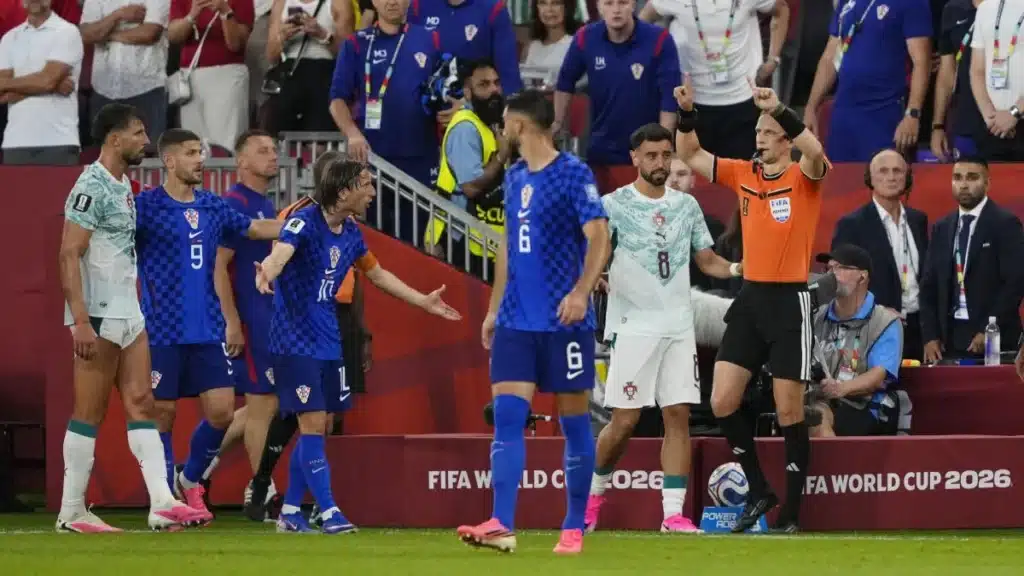
The 2026 World Cup refereeing decisions have produced almost as much debate as the goals, eliminations and dramatic comebacks. FIFA arrived at the tournament with expanded VAR powers, connected-ball technology and several changes to the Laws of the Game, but greater technological precision did not eliminate controversy.
Some decisions were clearly correct under the law but felt harsh because of the technology used to detect them. Others exposed weaknesses in the VAR protocol, while several incidents remained subjective even after multiple replays.
From Croatia’s disallowed equaliser against Portugal to the red card that changed Argentina’s quarter-final against Switzerland, these are the ten refereeing decisions that have defined the tournament so far.
This ranking considers the importance of the match, the effect on the result, the level of public debate and whether the decision raised wider questions about FIFA’s refereeing system. It covers the tournament through the semi-finals, before the final between Spain and Argentina.
10. Germany’s Goal Against Ecuador Survives a High-Boot Check
Germany’s early goal against Ecuador became one of the first major examples of VAR choosing not to intervene in a possible attacking-phase foul.
Before Leroy Sané scored, Aleksandar Pavlović challenged Pedro Vite with a raised boot that appeared to make contact near the Ecuadorian player’s head. Ecuador expected the goal to be disallowed, but the referee allowed play to continue and VAR did not recommend a review.
A high foot is not automatically an offence. The referee must judge whether the action was careless, reckless or involved excessive force. However, contact near an opponent’s head normally raises the threshold of concern, especially when the challenge directly precedes a goal.
Because the incident occurred during the attacking phase that produced Germany’s goal, VAR was permitted to examine it. The decision to clear the goal suggested the video officials did not believe the contact reached the level of a clear and obvious missed foul.
The VAR Verdict: The goal was legally supportable, but a pitchside review would have provided greater transparency. The high position of the boot and the direct connection to the goal made this more than a routine coming-together.
9. Vinícius Júnior’s Goal Disallowed Against Scotland
Brazil believed Vinícius Júnior had doubled their advantage against Scotland after he won possession near the penalty area and finished into the far corner. VAR intervened, however, and the referee disallowed the goal after reviewing contact between Vinícius and defender Jack Hendry.
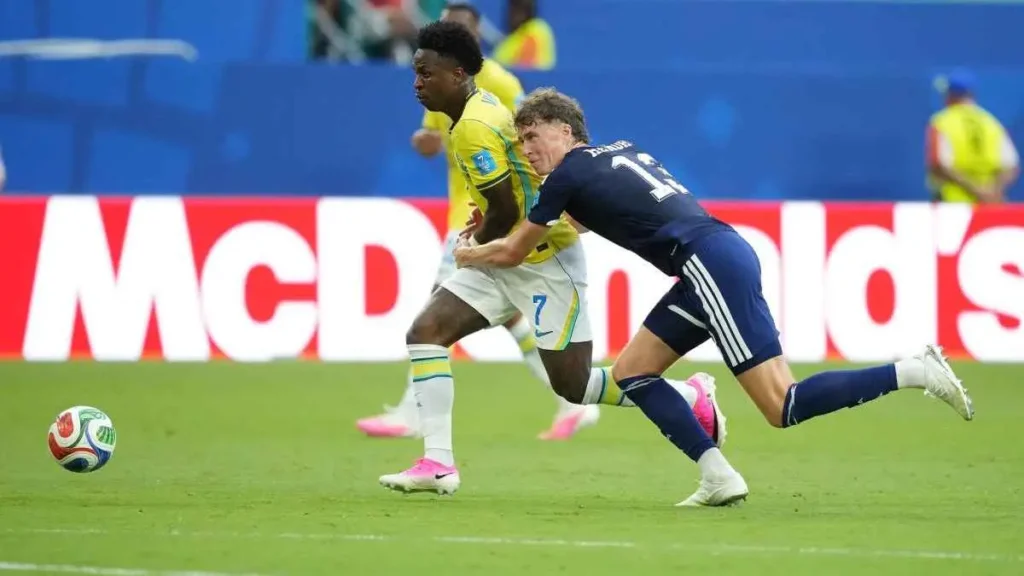
The controversy centred on whether the contact was strong enough to constitute a foul. There appeared to be a physical challenge, but critics argued it was normal football contact and did not meet the high threshold required for VAR intervention.
VAR should not re-referee subjective incidents merely because another interpretation is possible. Its role is to correct a clear and obvious error. When a referee has seen a challenge and judged it legal, the evidence must be sufficiently clear to justify overturning that decision.
Brazil later requested greater consistency in FIFA’s application of the VAR intervention threshold.
The VAR Verdict: This was one of the tournament’s more questionable interventions. There was contact, but it was debatable whether the original decision was clearly wrong.
8. Iran’s Stoppage-Time Winner Ruled Out for a Marginal Offside
Iran appeared to have secured a historic place in the knockout stage when Shoja Khalilzadeh scored in stoppage time against Egypt. The celebrations ended after VAR determined that the defender had been in an offside position.
The margin was extremely small, reportedly measured in millimetres. Technically, offside remains a factual decision once the relevant body positions and the moment of contact with the ball have been established.
That does not make the emotional consequences any easier to accept. Iran went from believing it had achieved a historic qualification to seeing the goal erased by a technological measurement almost impossible for the assistant referee to detect in real time.
The VAR Verdict: Correct under the current application of Law 11, but another example of technology finding an offence that no player, referee or supporter could confidently identify with the naked eye.
7. Ghana Denied a Penalty Against England
One of the clearest complaints from the group stage came during Ghana’s goalless draw against England.
Prince Kwabena Adu entered the penalty area before England defender Ezri Konsa challenged him. Replays appeared to show Konsa missing the ball and making contact around Adu’s knee, but no penalty was awarded and VAR did not send the referee to the monitor.
Ghana coach Carlos Queiroz later joked that the VAR had “gone for a coffee,” while Ghana’s players argued that the same incident would have received far more attention had it occurred at the opposite end.
Under Law 12, a careless challenge that trips or brings down an opponent is punished with a direct free kick, or a penalty when it occurs inside the defender’s penalty area. The key question was whether Adu was brought down by the defender or whether the contact was considered an acceptable consequence of both players competing for the ball.
The VAR Verdict: Ghana had a very strong penalty claim. The absence of an on-field review was difficult to understand because the available replays appeared to show clear leg-on-leg contact without Konsa playing the ball.
6. Harry Kane’s Penalty Appeal Against DR Congo
England were on the other side of a major penalty debate during their Round of 32 meeting with DR Congo.
Harry Kane went down inside the area under a defensive challenge, but the referee allowed play to continue. VAR checked the incident and supported the original decision rather than recommending an on-field review. Refereeing analysis after the match argued that England had grounds to feel a penalty should have been awarded.
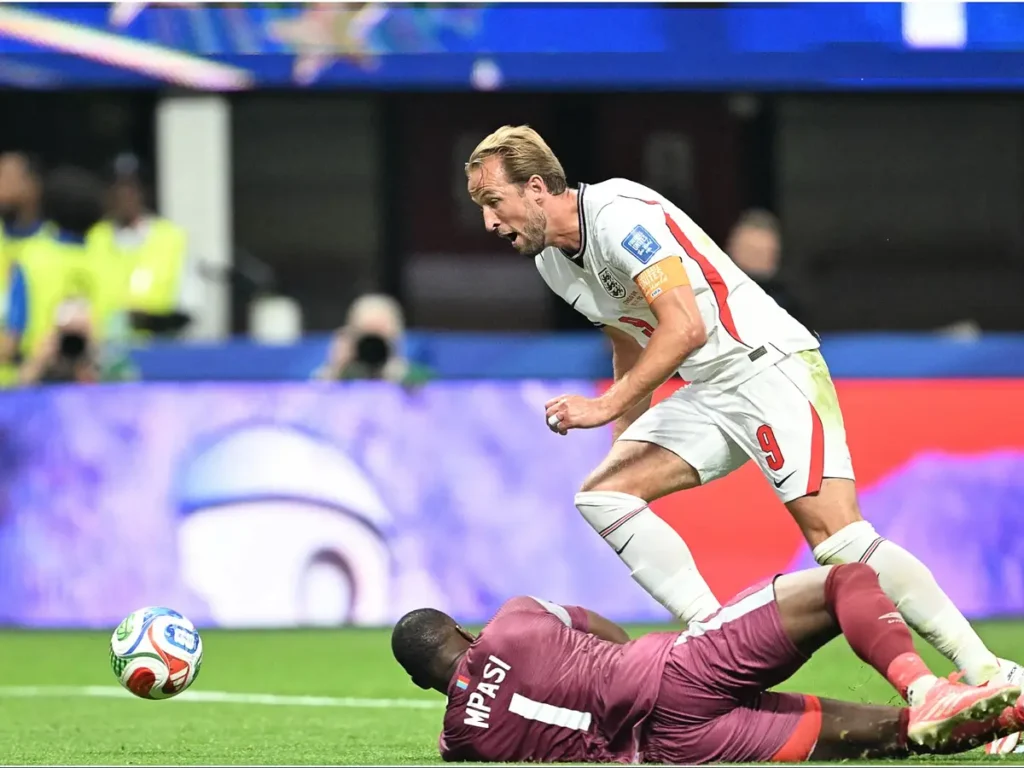
This incident demonstrated one of VAR’s continuing problems. Two challenges with broadly similar levels of contact can receive different outcomes depending on the referee’s original decision. A no-penalty call may survive because VAR considers it subjective, while an awarded penalty might also survive under the same clear-and-obvious threshold.
The VAR Verdict: A penalty would have been the stronger decision. The challenge affected Kane’s ability to continue towards the ball, and VAR had sufficient evidence to recommend a review.
5. Folarin Balogun Sent Off Against Bosnia and Herzegovina
The United States’ victory over Bosnia and Herzegovina produced one of the tournament’s most politically charged refereeing stories.
Folarin Balogun was initially allowed to continue after landing on Tarik Muharemović’s ankle. VAR recommended an on-field review for possible serious foul play, and referee Raphael Claus upgraded the incident to a red card.
The contact looked painful and the point of impact was high enough to cause concern. However, questions were raised about whether Balogun had the necessary speed, force and control for the action to constitute serious foul play rather than a reckless challenge worthy of a yellow card. ESPN’s refereeing analysis described the red card as the result of a misapplied protocol.
The controversy grew when FIFA suspended Balogun’s automatic one-match ban without rescinding the red card itself. That disciplinary decision came after public pressure and raised questions about the authority of the match officials, although FIFA insisted its judicial bodies acted independently.
The VAR Verdict: The challenge deserved a yellow card, but the evidence for serious foul play was not conclusive enough to justify a VAR upgrade. FIFA’s later treatment of the suspension made the situation even more confusing.
4. Croatia’s Equaliser Disallowed by Connected-Ball Technology
Croatia thought it had scored a dramatic late equaliser against Portugal when Mario Pašalić found the net. VAR ruled that Igor Matanović had made a slight touch before the ball reached Pašalić, placing the eventual scorer in an offside position.
The decisive evidence did not come only from conventional video. FIFA’s connected ball detected a tiny contact that established the exact moment the offside position had to be assessed.
Croatia disputed whether Matanović had touched the ball at all, while captain Luka Modrić strongly criticised the use of technology after the elimination. The incident became a central example in the debate over whether football was allowing sensors to detect actions that had no visible or meaningful effect on play.
Under Law 11, the strength of the touch does not matter. A deliberate play or touch by an attacking teammate establishes a new offside reference point. If the connected ball reliably confirmed that contact, the offside decision was technically correct.
The VAR Verdict: Correct by the letter of the law, but deeply unsatisfying. The technology detected a touch almost nobody could see, and that microscopic contact eliminated Croatia from the World Cup.
3. Egypt’s Goal Disallowed Against Argentina
Egypt believed it had taken a two-goal lead against Argentina when Mostafa Ziko scored in the second half of their Round of 16 match. VAR reviewed the attacking phase and identified an earlier foul by an Egyptian player, leading the referee to disallow the goal.
The decision sparked fury from Egypt because the foul occurred before several subsequent actions in the move. Critics argued that VAR had travelled too far back through the attacking phase to find a reason to cancel the goal.
The VAR protocol does not impose a fixed number of passes or seconds that can be reviewed. Officials must determine where the attacking possession phase began and whether an offence within that phase directly led to the goal. Analysis of the replay indicated that Marwan Attia pulled Lisandro Martínez’s shirt and caught his foot before Egypt retained possession and scored.
The VAR Verdict: A harsh but correct intervention. The foul was not invented by VAR, and Argentina never regained controlled possession before the goal. The length of the attacking phase made the decision controversial, not necessarily incorrect.
2. Egypt’s Late Penalty Appeal Rejected Before Argentina’s Winner
The disallowed goal was not the end of Egypt’s frustration. Late in the match, Hamdy Fathy went down in Argentina’s penalty area and appealed for a penalty. The referee rejected the appeal, VAR did not intervene, and Argentina moved forward to score the winning goal shortly afterwards.
Because the sequence ended with Argentina scoring, the rejected appeal immediately became more significant. Egypt argued that the match could have stopped for a penalty at one end instead of being decided at the other.
Available analysis concluded that the Egyptian attacker did not have secure control of the ball and that the contact did not clearly establish a punishable foul. Egypt nevertheless submitted a formal complaint and alleged that the officiating had influenced the result. FIFA refereeing chief Pierluigi Collina later rejected claims of bias and defended the independence of the officials.
The VAR Verdict: The decision was defensible. There was contact, but not every contact is a foul, and the evidence did not clearly justify overturning the referee’s judgment. The timing of Argentina’s winning goal made the incident appear more decisive than the contact itself.
1. Breel Embolo Sent Off for Simulation Against Argentina
The most consequential and unusual refereeing decision of the tournament came during Switzerland’s quarter-final against Argentina.
Referee João Pinheiro initially awarded Switzerland a foul and booked Argentina midfielder Leandro Paredes for bringing down Breel Embolo. VAR then intervened under the expanded mistaken-identity protocol.
After reviewing the incident, the referee cancelled Paredes’ yellow card, ruled that Embolo had simulated contact and cautioned the Swiss forward instead. Because Embolo had already been booked, the new yellow card resulted in his dismissal.
Switzerland had recently equalised and was applying pressure when the red card changed the match. Argentina later won 3-1 after extra time. Swiss coach Murat Yakin called the application of the rule unacceptable and requested an explanation from FIFA.
The controversy was not simply whether Embolo had dived. VAR’s intervention was made possible because the referee had allegedly cautioned the wrong player. Critics argued that mistaken identity should correct a sanction given to the wrong person involved in an offence, not allow VAR to reinterpret an ordinary foul and produce a second yellow card for simulation.
Former FIFA referee and rules analyst Christina Unkel argued that the protocol had been applied too broadly.
The VAR Verdict: This was the tournament’s most problematic decision. Even if replays suggested that Embolo initiated or exaggerated the contact, using mistaken identity to convert a defensive yellow card into an attacker’s second caution stretched the purpose of the protocol. It also directly changed a World Cup quarter-final.
Were These Decisions Actually Refereeing Mistakes?
Not all of the biggest 2026 World Cup refereeing decisions were incorrect.
Iran’s disallowed goal and Croatia’s cancelled equaliser were technically supported by offside law and modern tracking technology. Egypt’s goal against Argentina also appears to have been correctly disallowed once the full attacking phase was reviewed.
The greatest concerns came from subjective VAR interventions. Vinícius Júnior’s disallowed goal, Balogun’s red card and Embolo’s dismissal all required officials to reinterpret incidents that had initially been judged differently on the field.
That distinction matters. VAR is most effective when correcting factual errors, such as offside or mistaken player identification. It becomes more controversial when video officials replace one reasonable interpretation with another.
What the 2026 World Cup Has Taught FIFA About VAR
FIFA introduced expanded technology to make refereeing more accurate, but the tournament has shown that accuracy alone does not guarantee acceptance.
Connected-ball technology can identify the smallest touch, but supporters may still question whether that touch should decide a knockout match. Expanded VAR powers can correct more errors, but they also create more opportunities for video officials to influence games.
Transparency remains the most important issue. Supporters are more likely to accept a difficult decision when they can hear a clear explanation of what was reviewed, which law was applied and why the original decision changed.
FIFA has defended the performance and independence of its referees, but the controversies involving Croatia, Egypt, the United States and Switzerland show that publishing more detailed explanations or selected VAR audio could help rebuild trust. Reuters reported that the tournament’s use of technology had increasingly become the centre of disputes about consistency and excessive intervention.
The VAR Verdict
The 2026 FIFA World Cup has demonstrated both the strength and the danger of modern refereeing technology. VAR corrected several incidents that would have been almost impossible to detect in real time, but it also intervened in subjective situations where the original decision may not have been clearly wrong.
The disallowed Croatia goal was perhaps the tournament’s harshest technically correct decision. Egypt’s cancelled goal created the largest accusations of bias, even though the intervention was supported by the VAR protocol. Balogun’s red card became the biggest political controversy.
However, Embolo’s dismissal against Argentina stands above the rest because of its impact, its unusual use of the mistaken-identity protocol and the way it changed the direction of a World Cup quarter-final.
Final verdict: The VAR intervention that led to Breel Embolo’s second yellow card was the most controversial refereeing decision of the 2026 World Cup before the final. It was not simply a disputed foul. It raised fundamental questions about how far VAR should be allowed to go when reinterpreting a referee’s original decision.

0 Comments
Join the conversation with respect. Comments are moderated and must follow our community rules.
Want to join the discussion?
Please log in or create an account to comment and reply. This keeps the conversation cleaner and safer.