
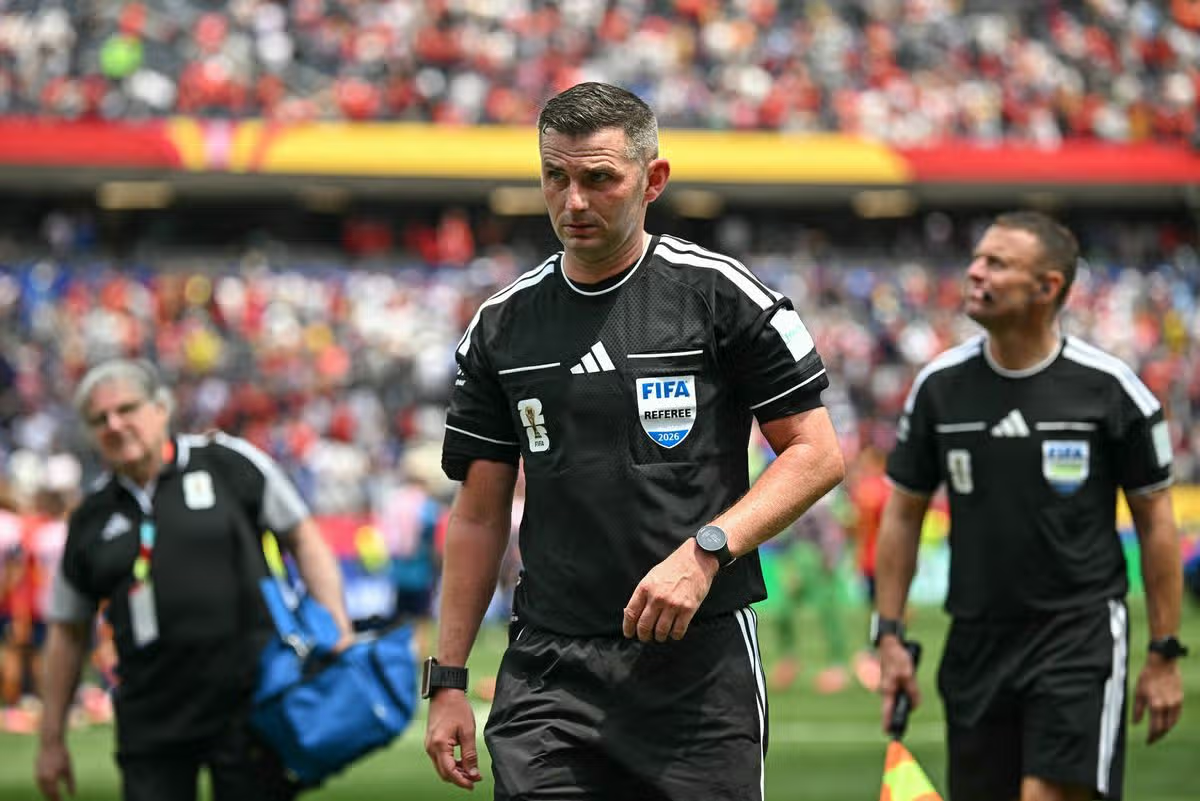
The World Cup may be over, but the debate surrounding its referees has not disappeared. Supporters continue to discuss which officials performed best, which made the biggest mistakes and why some referees received important knockout appointments while others were no longer selected.
The answer is found in the referee grading system.
How football referees are graded is far more complicated than counting penalties, yellow cards or VAR interventions. An official can finish a match without one obvious controversy and still receive an average assessment. Another referee may face several difficult incidents, make the correct decisions and earn an excellent grade despite appearing to have a more challenging night.
Behind almost every elite match is an official observer who assesses the referee team, reviews important incidents and produces a confidential report. At UEFA level, observers must conduct a post-match debrief and complete a written assessment. Those reports remain confidential within the refereeing department and referees committee.
How football referees are graded after the final whistle
The assessment does not begin when a controversy appears on television. It starts before kick-off.
The observer considers the expected difficulty of the match, the teams involved, the atmosphere, the tactical style and the potential pressure points. A derby, knockout match or relegation battle may require a different type of management from a routine fixture.
During the game, the observer watches the entire referee team. This includes the referee, assistant referees, fourth official and, where VAR is used, the VAR and assistant VAR. Positioning, management and decision-making accuracy are among the areas examined. The difficulty of the game can also influence the final assessment because successfully controlling a highly demanding match carries more value than completing a straightforward fixture without incident.
After the final whistle, important situations are reviewed on video. The observer discusses selected incidents with the officials, listens to their explanations and identifies both positive moments and areas requiring improvement.
The assessment is therefore not simply a fan rating created immediately after the match. It is a technical examination of how the referee applied the Laws of the Game and managed the contest from beginning to end.
1. Key match incidents carry the greatest weight
Not every decision has the same importance.
A throw-in awarded in the wrong direction is an error, but it will not usually damage a referee’s assessment as severely as an incorrectly awarded penalty. Official observers place greater weight on decisions capable of changing the match.
These are commonly described as key match incidents. They can include:
- Goals that should have been disallowed
- Incorrectly disallowed goals
- Penalty and no-penalty decisions
- Direct red cards
- Denial of an obvious goalscoring opportunity
- Serious foul play
- Violent conduct
- Important offside decisions
- Second cautions leading to dismissal
- Mistaken identity
The observer must determine whether the final decision was correct according to the Laws of the Game, not according to the reaction of the crowd, commentators or players.
Why a missed penalty is a serious error
Suppose a defender clearly trips an attacker inside the penalty area. The referee allows play to continue, but the replay shows that the defender did not play the ball and made careless contact that caused the attacker to fall.
The decision is wrong because a careless direct-free-kick offence committed inside the defender’s penalty area must result in a penalty kick.
The observer will then examine why the referee missed it. Was the referee too far away? Was another player blocking the viewing angle? Did the referee move too quickly and look away before the contact? Did the referee correctly see the contact but apply an excessively high threshold?
The error is not only recorded as “missed penalty.” The cause of the mistake matters because it helps determine whether the problem was positioning, concentration, interpretation or decision-making.
Why an unpopular decision can still be correct
The opposite situation is also important. An attacker may fall after minor contact, and thousands of supporters may demand a penalty. However, contact alone does not automatically create a foul.
The referee must judge whether the defender acted carelessly, recklessly or with excessive force. Normal football contact should not be punished simply because an attacker loses balance.
In that situation, allowing play to continue may be the correct decision even when television coverage focuses repeatedly on the contact. A professional assessment looks at the complete action, its intensity, the movement of both players and the football consequence of the challenge.
2. Foul recognition and the referee’s threshold
A referee is not expected to award a free kick for every physical challenge. Football allows fair contact, shoulder challenges and genuine attempts to compete for the ball.
The observer studies whether the referee established a clear and consistent foul threshold.
A good referee recognises the difference between normal contact and an offence. More importantly, that threshold should remain stable for both teams. A challenge punished in the 12th minute should not be ignored in the 70th minute simply because the match has become more intense.
Repeatedly penalising minor contact can interrupt the rhythm of the match and encourage players to fall easily. Ignoring clear careless challenges creates the opposite problem. Players may become frustrated and begin taking matters into their own hands.
The best performance is not the one with the fewest whistles. It is the performance in which the referee intervenes when necessary and allows the game to continue when the contact is fair.
3. Disciplinary control
Showing the correct number of cards is not enough. Observers examine whether each caution or sending-off was legally and tactically correct.
A referee must identify the nature of an offence. Was the challenge careless, reckless or made with excessive force? Did it stop a promising attack? Did it deny an obvious goalscoring opportunity? Was the player guilty of dissent, delaying the restart or persistent offences?
Why a wrong yellow card matters
Imagine a player makes a strong but fair tackle, clearly plays the ball and does not act recklessly. If the referee shows a yellow card because the challenge looked dramatic, the decision is incorrect.
The referee has punished the appearance of the tackle rather than its actual nature.
That can create problems later. The cautioned player may become unable to challenge normally, while opponents may believe that every forceful action will produce a card. One incorrect caution can therefore change the behaviour and tactical freedom of the players.
Why a missed second yellow can be more damaging
When a player already on a caution commits another clear yellow-card offence, the referee must not lower the disciplinary standard simply because the consequence would be a red card.
Avoiding the second caution may appear to keep 22 players on the field, but it damages credibility. Players immediately recognise when an official changes the threshold to avoid a difficult decision.
Under the current 2026/27 VAR protocol, a clearly incorrect second caution that produces a sending-off can be reviewed. However, VAR cannot intervene when the referee completely misses an offence that should have resulted in a second caution.
That means a missed second yellow may remain an important uncorrected refereeing error.
4. Positioning, movement and fitness
Correct positioning does not mean standing as close to the ball as possible. Referees need an angle that allows them to see the space between the players.
Being only five metres from a challenge can be less useful than being 15 metres away with an unobstructed side view.
Observers assess whether the referee:
- Anticipated the next phase of play
- Maintained an effective viewing angle
- Avoided blocking passing lanes
- Entered the penalty area when necessary
- Followed counterattacks with sufficient speed
- Adjusted position at corners and free kicks
- Remained concentrated late in the match
A referee may possess excellent knowledge of the Laws but still make mistakes because of poor movement.
For example, standing directly behind two players can hide a shirt pull or a stamp on the foot. The final decision may be wrong, but the underlying failure began several seconds earlier when the referee selected the wrong running line.
Fitness is therefore not assessed only through running distance. It is measured through purposeful movement, acceleration, recovery and the ability to make accurate decisions while physically tired.
5. Advantage and game understanding
Playing advantage is one of the clearest demonstrations of referee intelligence.
The referee must quickly decide whether stopping play or allowing the attack to continue will provide the greater benefit to the offended team. Possession alone is not always an advantage.
A player may keep the ball but be surrounded by defenders with no attacking opportunity. In that case, allowing play to continue can punish the team that was fouled.
A strong advantage decision considers:
- The position of the ball
- The number of available attackers
- The number and position of defenders
- The likelihood of a promising attack
- The severity of the offence
- The atmosphere and temperature of the match
An observer also considers whether the referee returns to caution the offender at the next stoppage when disciplinary action is still required.
A referee who plays an excellent advantage that produces a major opportunity can receive significant credit. However, repeatedly shouting “advantage” when no real benefit exists shows weak match understanding.
6. Match control and communication
Match control is difficult to measure with statistics, but it is central to official grading.
A referee must communicate decisions confidently without becoming aggressive or theatrical. Players should understand what has been decided and what behaviour will not be accepted.
Good management can prevent future offences. A quiet word after an early careless challenge may be enough. A public warning may be required when the same player commits another foul. Once the behaviour crosses the disciplinary line, the referee must use the card.
The observer examines whether the referee:
- Recognised rising tension
- Managed confrontations quickly
- Prevented mass disputes
- Dealt with dissent consistently
- Protected players from reckless challenges
- Communicated clearly with captains
- Remained calm after a controversial decision
- Maintained authority without unnecessary confrontation
A referee can make most technical decisions correctly but lose control through inconsistent communication. Once players stop trusting the referee’s threshold, even correct decisions can generate conflict.
7. Teamwork with the assistant referees
The referee does not work alone.
Assistant referees are assessed on offside judgement, concentration, movement, positioning, signalling and their assistance with fouls or misconduct outside the referee’s view.
The observer also studies the teamwork between officials. Did the referee accept useful information? Did the assistant intervene only when possessing a credible view? Was communication quick and accurate?
An assistant who correctly identifies an offence behind the referee can save the team from a major error. However, unnecessary intervention from a poor angle can create confusion and damage the referee’s control.
In competitions using delayed offside flags, assistants must balance two responsibilities. They should delay the flag during a close attacking situation so the opportunity is not incorrectly stopped, but they must still flag once the phase ends when an offside offence has occurred.
The final offside decision may be correct, but poor timing or unclear communication can still be discussed in the assessment.
8. How VAR affects a referee’s grade
VAR can correct a final decision, but it does not automatically erase the original mistake.
Under the IFAB protocol, the referee must make an initial decision. VAR may recommend a review when there is a clear and obvious error or serious missed incident, but the final decision remains with the referee.
Consider a referee who incorrectly rejects a clear penalty. VAR recommends an on-field review, and the referee awards the penalty after seeing the replay.
The final match decision is now correct. However, the observer still needs to assess why the original incident was missed. At UEFA level, the referee, VAR and assistant VAR are assessed as members of the officiating team, meaning the successful intervention can be credited to the video officials while the original on-field judgement remains relevant to the referee’s report. This is a practical inference from UEFA’s separate assessment of the officials involved.
When the referee is wrong but the VAR is also wrong
A more serious situation occurs when the referee makes a clear error and VAR fails to intervene.
For example, the referee awards a penalty for minimal contact that does not meet the expected foul threshold. The replay clearly demonstrates that the attacker initiated the contact or fell without a punishable action from the defender.
If VAR confirms the decision despite clear evidence, both officials may be criticised in the assessment. The referee made the original error, while VAR failed to apply the clear-and-obvious threshold correctly.
When no VAR intervention is the correct outcome
A controversial decision does not automatically require a review.
When the replay supports more than one reasonable interpretation, VAR should normally leave the on-field decision unchanged. The protocol states that the original decision should not be changed unless the video clearly demonstrates a clear and obvious error.
This is why two similar-looking incidents can produce different outcomes. The question is not always whether VAR would personally prefer a different decision. The question is whether the original judgement was clearly unsustainable.
9. Time management and restarts
Observers also examine the less dramatic parts of the performance.
A referee must correctly manage substitutions, injuries, goal celebrations, disciplinary delays, VAR reviews and deliberate time-wasting. The amount of added time should reflect significant time lost during each half.
Restart management is equally important. The referee should ensure that free kicks are taken from the appropriate position, opponents respect the required distance and play does not restart while disciplinary action or communication with VAR is incomplete.
These moments rarely dominate television discussion, but repeated weaknesses can reduce the overall grade.
Does one major mistake destroy the entire assessment?
One clear match-changing error can have a major effect, but referee development is not based on a single number or one match.
The difficulty of the fixture, the number of demanding incidents and the referee’s overall performance are considered. A referee who manages nine major situations correctly but misses one will be assessed differently from an official who faces few difficult decisions and still makes a decisive error.
The current UEFA Referee Convention also states that appointments should consider performance, personality, availability, development, examinations and fitness tests. Average observer scores must not be the sole criterion.
That explains why an official may receive another appointment after a controversial performance. It does not necessarily mean the previous mistake was ignored. Refereeing committees examine performances over time, not only the loudest social media reaction.
How referee grades affect future appointments
Consistent high-level performances can lead to more difficult domestic matches, international appointments, promotion to a higher category and selection for major tournaments.
Poor performances can result in less demanding appointments, additional coaching, a temporary period without matches or, over a longer period, demotion.
FIFA said its selection of match officials for the 2026 World Cup was based on the quality and consistency of performances at the highest level. This illustrates why one impressive game is not enough to reach a major tournament. Officials must demonstrate reliability across an extended period.
This is also why World Cup referee ratings should never be based only on one viral incident. A proper tournament evaluation must include all appointments, key decisions, disciplinary control, positioning, VAR cooperation and the difficulty of each match.
Official observer grades versus public referee ratings
Official grades are usually confidential. Supporters and media organisations therefore cannot claim to possess the referee’s real observer mark unless it has been officially released.
Public referee ratings are independent editorial assessments.
For The VAR Verdict, each rating should clearly explain:
- Which key decisions were correct
- Which decisions were incorrect
- The relevant Law of the Game
- Whether VAR intervention was expected
- Whether the error came from judgement or positioning
- How the referee controlled the match
- Whether the same threshold was applied to both teams
A rating should never be reduced simply because one team lost or because a manager criticised the referee.
The VAR Verdict referee rating model
To make future ratings consistent, The VAR Verdict can use a transparent 100-point assessment:
Key match incidents: 40 points
Penalties, goals, red cards, DOGSO, major offside decisions and serious missed incidents.
Foul recognition and disciplinary accuracy: 20 points
Correct foul threshold, yellow cards, persistent offences and management of reckless play.
Match control and communication: 15 points
Authority, dissent management, prevention of confrontation and communication with players.
Positioning and fitness: 10 points
Viewing angles, movement, counterattack coverage and concentration.
Teamwork and VAR cooperation: 10 points
Assistant referee support, communication and correct use of the review protocol.
Time and restart management: 5 points
Added time, delays, substitutions, injuries and correct restart procedures.
This should be identified as The VAR Verdict’s independent editorial model, not an official FIFA, UEFA or domestic league grade.
Final verdict
How football referees are graded cannot be understood by watching only the biggest controversy.
An observer examines the full performance: decisions, positioning, foul recognition, disciplinary control, communication, teamwork, advantage, VAR use and the overall difficulty of the match.
A corrected VAR decision can still expose an on-field weakness. A decision that looks unpopular may be fully correct. Several small mistakes may damage match control even when none directly changes the score.
The strongest referees are not those who avoid every difficult situation. They are the officials who consistently recognise incidents, apply the correct law, communicate their decisions and maintain control when the pressure is highest.
That is the difference between a social media rating and a professional referee assessment.

0 Comments
Join the conversation with respect. Comments are moderated and must follow our community rules.
Want to join the discussion?
Please log in or create an account to comment and reply. This keeps the conversation cleaner and safer.