
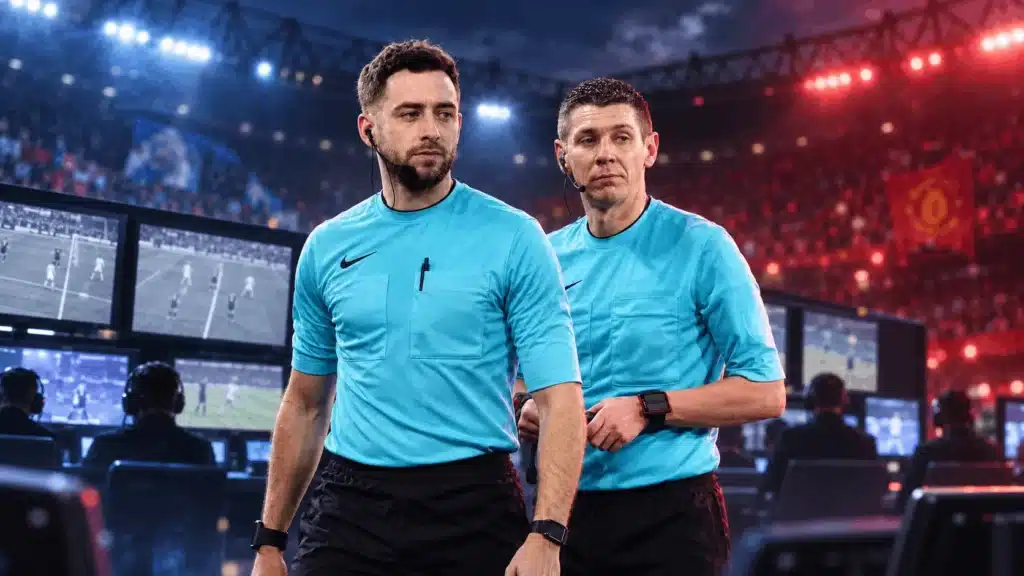
The Manchester derby VAR officials stood down from the next round of Premier League duty are Matt Donohue and assistant VAR Blake Antrobus, following the acknowledged error that allowed Erling Haaland’s winning goal against Manchester United to stand.
Reuters reports that neither official has been selected for next weekend’s Premier League fixtures after Pro Ref admitted that VAR mishandled the decisive goal in Manchester City’s 1-0 victory at Old Trafford. The decision was taken by chief refereeing officer Howard Webb and the refereeing management team. Reuters also reports that neither Donohue nor Antrobus is expected to return to Premier League duty until at least after the international break.
That is a significant consequence from an incident Pro Ref has already described as an “error of judgement.”
However, the wording matters.
There has been no publicly announced formal suspension of a fixed length. The confirmed development is that Donohue and Antrobus have not been appointed to the next Premier League round, with their return reportedly not expected until after the international break.
Why were Matt Donohue and Blake Antrobus stood down?
The decision follows the VAR controversy surrounding Haaland’s 60th-minute winner in the Manchester derby.
The goal was initially disallowed for offside.
VAR then established that Haaland himself was in an onside position because Manchester United defender Patrick Dorgu was playing him on.
That factual part of the review was correct.
The problem concerned Enzo Fernandez.
Fernandez was in an offside position when Josko Gvardiol’s cross entered the penalty area. He attempted to play the ball before it travelled through to Haaland, but did not make contact.
VAR concentrated on the fact that Fernandez had not touched the ball and ultimately recommended that Haaland’s goal be awarded.
Pro Ref later acknowledged that this analysis was incomplete.
The video team should also have considered whether Fernandez’s movement from an offside position affected Lisandro Martinez’s ability to defend the cross.
Because that was a subjective offside question, Michael Oliver should have been sent to the monitor.
He was not.
The VAR Verdict: ❌ Correct to identify a serious VAR failure
This was not a failure of semi-automated offside technology.
The technology correctly established Haaland’s position.
The mistake was a human interpretation error after the factual offside check.
That distinction is essential when analysing what went wrong.
What did Pro Ref admit?
Pro Ref, the refereeing organisation responsible for Premier League match officials, accepted after the game that VAR had failed to properly consider Fernandez’s involvement.
The body said Donohue should have recommended an on-field review to Michael Oliver and subsequently contacted Manchester United to acknowledge the error.
Reuters reports that this admission was followed by the decision from Webb and the refereeing management team to leave Donohue and Antrobus without Premier League appointments for the next round.
The development turns what began as a controversial VAR interpretation into a clear performance-management issue.
This is no longer simply Manchester United arguing that the decision was wrong.
The refereeing body itself has accepted that the VAR process failed.
Why Fernandez could be offside without touching the ball
The technical reason behind the error comes directly from IFAB Law 11.
A player in an offside position does not need to touch the ball to commit an offside offence.
Law 11 says a player can be penalised for interfering with an opponent if they:
- clearly attempt to play a nearby ball and that action impacts an opponent
- challenge an opponent for the ball
- make an obvious action that clearly affects an opponent’s ability to play the ball
IFAB even gives a very similar example: an attacker in an offside position attempts to head a ball, does not touch it, but impacts a defender who is challenging for the same ball. The correct decision is offside.
That is why “Fernandez did not touch it” was never enough to finish the review.
The relevant question was what his attempt to play the cross did to Martinez.
Why Michael Oliver should have gone to the monitor
There was another procedural distinction VAR needed to recognise.
Whether Haaland was beyond the second-last defender was a factual question.
Factual offside positions are normally handled through a VAR-only review.
Whether Fernandez interfered with Martinez was subjective.
The IFAB VAR Protocol specifically identifies interference at offside as the type of subjective decision for which an on-field review is appropriate.
The correct sequence should therefore have been:
- VAR establishes that Haaland is onside.
- VAR identifies Fernandez in an offside position.
- VAR considers Fernandez’s attempt to play the ball and its impact on Martinez.
- Because that interference question is subjective, VAR recommends an on-field review.
- Oliver watches the incident and makes the final decision.
The process effectively stopped at Step 2.
That is the central officiating error.
Was Matt Donohue solely responsible?
Donohue was the appointed VAR and therefore had primary responsibility for the video review.
Blake Antrobus was Assistant VAR.
The AVAR supports the VAR operation, but the ultimate responsibility for recommending an on-field review sits with the VAR.
Both officials have nevertheless been left without appointments following the incident.
That does not mean their roles in the error were necessarily identical.
It means the Premier League refereeing management team has chosen not to appoint either member of that VAR team for the upcoming round.
Were the officials suspended?
This needs careful wording.
There is currently no publicly announced formal suspension with a specified number of matches.
Reuters reports that Donohue has not been selected for any of next weekend’s Premier League fixtures and Antrobus has likewise received no appointment.
It further reports that neither is expected back until at least after the international break.
So headlines saying they have been “stood down” or “dropped from the next round” are supported.
Calling them formally “banned” or claiming a specific suspension would go beyond the information currently confirmed.
The VAR Verdict: ⚠️ Stood down, not officially banned
This is an officiating-management consequence, but not an announced disciplinary suspension in the way a player receives a three-match ban.
That distinction should be preserved.
Howard Webb’s response sends a clear message
The significance goes beyond one weekend of appointments.
Pro Ref has placed a strong emphasis on improved transparency and decision accuracy in 2026/27.
The Premier League says officials in its Professional Referee Group are assessed through performance review, training and the independent Key Match Incidents Panel.
The decision to remove the Manchester derby VAR team from the following round therefore appears consistent with performance management rather than simply public relations.
The error also came in one of the most high-profile matches of the season.
It decided the only goal in a Manchester derby.
That inevitably increases scrutiny.
But officials should still be assessed on the quality of the decision itself, not simply because the match involved Manchester United and Manchester City.
In this case, the technical error was substantial enough that Pro Ref itself accepted the review process was wrong.
Premier League’s VAR philosophy makes the error more striking
The Premier League has explicitly said that it wants to maintain a high threshold for VAR intervention in 2026/27.
The principle is that VAR should not re-referee normal subjective decisions. The referee’s call should remain unless the available evidence demonstrates a clear and obvious error.
But that philosophy was not the problem here.
This was not a case where Donohue correctly decided to respect Oliver’s subjective on-field judgement.
The original decision was no goal.
VAR intervened and changed it.
Once the video team decided to overturn that original decision, it needed to analyse every relevant offside component correctly.
It established that Haaland was onside but failed to properly assess Fernandez’s interference.
That is why the error is particularly difficult to defend as simply “VAR maintaining a high threshold”.
VAR had already intervened.
It just did not complete the subjective part of the analysis correctly.
Does this mean Haaland’s goal should definitely have been disallowed?
Pro Ref’s admission establishes that Oliver should have been given an on-field review.
It is therefore important to distinguish between procedural certainty and the final subjective decision.
The procedural conclusion is clear:
Oliver should have gone to the monitor.
The VAR process was wrong not to recommend that review.
The VAR Verdict’s own Law 11 analysis goes further.
Fernandez was in an offside position, clearly attempted to play a nearby cross and his movement affected how Martinez defended the situation.
Our conclusion remains that the correct outcome should have been:
No goal for Manchester City.
Indirect free kick to Manchester United for offside.
That assessment is based on Law 11’s interference criteria.
What happens to the Manchester derby result?
Nothing.
Manchester City’s 1-0 victory remains official.
Refereeing mistakes, even when acknowledged after the match, do not normally cause Premier League results to be rewritten.
The point of the review process is instead to identify mistakes, assess officials and improve future decision-making.
The consequences in this case are therefore focused on the officials rather than the scoreline.
City retain the victory.
Donohue and Antrobus have been removed from the immediate appointment cycle.
Is Michael Oliver also being stood down?
There is no indication from the current reporting that Michael Oliver has been stood down because of this incident.
That makes sense when the mechanics of the decision are examined.
Oliver’s on-field team initially had a no-goal decision.
VAR established that Haaland himself was onside and then instructed that the goal should be awarded without recommending an on-field review of Fernandez’s interference.
Oliver therefore never had the opportunity to make the subjective decision that Pro Ref says he should have been asked to make.
That is why the principal acknowledged failure sits with the VAR operation rather than the referee.
The VAR Verdict: ✅ Correct distinction
It would be inaccurate to frame this as Michael Oliver personally deciding that Fernandez had not interfered.
He was never shown the incident at the monitor.
The VAR team failed to trigger that review.
What happens next?
There are now three developments worth watching.
First, the Premier League’s Key Match Incidents Panel will provide its independent assessment of the major decisions from the match.
Second, Howard Webb could address the incident through the Premier League’s referee-communication channels or a future Match Officials Mic’d Up programme.
Third, the next set of appointments after the international break will show when Donohue and Antrobus are returned to duty.
Until then, the safest description is that both officials have been stood down from the next Premier League round, not formally suspended for a confirmed number of matches.
Quick answers
Why were the Manchester derby VAR officials stood down?
Matt Donohue and Blake Antrobus have not been appointed to the next Premier League round after Pro Ref admitted that VAR made an error in awarding Erling Haaland’s winning goal against Manchester United.
Who was VAR in Manchester United vs Manchester City?
Matt Donohue was VAR and Blake Antrobus was Assistant VAR.
What did VAR get wrong?
VAR correctly established that Haaland was onside but failed to properly assess whether offside-positioned Enzo Fernandez interfered with Lisandro Martinez.
Should Michael Oliver have gone to the monitor?
Yes. Pro Ref said VAR should have recommended an on-field review because Fernandez’s potential interference was a subjective offside judgement.
Are Donohue and Antrobus suspended?
There is no announced formal suspension of a fixed duration. They have not been appointed to the next Premier League round and Reuters reports that neither is expected back until at least after the international break.
Was the technology wrong?
No.
Semi-automated offside correctly showed that Haaland was onside.
The failure was in the human interpretation of Fernandez’s involvement.
Final VAR Verdict
The decision to stand down Matt Donohue and Blake Antrobus follows one of the clearest acknowledged VAR failures of the early 2026/27 Premier League season.
The technology did its job.
Haaland was onside.
But VAR’s responsibility did not end there.
Enzo Fernandez was in an offside position and attempted to play the same cross. Law 11 required consideration of whether that action affected Lisandro Martinez, and the VAR Protocol made an on-field review appropriate because that interference question was subjective.
Donohue did not recommend one.
Pro Ref has admitted that was an error.
Now the VAR and AVAR have both been removed from the next Premier League appointment cycle, with their return reportedly not expected until after the international break.
The VAR Verdict: ❌ Correct consequence after a significant VAR process failure.
But the terminology matters.
They have been stood down, not officially announced as banned or suspended for a fixed number of games.
The next important step will be the KMI Panel’s assessment and any detailed explanation from Howard Webb of exactly how the VAR team failed to identify Fernandez’s interference.

0 Comments
Join the conversation with respect. Comments are moderated and must follow our community rules.
Want to join the discussion?
Please log in or create an account to comment and reply. This keeps the conversation cleaner and safer.