

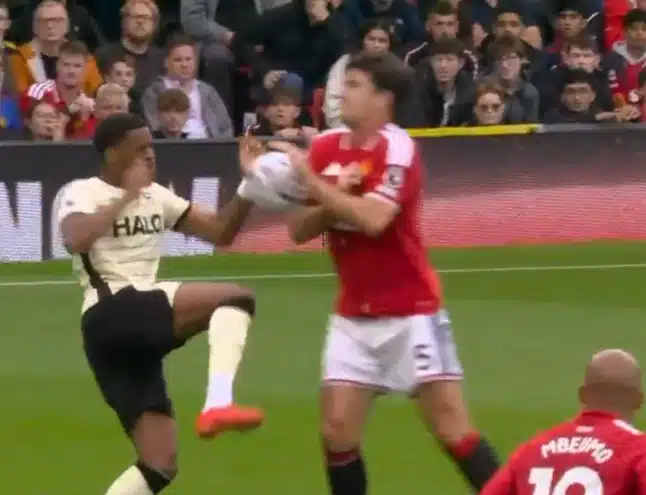
Manchester United beat Ipswich Town 5-2 at Old Trafford, but the biggest refereeing discussion came when Harry Maguire clearly handled the ball immediately before United took a 2-1 lead.
At first sight, the reaction is obvious: handball, free kick, no goal.
But VAR Jarred Gillett checked the incident and allowed the goal to stand.
The Premier League later confirmed why.
Because Maguire’s handball was judged accidental and his subsequent shot was deflected into the net by Ipswich defender Jacob Greaves, Maguire was not considered the immediate goalscorer. Under the current Law 12 wording, that accidental attacking handball did not automatically cancel the goal.
It is a strange rule, and Ipswich supporters have every right to dislike it. But if the handball itself was genuinely accidental and not otherwise an offence, the final decision was correct under the Laws.
Manchester United 5-2 Ipswich: the key referee incidents
Craig Pawson refereed the match, with Jarred Gillett on VAR, Andy Madley as fourth official and Tim Wood as assistant VAR.
Ipswich took the lead through Leif Davis before Bruno Fernandes equalised. United then went ahead through the controversial Greaves own goal, Fernandes scored from the penalty spot and later completed his hat-trick, while Bryan Mbeumo added the fifth. Chuba Akpom scored Ipswich’s late consolation.
From a referee-analysis perspective, three moments stand out:
Tielemans penalty appeal before half-time
Maguire handball before the 2-1 goal
Greaves challenge on Cunha for United’s penalty
Tielemans goes down: penalty or too theatrical?
Manchester United wanted a penalty shortly before half-time when Youri Tielemans went down after contact from Dara O’Shea.
Tielemans collected the ball on the half-turn and tried to move beyond the Ipswich defender. There was some contact involving O’Shea’s leg and arm, but Pawson immediately waved play on.
VAR checked the incident and supported the on-field decision.
Gary Neville also felt Tielemans exaggerated the contact and described the fall as too theatrical.
The VAR Verdict: No penalty ✅
We agree.
There is contact, but football does not punish contact by itself.
The referee has to decide whether O’Shea actually trips, pushes or otherwise illegally impedes Tielemans.
For us, the United midfielder feels the contact and then makes considerably more of it.
That does not automatically mean simulation. A player can genuinely experience contact and still go down too easily.
But it is not enough for a penalty.
Verdict: Correct decision to play on. Correct VAR non-intervention.
Maguire handball before United’s second goal
This was the incident everybody will remember.
Early in the second half, Chuba Akpom’s attempted clearance struck Harry Maguire’s raised arm near the edge of the Ipswich penalty area.
Pawson did not whistle.
Maguire controlled the situation, moved onto the ball and fired towards goal. His shot was going off target before striking Jacob Greaves and deflecting into the net.
The goal was therefore officially recorded as an own goal rather than a Maguire goal.
VAR checked the entire attacking phase.
The Premier League’s explanation was that Maguire’s handball was accidental and that he was not the immediate goalscorer, so the accidental handball was not automatically punishable.
The VAR Verdict: Correct under the current Law, even if it looks wrong ✅
This is one of those decisions where football instinct and the written Law can feel completely different.
Most supporters see:
Maguire handles ball → Maguire shoots → goal
and naturally expect the goal to be disallowed.
But Law 12 is more specific.
An attacker commits an automatic handball offence if they score directly with the hand or arm, even accidentally, or score immediately after an accidental handball.
However, accidental handball by an attacker is not automatically punished simply because a teammate later scores. IFAB even gives an example where an attacker accidentally handles before another attacker scores and states that the goal can stand, provided the arm position was not itself an illegal unnatural position.
In this case, Greaves’ touch is decisive because the final goal is an own goal.
If Maguire’s shot had gone directly into the net, the goal would have been disallowed.
Because Greaves diverted an off-target shot into his own goal, the automatic “scorer’s accidental handball” offence did not apply.
That sounds bizarre.
But that is the current Law.
The important question: was Maguire’s hand position itself illegal?
This is where the debate should actually focus.
The own-goal rule only helps United if Maguire’s handball was truly accidental and not otherwise punishable.
Law 12 still says it is an offence if a player deliberately moves the arm towards the ball or has the arm in a position that makes the body unnaturally bigger without justification for the player’s movement.
So the correct question is not simply:
“Did the ball hit his hand?”
We know it did.
The question is:
“Was the arm position itself a handball offence?”
VAR judged that it was not.
From the available footage, I understand why Ipswich supporters are unhappy because Maguire’s arms are visibly raised. But the video officials considered the contact accidental rather than a deliberate or unjustifiable blocking action.
Once that interpretation is accepted, the rest of the decision follows the Law.
Our verdict
The rule is awkward, but VAR applied it correctly.
You can criticise the wording of the handball law.
That is different from saying Gillett ignored the law.
Would the goal have been disallowed if Maguire had scored?
Yes.
This is probably the easiest way to understand the controversy.
Scenario 1: Maguire accidentally handles the ball and his shot goes straight in.
Decision: No goal.
Scenario 2: Maguire accidentally handles, shoots off target, Greaves deflects it into his own goal.
Decision: Goal can stand, provided Maguire’s original arm contact was not otherwise a handball offence.
That is effectively what happened at Old Trafford.
It creates a result that feels counter-intuitive, but IFAB deliberately removed the old rule that automatically punished every accidental attacking handball leading to a teammate’s goal.
Greaves on Cunha: clear penalty
Only a few minutes later Ipswich were in trouble again.
Matheus Cunha was played through into the penalty area and Greaves slid across him, missed the ball and brought the United forward down.
Pawson immediately pointed to the penalty spot and showed Greaves a yellow card.
Fernandes converted to make it 3-1.
The VAR Verdict: Penalty and yellow correct ✅
This is much simpler than the handball.
Greaves makes a genuine challenge for the ball but gets there late and takes Cunha down inside the area.
Penalty.
The yellow card is also consistent with the current DOGSO law.
When a defender denies an obvious goalscoring opportunity inside their own penalty area and the offence is an attempt to play or challenge for the ball, the correct sanction is normally a yellow card rather than a red, provided a penalty is awarded.
Greaves is trying to win the ball.
He simply fails.
There is no holding, pulling or deliberate push with no possibility of playing it.
Verdict: Penalty correct. Yellow correct. No red required.
Did the controversial goal change the match?
Psychologically, probably.
Legally, that is irrelevant to the referee.
Ipswich had played well for long periods and were level at 1-1 when the Maguire incident happened. Within five minutes, they were 3-1 down.
Their own post-match reporting described the own goal as controversial and noted how quickly the game got away from them afterwards.
But referees cannot decide based on momentum.
If the goal is legal under the Laws, it has to stand even if it completely changes the match.
United then took control and Fernandes completed his hat-trick before Mbeumo made it five.
Craig Pawson’s performance
Pawson had a reasonably strong game overall.
The Tielemans penalty appeal was correctly rejected.
The Cunha penalty was straightforward and correctly recognised immediately.
The Maguire handball looked much more problematic live, but VAR had the chance to examine it and the final interpretation followed the current handball wording.
The controversy is therefore more about the Law itself than an obvious failure by Pawson or Gillett.
The VAR Verdict referee rating: 7.5/10
Tielemans penalty appeal: ✅ No penalty
Maguire handball: ⚖️ Looks controversial, but not judged an independent offence
Greaves own goal: ✅ Correct under current Law
Cunha penalty: ✅ Correct
Greaves yellow: ✅ Correct
Major VAR error: ✅ None
Should the handball rule change?
This incident will probably restart the debate.
There is an understandable argument that if an attacker accidentally handles the ball and then immediately creates the goal himself, the attacking team has gained an unfair advantage.
In Maguire’s case, the hand contact directly preceded his shot.
Without the contact, the entire sequence may develop differently.
Supporters therefore ask why the defender’s deflection should suddenly make the earlier handball irrelevant.
That is a fair policy question.
But referees cannot invent a different rule because the existing one feels strange.
If football wants all accidental attacking handballs in the immediate build-up to be punished again, IFAB would need to change Law 12.
Until then, officials have to apply the wording that exists.
Final VAR Verdict
Manchester United deserved their 5-2 victory, but the Maguire incident deserves explanation because it looks completely wrong if you only watch the replay without knowing the current handball law.
Maguire clearly handled the ball.
That part is not disputed.
VAR decided the contact itself was accidental and not an illegal unnatural-arm handball offence.
His subsequent shot was then deflected into the net by Greaves and recorded as an own goal.
Because Maguire was not the immediate goalscorer, his accidental handball did not automatically cancel the goal.
So our final decisions are:
Tielemans penalty appeal: ✅ No penalty
Maguire handball own goal: ✅ Legal under current Law
Greaves foul on Cunha: ✅ Penalty
Greaves yellow instead of red: ✅ Correct
The strangest decision at Old Trafford was not necessarily a refereeing mistake.
It was a reminder that football’s handball law can sometimes produce an outcome that looks very different from what supporters instinctively expect.

0 Comments
Join the conversation with respect. Comments are moderated and must follow our community rules.
Want to join the discussion?
Please log in or create an account to comment and reply. This keeps the conversation cleaner and safer.