
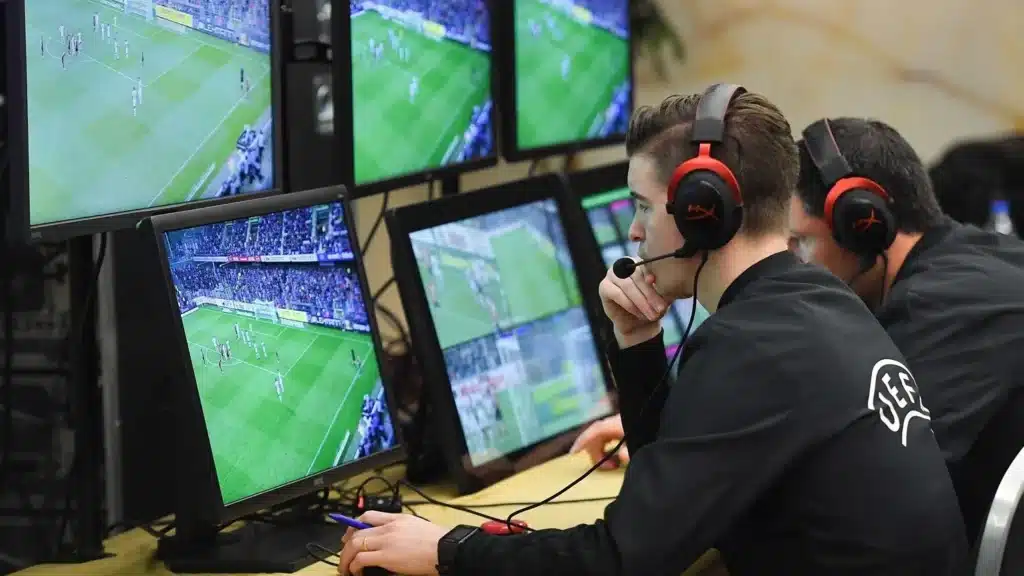
The UEFA VAR rules for 2026/27 include one of the biggest changes to video refereeing since VAR was introduced: a clearly incorrect second yellow card that results in a player being sent off can now be reviewed.
UEFA refereeing director Roberto Rosetti has outlined how the updated Laws of the Game and VAR Protocol will be applied in the Champions League, Europa League and other UEFA competitions this season.
There are also changes involving incorrectly awarded corners, mistaken identity, offences before corners and free kicks, substitutions, injuries and deliberate time-wasting.
The overall UEFA philosophy, however, has not changed.
VAR should intervene less, not more.
Rosetti described UEFA’s approach as “minimal interference for maximum benefit”, with the on-field referee remaining at the centre of decision-making.
Can VAR now review a second yellow card?
Yes, but only in a very specific situation.
If a referee shows a player a second yellow card and therefore sends them off, VAR can now intervene if video evidence clearly shows that the second caution was incorrect.
The referee can then review the incident at the pitch-side monitor and cancel the yellow card.
The player stays on the pitch.
This closes one of the most controversial gaps in the previous VAR protocol.
What was the old VAR rule?
Previously, VAR could intervene for a direct red card but generally could not review an ordinary second yellow.
That could create a strange situation.
Imagine a player already has one caution.
He then makes a challenge, clearly wins the ball and is wrongly shown another yellow.
Because that second yellow automatically produces a red card, his team is reduced to ten players.
Under the previous system, VAR could identify that the decision was wrong but had extremely limited power to correct the second-yellow decision itself.
That changes in 2026/27.
A clearly incorrect second caution resulting in a red card is now reviewable.
Can VAR give a second yellow that the referee missed?
No.
This is probably the most important limitation to understand.
The new protocol works in one direction.
VAR can help cancel a clearly wrong second yellow that has already resulted in a dismissal.
VAR cannot watch a replay and tell the referee:
“You should have given that player another yellow. Send him off.”
For example, if a player already on a yellow makes another tactical foul and the referee chooses not to caution him, VAR cannot intervene simply to create the second yellow.
So:
Wrong second yellow given: ✅ VAR may intervene
Second yellow not given: ❌ VAR cannot create it
Why has the rule changed?
The logic is based on consequence.
An ordinary yellow card usually does not directly change the number of players on the pitch.
A second yellow does.
Once the second caution results in a red card, the decision becomes potentially match-changing.
IFAB therefore decided that VAR should be able to prevent a player being sent off because of a clearly incorrect second caution.
The intervention threshold remains deliberately high.
If there is genuine doubt over whether a challenge was reckless, whether a foul stopped a promising attack or whether the caution was justified, VAR should normally stay out.
Example: when should VAR cancel a second yellow?
Imagine a midfielder already booked in the first half.
In the 70th minute, he slides towards an opponent.
The referee believes he has caught the player late and shows a second yellow.
The player is sent off.
Replays then clearly show that the midfielder cleanly played the ball and the remaining contact was normal football contact.
Under the new protocol, VAR can recommend an on-field review.
The referee can cancel the second caution and the player can remain in the match.
That is exactly the type of clear mistake the new rule is designed to fix.
VAR can now correct some wrongly awarded corners
There is another significant change.
Competitions now have the option to allow VAR to correct a clearly incorrectly awarded corner kick.
UEFA has decided to use that option.
But the threshold is extremely strict.
The correction should happen only where the footage provides an obvious answer and VAR can communicate the information immediately without delaying the restart.
If the corner is taken quickly, it is too late to change the decision.
This is not supposed to produce 30-second VAR checks before every corner.
Can VAR change a goal kick into a corner?
No.
This is an important asymmetry in the new rule.
VAR can correct a clearly wrong corner into a goal kick when UEFA’s conditions are satisfied.
But an incorrectly awarded goal kick cannot be changed into a corner through this new procedure.
So:
Wrong corner awarded: ✅ Can potentially be corrected
Wrong goal kick awarded: ❌ Cannot be turned into a corner
The objective is to prevent a team scoring directly from a corner it obviously should never have received, without creating constant VAR involvement in routine restarts.
VAR can intervene for offences before a corner or free kick is taken
UEFA has also confirmed a significant development involving set pieces.
VAR can intervene when an attacking player commits a clear offence before the ball is actually put into play at a corner or free kick, provided that offence directly affects a resulting goal, penalty or disciplinary decision.
Imagine an attacker clearly pushes a defender to the ground before a corner is taken.
The ball is then delivered and the attacking team scores.
Previously, the timing of an offence before the restart could create complications for VAR.
Under UEFA’s 2026/27 approach, the video official can identify the clear attacking offence.
The resulting goal or sanction can be cancelled and the original corner or free kick retaken.
Mistaken identity rules have also expanded
VAR can now intervene where the referee has correctly identified that an offence occurred but has clearly punished the wrong player, including situations involving players from opposing teams.
The key distinction is important:
VAR is checking who committed the offence, not automatically reopening the referee’s judgement about whether the offence happened.
For example, if the referee correctly awards a foul but shows a yellow card to Player A when the video clearly proves Player B committed it, VAR can help correct the identity.
This applies to yellow and red-card situations covered by the updated protocol.
A new rule could punish slow substitutions
VAR is not the only major change this season.
UEFA will also enforce new measures designed to reduce time-wasting.
A substituted player now has 10 seconds to leave the field once the substitution board is shown, or once the referee gives the signal where no board is being used.
If the player deliberately takes longer, the incoming substitute cannot immediately enter.
Instead, the substitute must wait until the first stoppage after one minute has elapsed following the restart.
That creates a real sporting punishment for wasting time during substitutions.
A team attempting to kill 20 seconds may instead find itself temporarily playing with ten players.
Injured players may have to remain off for one minute
There is also a stronger rule surrounding treatment.
When play is stopped because an outfield player requires treatment, that player will normally have to leave the pitch and remain off for one minute after play restarts.
There are important exceptions.
They include goalkeepers, certain collisions involving a goalkeeper, two team-mates injured in the same collision, an injury caused by an opponent receiving a yellow or red card, and situations where an injured player will take an awarded penalty.
The objective is straightforward: reduce situations where players exaggerate injuries simply to stop the match.
New five-second countdown for delaying throw-ins
Referees can now use a visible five-second countdown when a team is deliberately delaying a throw-in.
If the team still fails to take the throw by the end of the countdown, the throw-in is awarded to the opposition.
This is similar to the visual countdown already introduced for goalkeepers holding the ball too long.
There is an important correction to some early reports about this rule:
A delayed throw-in does not become a corner.
It becomes a throw-in for the opposition.
Delaying a goal kick can now give the opposition a corner
The goal-kick rule is much more severe.
If a team deliberately delays taking a goal kick, the referee can signal the five-second countdown.
If the ball is still not put into play when the countdown expires:
the opposition receives a corner kick.
That is potentially a major punishment.
A team attempting to waste a few seconds while protecting a late lead could hand the opposition an attacking corner.
Deliberate handball after a goal kick
UEFA has also clarified an unusual goal-kick situation.
Once the ball is stationary inside the goal area and is kicked, the goal kick has been taken.
If a team-mate of the goalkeeper then deliberately handles the ball inside the penalty area, a penalty should be awarded.
The clarification removes arguments that the goal kick had somehow not been properly completed before the handball.
Once it has been kicked and is in play, normal handball law applies.
Only the captain should approach the referee
UEFA will continue the referee-captain cooperation model introduced successfully at Euro 2024.
The captain should be the player who approaches the referee for explanations about major decisions.
Other players who aggressively surround or disrespect the referee risk disciplinary action.
This is worth distinguishing from a universal IFAB change.
The captain-only approach is being actively used by UEFA, while IFAB has given advance notice that its compulsory worldwide protocol is scheduled from July 2027.
UEFA does not want more VAR intervention
With several new reviewable situations, it would be easy to assume UEFA wants VAR involved more often.
Rosetti’s message is actually the opposite.
UEFA says VAR exists to correct clear and obvious errors and wants the on-field referee to remain the primary decision-maker.
Its stated philosophy is:
Minimal interference for maximum benefit.
That means the additional powers should act as safety nets for specific serious mistakes rather than excuses to analyse every challenge from multiple slow-motion angles.
UEFA introduces a standard four-step VAR review
UEFA has also created a standardised process for referees using the pitch-side monitor.
The objective is to make reviews more consistent across European competitions rather than allowing different referees to approach footage in completely different ways.
The process starts by identifying the alleged offence using the clearest angle, then examining the technical elements and wider context before the referee reaches the final decision.
UEFA wants referees in different countries to interpret similar incidents using the same framework.
That could be almost as important as the rule changes themselves.
Why the second-yellow change is the biggest one
Correcting a corner is useful.
Reducing time-wasting is positive.
Improving mistaken identity makes sense.
But the second-yellow VAR change could have the greatest direct effect on major matches.
Playing with ten men can completely change a Champions League knockout tie.
If a player is dismissed because of an objectively wrong second caution and every television viewer can immediately see the mistake, it has always been difficult to explain why VAR could not help.
Now it can.
Crucially, UEFA and IFAB have not turned every yellow card into a VAR decision.
Only the second caution that creates a red card becomes reviewable, and only where it is clearly incorrect.
That balance is important.
UEFA VAR rules 2026/27: quick answers
Can VAR review a second yellow card?
Yes, if a clearly incorrect second yellow has resulted in the player being sent off.
Can VAR give a second yellow the referee missed?
No.
Can VAR correct a wrongly awarded corner?
Yes in UEFA competitions, but only when it is clearly wrong and the correction can be made immediately.
Can VAR turn a goal kick into a corner?
No under this new corner-review provision.
Can VAR review an attacking foul before a corner is taken?
Yes in the circumstances UEFA has outlined when a clear offence directly affects the subsequent goal, penalty or sanction.
How long does a substituted player have to leave?
Normally 10 seconds.
What happens if a team delays a throw-in?
After the referee’s five-second countdown expires, the throw goes to the opposition.
What happens if a team delays a goal kick?
The opposition can be awarded a corner.
The VAR Verdict
The 2026/27 changes fix one of VAR’s most difficult contradictions.
If a player is wrongly shown a second yellow and sent off, video officials no longer have to stand by while an obvious mistake changes the match.
That is a sensible expansion of VAR.
The important limitation is equally sensible: VAR cannot search for missed yellow cards and manufacture new dismissals.
The new corner rule follows the same philosophy. Correct the obvious factual mistake immediately, but do not create lengthy reviews around routine restarts.
UEFA’s challenge will now be consistency.
If “minimal interference for maximum benefit” genuinely remains the standard, these changes could make VAR more useful without making it more intrusive.
The biggest change is simple: from 2026/27, an obviously wrong second yellow no longer has to mean an obviously wrong red card.

0 Comments
Join the conversation with respect. Comments are moderated and must follow our community rules.
Want to join the discussion?
Please log in or create an account to comment and reply. This keeps the conversation cleaner and safer.