
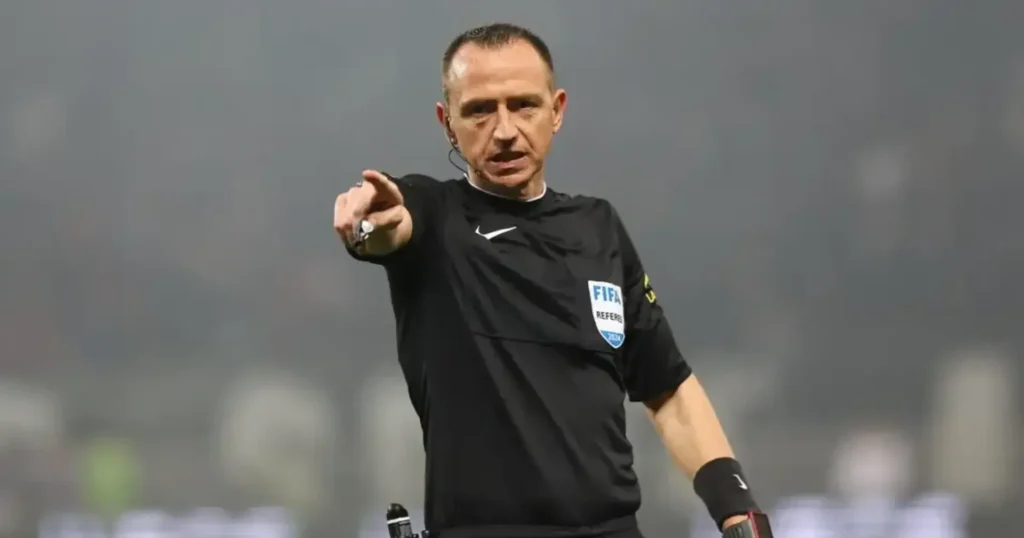
The biggest refereeing incident of the night came at the Stade Vélodrome.
Marseille were leading Strasbourg 1-0 when Samir El Mourabet became involved in another confrontation with Pierre-Emile Højbjerg.
The initial incident did not immediately produce the final punishment. VAR reviewed what had happened and Ruddy Buquet was advised to look again at the incident.
The replay showed El Mourabet deliberately kicking out at Højbjerg.
Buquet completed an on-field review and changed the disciplinary outcome to a straight red card. El Mourabet was dismissed in the 59th minute, leaving Strasbourg with ten players. The official match data classified the dismissal as violent conduct.
The VAR Verdict: Correct red card
Verdict: CORRECT DECISION ✅
This is exactly the type of incident VAR is supposed to identify.
The important distinction is that we are not analysing an ordinary attempt to challenge for the ball.
El Mourabet’s action comes after the footballing duel and is directed at Højbjerg. L’Équipe described it as a deliberate kick, while the official match event was recorded as violent conduct.
Under Law 12, violent conduct can apply when a player uses or attempts to use excessive force or brutality against an opponent when not challenging for the ball.
That does not mean every small kick automatically deserves a red card. Context, force and the nature of the action still matter.
Here, however, the action is retaliatory rather than a genuine football challenge. Once Buquet was shown the relevant replay, a straight red was a defensible and, in our view, correct outcome.
The VAR intervention also meets the protocol perfectly because a potential direct red card is one of VAR’s reviewable categories.
This was not VAR re-refereeing a normal yellow-card challenge. It identified possible violent conduct that the referee had not properly sanctioned in real time.
Ruddy Buquet explains the red card to the stadium
There was another significant element to the decision.
After completing his review, Buquet explained the outcome to supporters inside the Vélodrome through the stadium sound system.
Ligue 1 has expanded this type of referee communication for the 2026/27 season after testing it previously. The El Mourabet dismissal therefore became an immediate example of how the system can work in a major decision.
This is a change The VAR Verdict strongly supports.
Supporters watching on television can normally see that a review is taking place and hear commentators discussing possible outcomes. Fans inside the stadium often have far less information.
That creates confusion.
A referee walking to the monitor, watching several replays and then suddenly producing a red card can leave tens of thousands of people trying to understand what has happened.
A short explanation solves much of that problem.
It does not require referees to hold press conferences during matches. It simply tells supporters what was reviewed and why the final decision changed.
For example:
“Following review, Strasbourg number 29 committed violent conduct. The final decision is a red card.”
That is enough.
Transparency does not eliminate disagreement, but at least everyone understands the basis of the decision.
Second Marseille VAR intervention: penalty against Guéla Doué
VAR was involved again only a few minutes later.
Igor Paixão battled Guéla Doué inside the Strasbourg penalty area and went down following the challenge.
Buquet initially did not award Marseille a penalty.
The incident was checked by VAR and the video official determined that the challenge required another look. Marseille were subsequently awarded the spot kick for Doué’s foul on Paixão.
Amine Gouiri converted it to make the score 2-0. Reuters confirms that the penalty followed another VAR intervention, while L’Équipe identifies Doué’s challenge on Paixão as the offence.
The VAR Verdict: VAR intervention justified
Verdict: CORRECT INTERVENTION ✅
This incident is more subjective than the red card.
With a violent-conduct situation, the key evidence is often relatively simple. Did the player make the prohibited action, and was its nature serious enough for dismissal?
Penalty-area contact can be more difficult.
The presence of contact alone is not enough.
Football is a contact sport. A defender can legally compete shoulder-to-shoulder, use normal body positioning and make legitimate contact while challenging for the ball.
The relevant question is whether Doué’s action illegally impeded or brought down Paixão.
Based on the available description of the incident and the decision after review, the officials concluded that it did.
The fact Buquet originally allowed play to continue is important because VAR should not simply replace one subjective interpretation with another.
For the intervention to be good VAR, the video evidence needs to demonstrate something significant that the referee either did not see or incorrectly interpreted.
Here, the review identified a foul inside the area and corrected the non-award.
That is the correct function of VAR.
Two VAR interventions changed Marseille vs Strasbourg
The sequence effectively transformed the match.
Gouiri had given Marseille the lead immediately after half-time.
Then:
58′ – VAR review for El Mourabet incident
59′ – El Mourabet sent off
Around 64′-65′ – VAR penalty decision for Marseille
67′ – Gouiri converts the penalty
Within a short period, Strasbourg went from trailing 1-0 with eleven players to trailing 2-0 with ten.
Reuters confirms that the red card and penalty were the two decisive VAR interventions in Marseille’s 4-0 victory.
That does not mean VAR “decided” the match.
This distinction matters.
If a player commits a sending-off offence, the fact that the dismissal makes his team less likely to win is irrelevant to the referee.
If a defender commits a penalty offence, the score and previous VAR intervention cannot influence the next decision either.
Officials must judge every incident independently.
The fact both major calls went against Strasbourg does not make the second intervention less legitimate.
Refereeing is not about balancing decisions between two teams.
It is about making each decision correctly.
Ruddy Buquet referee performance
Buquet deserves credit for accepting the information provided by VAR without appearing reluctant to change his original judgement.
That sounds obvious, but it is an important part of modern refereeing.
The referee remains responsible for the final decision after an on-field review.
VAR is not supposed to send the referee to the monitor simply to confirm a predetermined outcome. Buquet must look at the evidence himself and decide whether his original call was clearly wrong.
The experienced French referee entered the new season after taking charge of 17 tracked matches in 2025/26, averaging roughly 3.06 yellow cards and 23.65 fouls per match, with one red card recorded in that sample.
Interestingly, his first major Ligue 1 assignment of the new campaign produced a straight red through VAR and another important video intervention soon afterwards.
The VAR Verdict referee rating: Ruddy Buquet — 8/10
The two most important decisions ultimately appear to have reached the correct outcome.
Most importantly, Buquet used the monitor properly and communicated the red-card decision clearly afterwards.
That is the standard supporters should want from VAR.
Arsenal vs Coventry: should Caleb Yirenkyi have been sent off?
There was no major VAR intervention in Arsenal’s 3-0 victory over Coventry City, but there was an interesting disciplinary incident before half-time.
Caleb Yirenkyi had already been booked after bringing down Myles Lewis-Skelly in the 27th minute.
Later in the first half, Yirenkyi caught Christos Tzolis with another late challenge.
Referee Thomas Bramall awarded the foul but did not show a second yellow card.
The Guardian described the Coventry midfielder as fortunate to escape dismissal.
The VAR Verdict: Second yellow was a realistic option
Verdict: DEBATABLE ⚖️
This is a more difficult incident than El Mourabet’s red card.
A referee should never lower the threshold for a yellow card simply because a player has already been booked.
But he should not artificially raise it either.
This principle is important.
If a challenge deserves a yellow card in the fifth minute, the same challenge should normally deserve a yellow card when committed by a player already carrying a booking.
Referees sometimes become reluctant to produce the second yellow because they know the consequence is dismissal.
That can create inconsistency.
From the descriptions of the incident, Yirenkyi was late on Tzolis after already receiving a caution for a previous foul.
There is therefore a reasonable argument that Bramall could have shown another yellow and reduced Coventry to ten men.
But this does not appear to reach the threshold of a direct red card.
That distinction becomes extremely important because of the new Premier League VAR rules.
Why VAR could not simply send Yirenkyi off
The Premier League has changed its VAR protocol for second yellow cards in 2026/27.
But there is an important limitation many supporters may misunderstand.
VAR can now review a second yellow card that has actually been awarded and resulted in a red card.
It does not mean VAR can search for possible second-yellow offences that the referee did not give.
The Premier League explicitly states that the change applies only when a player has actually received the second yellow, “rather than a potential second yellow card.”
That means Bramall’s decision remained his own.
Because he did not give Yirenkyi a second yellow, VAR Jarred Gillett could not intervene simply because he believed the challenge might deserve another caution.
VAR could intervene only if the challenge itself met the threshold for a straight red card.
There is no strong evidence that it did.
So even if you believe Bramall should have sent Yirenkyi off for two bookings, this is primarily an on-field refereeing debate rather than a VAR error.
That distinction is crucial.
The new second-yellow VAR rule explained
This incident is actually an excellent early example of what the Premier League’s rule change does and does not mean.
Imagine Bramall had shown Yirenkyi a second yellow for the challenge.
Yirenkyi would have been sent off.
Under the new 2026/27 protocol, VAR could then review whether there had been a clear factual error surrounding the foul that produced the second caution.
But because Bramall chose not to issue that caution, VAR cannot effectively say:
“We think that should have been a yellow, so please send him off.”
Yellow-card judgement remains primarily with the referee.
That preserves one of the most important boundaries in the VAR system.
If every possible caution became reviewable, football would quickly become overloaded with video checks.
Thomas Bramall’s performance
Bramall otherwise had a relatively quiet opening-night assignment.
Arsenal dominated the game and won 3-0 through goals from Kai Havertz, Bukayo Saka and Martin Ødegaard.
The Yirenkyi challenge was therefore the most interesting disciplinary decision of the match from our perspective.
Bramall was a regular Premier League referee last season, with different statistical databases placing his league card average around four yellow cards per game. One dataset records 69 yellow cards across 17 Premier League matches in its 2025/26 sample, an average of 4.06 per match.
His decision not to produce another caution for Yirenkyi can therefore hardly be explained by a general reluctance to use cards.
It was a judgement about that specific challenge.
The VAR Verdict referee rating: Thomas Bramall — 7/10
A solid overall performance, although the Yirenkyi incident is worth debating.
Our preference would be for officials to judge second-yellow situations using exactly the same disciplinary threshold as a player’s first yellow.
No “final warning” should exist simply because another card would result in a dismissal.
Arsenal vs Coventry also showed why the new VAR rule matters
The Premier League has made several refereeing changes for 2026/27, but the second-yellow expansion could become one of the most discussed.
The league has confirmed that it will maintain a high threshold for VAR intervention and a high threshold for penalising ordinary physical contact.
That is the right approach.
VAR works best when its responsibilities are clearly defined.
The El Mourabet incident in France is a perfect example of something VAR should correct: possible violent conduct missed in real time.
The Yirenkyi incident is almost the opposite.
It is a borderline disciplinary judgement where the debate is whether a challenge deserved another caution.
Unless that challenge itself reaches direct-red severity, this should remain the responsibility of the referee on the field.
Those two incidents demonstrate the difference between good VAR intervention and unnecessary video refereeing.
Real Betis vs Real Sociedad: no major VAR controversy
Real Betis also defeated Real Sociedad 1-0 on Friday, with Rodrigo Riquelme scoring the decisive goal in the second half.
Unlike Marseille vs Strasbourg, there was no major publicly documented red-card, penalty or VAR controversy that warrants forcing a referee story into the match. Contemporary reports focused overwhelmingly on the football rather than an officiating decision.
That is worth saying.
A referee-analysis site should not search for controversy simply because a match has finished.
Sometimes the correct referee verdict is that the official did not become part of the story.
That is usually a positive result.
Final VAR Verdict
Friday’s matches produced three very different refereeing lessons.
El Mourabet red card: CORRECT ✅
VAR correctly identified a potential violent-conduct incident and Ruddy Buquet was right to dismiss the Strasbourg midfielder after reviewing the footage.
Marseille penalty: CORRECT ✅
The intervention against Guéla Doué was more subjective, but the review identified the foul on Igor Paixão that Buquet had initially allowed to continue.
Yirenkyi possible second yellow: DEBATABLE ⚖️
Thomas Bramall could reasonably have produced another caution, but because no second yellow was given, the new Premier League VAR protocol did not allow VAR to create one. It would have needed to be a possible straight-red offence for normal red-card VAR intervention.
From a VAR perspective, Marseille vs Strasbourg was the more significant match.
Two interventions in a matter of minutes changed important on-field decisions, while the new stadium explanation system immediately showed why better communication between officials and supporters can improve the experience.
The most encouraging part was not simply that VAR intervened.
It was that VAR intervened for incidents within its proper remit.
That should remain the standard.
Correct clear mistakes. Protect the referee’s authority on subjective calls. Explain major decisions clearly.
If football can consistently achieve those three things, VAR will become much easier for supporters to accept.

0 Comments
Join the conversation with respect. Comments are moderated and must follow our community rules.
Want to join the discussion?
Please log in or create an account to comment and reply. This keeps the conversation cleaner and safer.