
A defender makes contact with an attacker inside the penalty area. The attacker falls, the referee allows play to continue and television replays immediately show the incident from several angles.
Supporters wait for the referee to point towards the screen. Nothing happens. Play continues, and the message eventually comes through that the VAR check is complete.
This is the moment when many fans ask the same question: why doesn’t VAR intervene every time a decision appears to be wrong?
The answer is that VAR was never designed to make every refereeing decision perfect. Its purpose is more limited. The video assistant referee can assist only with specific match-changing incidents and normally intervenes only when the original decision contains a clear and obvious error or when the officials have missed a serious incident.
That distinction explains why VAR may examine an incident without recommending a review, why two similar challenges can produce different outcomes and why a debatable decision is not automatically an incorrect decision.
VAR checks incidents without always intervening
One of the biggest misunderstandings surrounding VAR is the belief that no intervention means the incident was ignored.
In reality, the VAR automatically checks potential incidents involving goals, penalties, red cards and mistaken identity. The video officials can examine different camera angles and replay speeds while play continues or during a natural stoppage. A formal review is recommended only when the VAR believes the evidence meets the required threshold.
Therefore, there is an important difference between a VAR check and a VAR review.
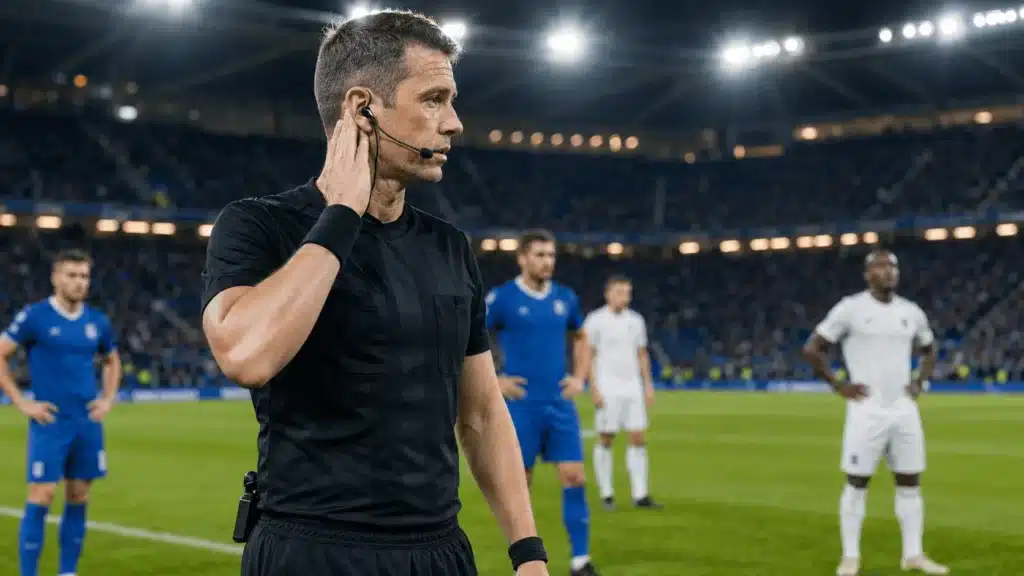
A check happens in the video operation room. Supporters may not see anything except the referee touching the earpiece or delaying a restart.
A review happens when the VAR identifies a possible clear error and recommends that the referee reconsider the decision. For subjective incidents, the referee will normally visit the pitchside monitor. For factual matters, such as whether an offence occurred inside or outside the penalty area, the VAR may communicate the information directly.
When a broadcaster displays “VAR checking possible penalty,” it does not mean a penalty is likely to be awarded. It only confirms that the incident is being examined.
What does “clear and obvious error” mean?
The phrase clear and obvious error is at the centre of the VAR system, but it is also the source of much of the frustration.
The referee makes the original decision on the field. The VAR then asks whether the available video evidence clearly demonstrates that the decision was wrong.
The VAR is not supposed to ask:
Would I have made a different decision?
The proper question is:
Is the referee’s decision clearly wrong based on the evidence?
That creates a deliberately high threshold.
A challenge may look careless to one referee and legal to another. A handball incident may involve several subjective factors. Contact may exist without being sufficient to justify a penalty. In those situations, the original decision can remain because it falls within a reasonable range of interpretation.
The IFAB protocol states that the original decision should not be changed unless the video review clearly shows a clear and obvious error. The final decision always belongs to the referee.
Why contact does not automatically mean a penalty
A common reaction after a penalty-area incident is: “There was contact, so VAR had to intervene.”
That is not how the Laws of the Game work.
Football is a contact sport. The existence of contact does not automatically establish that a foul occurred. The referee must judge the nature and consequence of that contact.
The questions may include:
- Did the defender trip, push, hold or charge the opponent illegally?
- Was the contact caused by the attacker moving into the defender?
- Was the contact normal and expected within the challenge?
- Did the attacker exaggerate its effect?
- Did the contact genuinely prevent the attacker from continuing?
- Was the defender making a fair attempt to play the ball?
A replay can prove that two players touched each other, but it cannot always provide a single objective answer about whether that contact crossed the threshold for a foul.
That is why some penalty appeals are checked and cleared quickly. The VAR may see contact but conclude that the referee’s decision to continue is supportable.
VAR does not award penalties for contact alone. It intervenes when the evidence clearly shows a punishable offence that the referee missed or incorrectly judged.
Why slow-motion replays can be misleading
Slow motion is useful for identifying the point of contact, the position of a player’s foot or whether the ball touched an arm.
However, slow motion can also make an incident appear more severe than it was at normal speed.
A brief contact can look prolonged. A natural movement may appear deliberate. A challenge made with limited force can appear dangerous when every frame is examined separately.
For that reason, referees should consider both slow-motion and normal-speed footage. The IFAB protocol allows the VAR and referee to use different angles and replay speeds, depending on what must be assessed.
Slow motion is particularly useful for factual information:
- Where the contact occurred
- Which player touched the ball
- Whether studs made contact
- Whether the ball hit the hand or arm
- Whether a player was offside
Normal speed is often more useful for judging:
- Intensity
- Force
- Natural movement
- The effect of contact
- The speed of a challenge
- Whether a fall was consistent with the contact
A still image can make almost any challenge look serious. A proper VAR assessment requires the complete action.
Which decisions can VAR review?
VAR does not have authority over every refereeing decision.
The core reviewable categories are:
Goal or no goal
VAR may examine an offence in the attacking phase before a goal, including offside, handball, a foul or the ball going out of play.
Penalty or no penalty
VAR can review whether a penalty was wrongly awarded or whether a penalty offence was missed. It may also correct whether an offence happened inside or outside the penalty area.
Red-card incidents
VAR may review potential serious foul play, violent conduct, denying an obvious goalscoring opportunity and other direct sending-off offences.
Under the 2026/27 changes, VAR may also correct a clearly incorrect second yellow card when that caution has resulted in a player being sent off. However, VAR cannot intervene simply because the referee missed a possible second-yellow-card offence.
Mistaken identity
VAR may assist when the referee cautions or sends off the wrong player.
Clearly incorrect corner kicks in competitions using the option
The 2026/27 protocol allows competitions to use VAR to correct a clearly incorrect corner-kick decision, but only when it can be corrected immediately without delaying the restart. If the corner is taken quickly, the decision cannot be changed.
What VAR normally cannot review
Many controversial decisions fall outside the normal VAR protocol.
VAR generally cannot intervene for:
- An ordinary foul in midfield
- A missed free kick that does not lead to a reviewable incident
- A disputed throw-in
- Most yellow-card decisions
- A missed possible second yellow card
- Minor holding or pushing away from a goal or penalty incident
- A corner decision unless the competition uses the new optional protocol
- General inconsistency in how the referee manages the match
Imagine that a referee incorrectly awards a free kick near the halfway line. The attacking team keeps possession for several phases and later creates a chance.
Supporters may argue that the original free kick was wrong. That may be true, but VAR is not permitted to correct every earlier decision in the match.
Without limits, almost every goal could be traced backwards through a long sequence of passes, challenges and restarts. Football would become a continuous forensic review rather than a live sport.
Why VAR cannot simply “re-referee” the match
The VAR’s role is to assist the referee, not replace the referee.
Referees make hundreds of judgements during a match. These include small fouls, advantages, disciplinary warnings, positioning decisions, physical contact and the management of player behaviour.
If VAR attempted to correct every questionable judgement, the match would be interrupted constantly.
More importantly, many football decisions are subjective. Different experienced referees can watch the same incident and reach different reasonable conclusions.
The clear and obvious threshold attempts to preserve the authority of the on-field referee while still allowing major errors to be corrected.
This approach is imperfect, but the alternative would create a different problem. A lower intervention threshold would produce more reviews, longer delays and even greater inconsistency because video officials would repeatedly substitute their personal judgement for the referee’s view.
Why similar incidents can produce different VAR outcomes
Supporters often compare two incidents and say: “VAR intervened last week, so why did it not intervene today?”
That comparison can be valid, but incidents that look similar may contain important differences.
For a penalty challenge, the difference may involve:
- The defender’s movement
- The force of contact
- Whether the attacker initiated the contact
- Whether the ball remained playable
- Whether the player was already falling
- The referee’s original decision
- The clarity of the camera angle
The original decision is especially important.
Suppose two nearly identical incidents occur in different matches. In the first, the referee awards a penalty. In the second, the referee allows play to continue.
If the video evidence does not clearly prove that either decision was wrong, VAR may support both original calls.
To supporters, that can look inconsistent. Under the protocol, however, both decisions may be considered within the acceptable range of judgement.
This is one of VAR’s most difficult concepts: the system can accept different outcomes when neither original decision is clearly and obviously incorrect.
Why the referee sometimes goes to the monitor
A referee visiting the pitchside monitor does not mean the original decision must be overturned.
The VAR recommends an on-field review when a subjective match-changing decision may contain a clear error. The referee then examines the footage and makes the final decision.
The referee can:
- Change the original decision
- Keep the original decision
- Change the disciplinary sanction
- Award a different restart based on what the replay shows
The IFAB protocol makes clear that only the referee can initiate the review and that the referee retains responsibility for the final decision.
In practice, most monitor visits result in a change because the VAR is expected to recommend a review only when the evidence is strong. But an on-field review is not supposed to be an automatic instruction to overturn the call.
Why VAR does not always send the referee to the screen
Not every VAR correction requires the referee to watch the monitor.
For factual decisions, a VAR-only review is often appropriate. Examples include:
- Offside
- Whether the ball went out of play
- Whether an offence occurred inside or outside the penalty area
- The identity of the offending player
In these cases, the video provides an objective answer. The referee does not need to reinterpret the nature of the challenge.
For subjective decisions, such as whether a handball offence occurred or whether a tackle used excessive force, an on-field review is normally more appropriate because the referee must make the final judgement.
Why an inconclusive camera angle means no intervention
VAR can only work with the available footage.
Sometimes no camera provides a clear view of the decisive contact. One player may block the incident. The ball may be hidden. The relevant moment may occur between frames or outside the best camera position.
In those circumstances, VAR cannot guess.
The absence of proof that the referee was correct is not the same as proof that the referee was wrong.
For the decision to change, the video must provide sufficiently clear evidence. When footage remains inconclusive, the original on-field decision should stand.
This can be frustrating when television viewers believe another angle must exist. However, more cameras do not always produce a decisive image.
Why play restarting can end the opportunity for review
Timing also matters.
When the VAR is checking a possible incident, the referee may delay the restart. Once play has stopped and restarted, a review is generally no longer permitted.
There are limited exceptions, including certain cases of mistaken identity and serious sending-off offences involving violent conduct or extremely offensive behaviour.
This is why referees sometimes stand with one hand near the earpiece while players prepare to take a free kick or corner. The referee may be waiting for confirmation that the check is complete before allowing play to restart.
Once the next phase begins, the opportunity to correct most earlier incidents has passed.
Why VAR cannot review every yellow card
Yellow cards are among the most common sources of inconsistency in football, but most caution decisions are not reviewable.
VAR cannot normally intervene because it believes a challenge should have received a yellow card or because the referee cautioned a player too harshly.
This limit exists partly because yellow-card decisions occur frequently and are often highly subjective. Reviewing all of them would create constant interruptions.
The significant 2026/27 exception concerns a clearly incorrect second caution that directly results in a red card. Because the player is removed from the match, the error becomes potentially match-changing. VAR may now assist in correcting that particular mistake.
However, the protocol remains deliberately narrow. A missed challenge that could have produced a second yellow is still not reviewable.
That distinction may appear strange, but the logic is that VAR can correct a clearly wrongful dismissal without taking responsibility for searching for every possible caution.
Why VAR sometimes feels inconsistent
The biggest problem is not always the protocol itself. It is the way the threshold is applied.
“Clear and obvious” is not a mathematical measurement. It requires human judgement from the VAR, assistant VAR and referee.
One video official may believe an error is obvious. Another may believe the original decision remains supportable.
Different competitions may also issue different technical guidance concerning handball, holding, physical contact and the expected level of intervention.
This is why VAR cannot eliminate controversy. The technology provides replays, but humans still interpret the evidence.
The real objective should not be the impossible promise of perfect decisions. It should be a more consistent and transparent application of the intervention threshold.
When non-intervention is genuinely wrong
It is important not to defend every VAR decision simply by repeating the phrase “clear and obvious.”
There are occasions when the evidence clearly demonstrates that the referee made a major mistake and the VAR still fails to intervene.
Examples may include:
- A clear foul inside the penalty area
- An obvious handball offence
- Violent conduct missed by the officials
- A clearly dangerous challenge deserving a red card
- A factual error concerning the location of an offence
- An attacking offence immediately before a goal
In these situations, non-intervention represents a VAR failure.
The clear and obvious threshold should protect reasonable refereeing decisions. It should not become an excuse for avoiding difficult corrections.
A strong VAR does not search for reasons to support the referee at all costs. The VAR provides honest assistance and recommends a review when the evidence clearly demands it.
The VAR Verdict opinion
At The VAR Verdict, we believe the biggest misunderstanding is the expectation that VAR should deliver perfection.
It cannot.
Football contains subjective decisions, incomplete camera angles and incidents that fall between legal thresholds. Technology can help identify mistakes, but it cannot remove judgement from the game.
The principle of limited intervention is correct. Without it, matches would be interrupted repeatedly and every physical challenge would become a potential review.
However, the current system still has weaknesses.
The phrase “clear and obvious” is applied too inconsistently. Supporters are rarely given enough information about why a check ended without intervention. Broadcasters may show repeated slow-motion replays without explaining the legal considerations used by the officials.
This creates the impression that VAR has seen an obvious mistake and chosen to ignore it.
Greater communication would help. When a major incident is checked, supporters should receive a concise explanation:
- What was examined
- What the referee decided
- Why the threshold for intervention was or was not met
Public explanations will not make everyone agree, but they can make the process easier to understand.
VAR should remain a system of minimum interference and maximum benefit. But minimum interference must not become minimum accountability.
Final verdict
Why VAR doesn’t intervene every time can be explained through three principles.
First, VAR has authority over only a limited number of match-changing incidents.
Second, a questionable decision is not automatically a clear and obvious error.
Third, the on-field referee remains the final decision-maker.
VAR checks more incidents than supporters see. In many cases, it decides that the original call is supportable even though another referee might have reached a different conclusion.
That does not mean every non-intervention is correct. VAR teams can still miss clear offences or apply the threshold inconsistently.
But understanding the protocol changes the question supporters should ask.
Instead of asking, “Was there contact?” or “Could the referee have given a penalty?”, the more accurate question is:
Did the replay clearly prove that the original decision was wrong?
Only when the answer is clearly yes should VAR intervene.
FAQ
Does VAR check every penalty appeal?
VAR automatically checks potential penalty incidents, but it recommends a review only when there may have been a clear and obvious error or serious missed incident.
Can VAR intervene for a normal foul?
Not usually. A standard foul outside the reviewable categories cannot be corrected unless it forms part of a goal, penalty or red-card situation.
Can VAR review a yellow card?
Most yellow cards cannot be reviewed. Under the 2026/27 protocol, VAR may correct a clearly incorrect second yellow card that results in a player being sent off. It cannot intervene for a missed possible second-yellow offence.
Does the referee have to accept the VAR’s advice?
No. The VAR can recommend a review, but the referee makes the final decision.
Why does VAR check an incident but not send the referee to the monitor?
The VAR may conclude that the original decision was not clearly wrong. A monitor review is normally recommended only when the evidence indicates a possible clear and obvious error.
Can VAR review a corner kick?
From 2026/27, competitions may choose to allow the VAR to correct a clearly incorrect corner kick, provided it can be done immediately without delaying the restart.

0 Comments
Join the conversation with respect. Comments are moderated and must follow our community rules.
Want to join the discussion?
Please log in or create an account to comment and reply. This keeps the conversation cleaner and safer.