
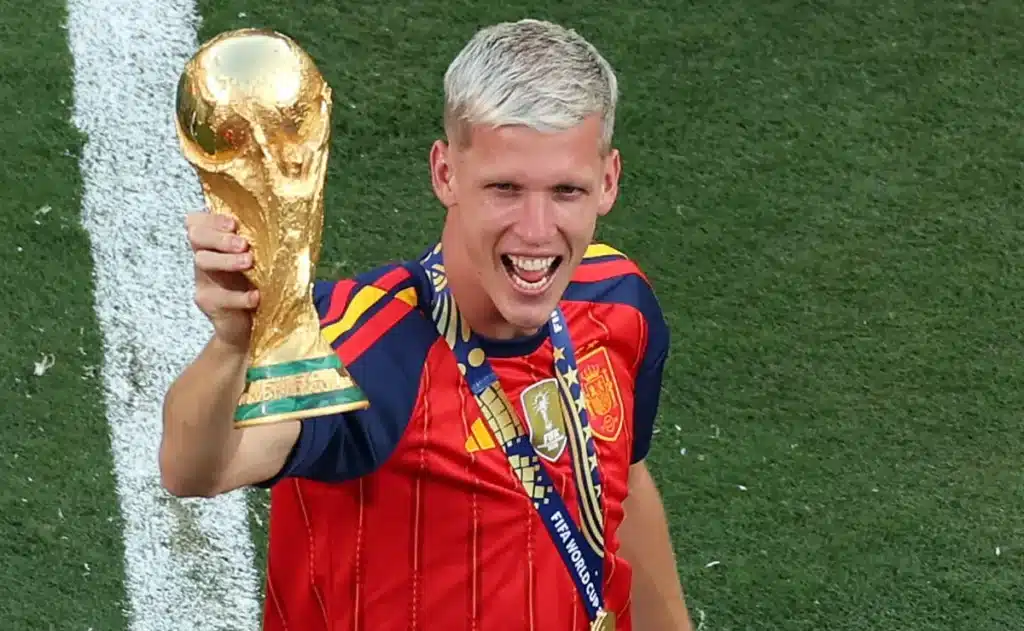
The confrontation between Dani Olmo and Argentina assistant coach Roberto Ayala after the 2026 World Cup final has taken another significant turn.
Ayala publicly apologised for his actions following Spain’s 1-0 victory over Argentina, but argued that the incident was closer to a push than a punch and claimed that he had reacted to something Olmo said.
Olmo has now directly rejected that version.
The Spain midfielder said he did not say anything to Ayala and questioned whether the apology was genuine when it was accompanied by an attempt to justify the physical confrontation. His response places the two men’s accounts in direct conflict while FIFA continues investigating the disorder that followed the final whistle.
What did Roberto Ayala say?
Ayala acknowledged that his conduct was inappropriate and said emotions had affected his behaviour during the chaotic scenes after the match.
The former Argentina defender insisted that he initially entered the confrontation to separate players. He described his contact with Olmo as a shove rather than a punch and said it followed something the Spanish player had said.
Ayala also stated that he would apologise personally if he met Olmo again.
That explanation contained two separate parts.
First, Ayala accepted responsibility for allowing his emotions to influence his actions. Second, he disputed the description of the incident and suggested that Olmo’s words had contributed to his reaction.
It is the second part that Olmo has now strongly challenged.
Dani Olmo says he did not provoke Ayala
In an interview reported by Cadena SER and AS, Olmo said Ayala was not telling the truth about the exchange.
Olmo’s position is clear: he says he did not say anything to the Argentina assistant before the confrontation. He also argued that admitting regret while continuing to justify the action made the apology appear less sincere.
The Spain midfielder then widened the discussion beyond the specific incident. He spoke about the responsibility footballers and coaches have as examples for younger supporters and said mistakes should be accepted with honesty, humility and dignity.
His response increases the pressure on Ayala because FIFA’s investigation will now have to consider two conflicting accounts.
Ayala says there was a verbal trigger.
Olmo says there was no verbal exchange at all.
The final disciplinary decision should therefore be based on the available video, match-official reports, witness accounts and any additional evidence collected by the investigator rather than either public statement alone.
What happened after the World Cup final?
Spain defeated Argentina 1-0 in the World Cup final, but the celebrations were followed by confrontations involving players and members of both teams’ staff.
Television footage showed Ayala confronting Olmo during the post-match disorder. Argentina players Nahuel Molina and Thiago Almada were also identified among those involved, while Leandro Paredes was seen grabbing Spain defender Eric García around the throat.
FIFA subsequently appointed a disciplinary and ethics prosecutor to investigate the incidents. Reuters reported that individuals involved could face suspensions and that the Argentine Football Association could also receive a financial sanction.
No final punishments have been publicly announced at the time of writing.
It is therefore important not to present any suspension, fine or disciplinary finding as confirmed before FIFA publishes its decision.
Can the referee punish misconduct after the final whistle?
Yes.
The referee’s disciplinary authority does not disappear immediately when the final whistle is blown. Under Law 5, the referee can continue taking disciplinary action until leaving the field of play.
The IFAB specifically explains that a player can still be cautioned or sent off for misconduct occurring on the pitch after full-time. Even when the referee does not show a card, the incident must still be included in the official report where appropriate.
This matters because post-match incidents can be handled in two ways.
The referee and other match officials can act immediately when they clearly see what happened. FIFA’s disciplinary bodies can then examine additional conduct through match reports, television footage and the evidence gathered during an investigation.
The current inquiry is therefore not restricted only to the actions personally seen and sanctioned by referee Slavko Vinčić.
Can FIFA punish an incident missed by the officials?
Yes.
The investigation itself demonstrates that FIFA can examine the wider post-match confrontation rather than relying exclusively on cards shown on the field.
A disciplinary prosecutor can review available footage, statements and official reports before deciding whether proceedings should continue against particular players, coaches or the participating association. FIFA’s current legal framework gives its judicial bodies authority to investigate and sanction misconduct connected to its competitions.
This does not mean every person visible in the confrontation will automatically be punished.
FIFA must determine individual responsibility.
Being present near a confrontation is not the same as striking, pushing, grabbing or provoking another participant. Each action should be assessed separately rather than treating the entire team as equally responsible.
What punishment could Roberto Ayala face?
Reuters reported that those involved could face suspensions, while the Argentine Football Association could be fined. The exact sanction will depend on how FIFA classifies the conduct and what the investigation establishes.
Possible factors include:
- The nature and force of the physical contact
- Whether the action was aggressive or intended to separate others
- Whether there was any verbal provocation
- Ayala’s position as a member of the coaching staff
- His public acceptance of responsibility
- The clarity of the available video evidence
- Whether his account is supported or contradicted by other evidence
Ayala’s role may be especially relevant.
Coaches and staff members are expected to help calm confrontations rather than become active participants. A disciplinary body may therefore view physical involvement by a senior member of staff more seriously than ordinary emotional disagreement.
However, it would be premature to predict a specific number of matches or claim that a suspension is certain.
Does Ayala’s apology reduce the possible punishment?
An apology can demonstrate regret, cooperation and recognition that the behaviour was inappropriate.
But it does not erase the incident.
FIFA can consider Ayala’s public comments as part of the wider case, but the disciplinary body will still examine what he actually did. The apology also becomes more complicated because Ayala continued to dispute the description of the contact and suggested that Olmo had provoked the reaction.
Olmo’s response directly challenges that explanation.
This means Ayala’s statement could be viewed in two different ways. It can be seen as an acceptance of responsibility, but it can also be seen as an attempt to reduce responsibility by shifting part of the blame towards Olmo.
Only the evidence can resolve that conflict.
Why Olmo’s response matters to FIFA
Olmo’s comments do not determine the disciplinary outcome, but they remove any suggestion that both sides agree on the basic facts.
Ayala says his reaction followed something Olmo said.
Olmo says no words were exchanged.
If clear video or audio supports Olmo’s version, Ayala’s justification would be weakened. If witnesses or other evidence support Ayala’s account, FIFA may consider the wider context while still deciding that a physical reaction was unacceptable.
Even if provocation occurred, it would not automatically excuse physical misconduct.
Football’s disciplinary system generally separates the actions of each participant. One person’s misconduct does not give another person permission to respond physically.
Could the Argentine Football Association also be punished?
Yes, according to Reuters, the Argentine Football Association could face a fine as part of the proceedings.
That possibility may depend on the number of Argentina representatives involved, whether members of staff failed to control the situation and how FIFA assesses the collective conduct of the delegation.
A federation-level sanction would be separate from individual punishments.
For example, FIFA could punish a player or coach personally while also deciding that the association bears responsibility for the behaviour of its representatives.
However, there is currently no reliable indication that Argentina will be removed from a competition, stripped of a result or given any extreme sporting punishment. Claims of that kind should not be presented as fact.
The investigation concerns post-match discipline. It does not currently represent a review of Spain’s victory.
Could Spain players also be investigated?
FIFA’s investigator is not required to limit the examination to one team.
If footage shows misconduct by Spain players or staff, those actions can also be considered. A fair investigation should identify every relevant incident rather than beginning with the assumption that only Argentina representatives were responsible.
At the same time, public reporting has focused most heavily on the actions attributed to Ayala, Paredes, Molina and other Argentina representatives.
The final decision should make clear who was investigated, what each person was accused of doing and which evidence supported the outcome.
Will FIFA release the full decision?
FIFA publishes decisions from its disciplinary bodies under its disciplinary framework, although confidential information may be removed or redacted.
For a case involving the World Cup final, transparency will be particularly important.
A useful decision should explain:
- Which incidents were investigated
- Which individuals were charged
- What the video evidence showed
- Whether match officials reported the actions
- Which disciplinary provisions were applied
- Why each sanction was selected
Publishing only a list of punishments without reasoning would allow the argument to continue.
The VAR Verdict opinion
Roberto Ayala was right to acknowledge that his behaviour did not meet the standard expected from a member of an international coaching staff.
However, an apology is less convincing when it is accompanied by an unproven claim that the other person caused the reaction.
Dani Olmo has now directly denied saying anything. FIFA should therefore avoid relying on either man’s public version and base its decision on the strongest available evidence.
The video footage should establish the nature of the physical contact. Additional footage, audio and witness evidence may clarify whether any verbal exchange occurred beforehand.
Even if Olmo did say something, that would not automatically excuse a physical response.
Coaches have a responsibility to reduce tension after a match, particularly after a World Cup final watched by millions of people. Entering the field to separate players is understandable. Becoming part of the confrontation is not.
FIFA should also assess the incident consistently with every other action during the brawl. Ayala should not receive special treatment because of his reputation as a former player, but he should not be punished based only on the most dramatic description circulating online either.
The decision must match the evidence.
Final verdict
The Dani Olmo Roberto Ayala incident has developed from a post-match confrontation into a public dispute over what caused it.
Ayala says he regrets his behaviour but insists the contact was a shove and a reaction to something Olmo said.
Olmo says he said nothing and believes Ayala’s explanation is untrue.
FIFA now has the responsibility to establish the facts.
The governing body can suspend individuals involved in the confrontation and may fine the Argentine Football Association. The referee’s report, television footage and evidence gathered by the disciplinary prosecutor will all be important.
Ayala’s apology may form part of the assessment, but it does not automatically protect him from punishment. Olmo’s denial also means FIFA cannot treat Ayala’s description of the exchange as undisputed.
The most important outcome is not the largest possible ban. It is a clear and transparent decision explaining exactly what happened and why any sanction was imposed.

0 Comments
Join the conversation with respect. Comments are moderated and must follow our community rules.
Want to join the discussion?
Please log in or create an account to comment and reply. This keeps the conversation cleaner and safer.