
The 2026 FIFA World Cup delivered outstanding football, dramatic knockout matches and several excellent refereeing performances. It also produced a collection of decisions that exposed the continuing weaknesses of modern officiating.
Some of the biggest World Cup referee mistakes were traditional on-field errors. Referees missed penalties, failed to caution reckless challenges and incorrectly punished normal physical contact. Others involved VAR intervening where the original decision was not clearly wrong.
This ranking is not a list of every controversial decision. A call can be unpopular, painful or decided by a tiny margin and still be correct under the Laws of the Game. Instead, The VAR Verdict has selected ten incidents where the final decision, the disciplinary sanction or the use of VAR was difficult to justify.
The ranking considers the clarity of the error, the importance of the match, the effect on the result and whether VAR had an opportunity to correct the decision.
The 10 Worst World Cup Referee Mistakes
| Rank | Match | Decision | The VAR Verdict |
|---|---|---|---|
| 1 | Germany vs Paraguay | Jonathan Tah goal disallowed | Goal should have stood |
| 2 | Spain vs Argentina | Nico Williams goal disallowed | Foul was too soft |
| 3 | England vs Ghana | Ghana denied a penalty | Clear penalty missed |
| 4 | Argentina vs Switzerland | Embolo dismissed after VAR review | Protocol applied too broadly |
| 5 | United States vs Bosnia | Balogun shown a red card | Yellow card was sufficient |
| 6 | Argentina vs Algeria | Messi escaped disciplinary action | At least a yellow was required |
| 7 | England vs DR Congo | Kane denied a penalty | Penalty should have been awarded |
| 8 | France vs Senegal | Mbappé denied a penalty | Referee should have changed decision |
| 9 | Brazil vs Scotland | Vinícius goal disallowed | VAR should not have intervened |
| 10 | Belgium vs Senegal | Belgium awarded late penalty | Intervention threshold was too low |
These are independent editorial verdicts, not official FIFA referee assessments.
1. Jonathan Tah’s Goal Disallowed Against Paraguay
Decision: Goal disallowed after VAR intervention
Verdict confidence: High
Germany thought it had scored a decisive extra-time goal in its Round of 32 match against Paraguay when Jonathan Tah headed Nathaniel Brown’s corner into the net.
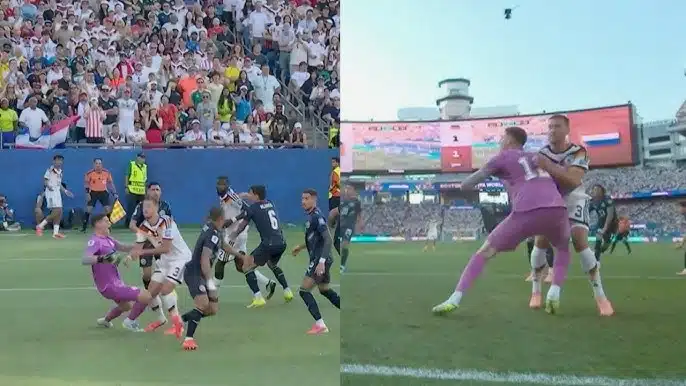
VAR advised referee Jalal Jayed to review the attacking phase. Waldemar Anton was judged to have illegally blocked goalkeeper Orlando Gill, and the goal was cancelled. Germany later lost the penalty shootout, making the intervention one of the tournament’s most consequential refereeing moments.
The Laws do not provide goalkeepers with automatic protection simply because they are inside the six-yard area. An attacker may occupy a legal position and challenge for space. A foul should be awarded only if the attacker holds, charges, pushes or illegally impedes the goalkeeper.
Anton and Gill made contact, but the contact appeared minimal. The goalkeeper was not clearly pushed away from the flight of the ball, and the evidence did not prove that Anton committed an offence rather than simply holding his position.
More importantly, the original decision was a goal. VAR should only intervene when the referee has made a clear and obvious error. The replay provided an alternative interpretation, but not unmistakable proof that the goal was illegal. The IFAB protocol is designed around minimum interference, not searching for minor contact that might support a different decision.
The VAR Verdict: The goal should have stood. Even those who considered Anton’s positioning questionable should ask whether the original decision was clearly wrong. The answer, in our view, is no.
2. Spain’s Goal Disallowed Against Argentina in the Final
Decision: Foul awarded against Mikel Merino
Verdict confidence: Medium to high
Spain appeared to break the deadlock in the 96th minute of the World Cup final when Nico Williams converted after sustained pressure inside Argentina’s penalty area.
Slavko Vinčić had penalised Mikel Merino for a challenge on Nicolás Otamendi immediately before the finish. The decision was based on Merino stepping on Otamendi’s foot, but several live reports described the contact as extremely soft. The goal remained disallowed after the check.
The strongest argument in favour of the decision is simple: stepping on an opponent’s foot can constitute a careless foul. However, contact alone does not automatically make every challenge illegal.
The replay showed two players converging while competing for the ball inside a crowded area. Merino did not appear to make a deliberate movement through Otamendi or use his body in a careless manner. The contact looked incidental to the football action rather than a clear trip or stamp.
In a World Cup final, the referee must not change the foul threshold simply because the incident occurs close to goal. Normal football contact remains normal football contact regardless of the importance of the match.
The VAR Verdict: The foul was too soft. Williams’ goal should have stood. Spain eventually won, but that does not reduce the importance of an incorrect decision in a goalless World Cup final.
3. Ghana Denied a Penalty Against England
Decision: No penalty for Ezri Konsa’s challenge
Verdict confidence: Very high
Ghana produced one of the group stage’s strongest performances during its goalless draw with England, but the match could have ended very differently.
Prince Kwabena Adu entered the penalty area before Ezri Konsa launched into a challenge. Konsa did not play the ball and appeared to catch Adu around the knee. Referee Saíd Martínez allowed play to continue, and VAR did not recommend an on-field review.
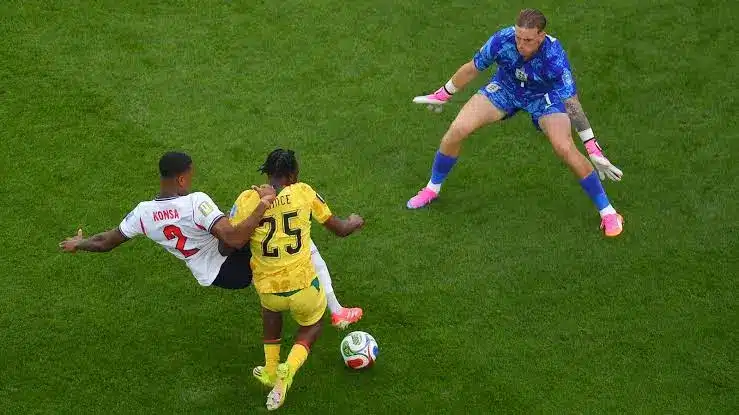
Law 12 states that a direct free kick must be awarded when a player carelessly tackles, challenges or trips an opponent. When the offence occurs inside the defender’s penalty area, the restart is a penalty kick. A careless foul does not require a yellow card, but it must still be penalised.
Konsa’s challenge met that standard. He arrived without winning the ball, made direct contact and prevented Adu from continuing his run. This was not a situation where the attacker deliberately moved into a stationary defender.
It was also exactly the type of incident VAR was introduced to correct. The contact was visible, the defender missed the ball and the consequence was clear.
The VAR Verdict: Ghana should have received a penalty. The initial mistake belonged to the referee, but VAR’s failure to recommend a review made the error more serious.
4. Breel Embolo Dismissed Against Argentina
Decision: Second yellow card for simulation after VAR review
Verdict confidence: High regarding the protocol
The most unusual VAR intervention of the tournament occurred during Argentina’s quarter-final against Switzerland.
Referee João Pinheiro initially awarded Switzerland a free kick and cautioned Leandro Paredes for his challenge on Breel Embolo. VAR then became involved through the expanded mistaken-identity protocol. Paredes’ yellow card was cancelled, Embolo was cautioned for simulation and, because it was his second yellow, Switzerland were reduced to ten players.
There was a reasonable argument that Embolo exaggerated the contact. The problem was not necessarily the final assessment of his fall. The problem was how VAR reached that outcome.
Mistaken identity is intended to correct a sanction given to the wrong player. In this case, VAR did much more. It changed the direction of the free kick, reversed the referee’s judgment of the challenge and identified an entirely different offence by the opposing player.
Former FIFA referee Christina Unkel described the application as too broad because it changed the basis of the original decision rather than simply correcting the identity of the offender.
The expanded 2026 protocol permits greater assistance in cases of mistaken identity and clearly incorrect disciplinary decisions. However, the central philosophy remains that VAR should correct clear errors, not re-referee normal subjective incidents.
The VAR Verdict: Even if Embolo exaggerated the contact, VAR should not have used mistaken identity to reconstruct the entire incident. The intervention went beyond correction and entered the area of re-refereeing.
5. Folarin Balogun Sent Off Against Bosnia and Herzegovina
Decision: Straight red card for serious foul play
Verdict confidence: Medium to high
Folarin Balogun was initially allowed to continue after making contact with Tarik Muharemović during the United States’ Round of 32 match against Bosnia and Herzegovina.
VAR recommended an on-field review, after which referee Raphael Claus sent Balogun off for serious foul play. His boot had moved down Muharemović’s leg before making contact around the heel and ankle.
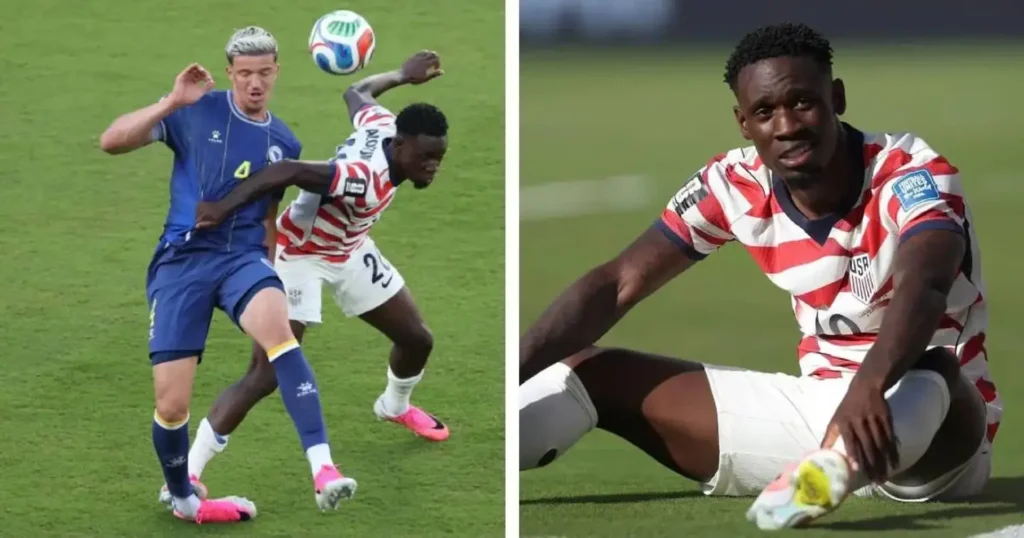
The point of contact looked worse in slow motion than it did at normal speed. That distinction is important. A red-card judgment should consider the complete action, including speed, force, intensity, control and whether the challenge endangered the opponent’s safety.
Law 12 reserves serious foul play for challenges that use excessive force or endanger an opponent. A reckless action, where the player disregards the danger or consequences, must instead be punished with a yellow card.
Balogun’s challenge was poorly controlled and deserved disciplinary action. However, the force was limited, the action did not resemble a full lunge and the contact resulted partly from the natural movement of two players competing for the ball.
ESPN’s VAR analysis concluded that Balogun had been wrongly sent off following a misapplication of the protocol.
The VAR Verdict: A yellow card was the more proportionate sanction. Slow-motion replays made the contact look more violent than the complete action justified.
6. Lionel Messi Escapes a Card Against Algeria
Decision: No disciplinary sanction
Verdict confidence: High that a card was required
Argentina’s opening match against Algeria produced an incident that became more significant as the tournament progressed.
Lionel Messi caught Algerian captain Aïssa Mandi with his studs, appearing to rake down the defender’s calf. A foul was awarded, but the referee did not show a card and VAR did not recommend a red-card review. Messi remained on the field and later completed a hat-trick.
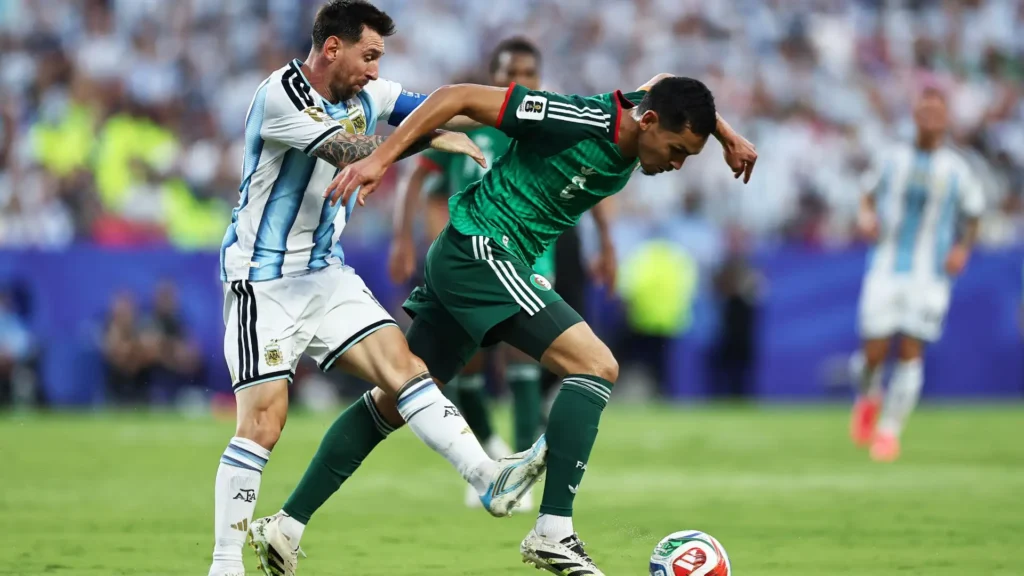
Intent is not the deciding factor when assessing the severity of a challenge. A player can commit serious foul play without deliberately trying to injure an opponent. Referees must assess the danger, force and nature of the contact.
The studs made contact above the foot, and the action created a clear risk to Mandi. At the absolute minimum, it was reckless and required a yellow card. There was also a credible argument that the height and nature of the contact met the threshold for serious foul play.
VAR could not intervene merely to recommend a yellow card, but it could have advised a review if the video officials considered the incident a possible direct red card.
The VAR Verdict: Messi should not have escaped without a card. A caution was the minimum acceptable sanction, while a red-card review would also have been supportable.
7. Harry Kane Denied a Penalty Against DR Congo
Decision: No penalty after goalkeeper’s challenge
Verdict confidence: High
England captain Harry Kane went down inside the penalty area during the Round of 32 match against DR Congo after goalkeeper Lionel Mpasi slid towards him.
The referee waved away England’s appeals and appeared to believe Kane had attempted to create the contact. VAR checked the incident but supported the original no-penalty decision.
Attackers are not entitled to manufacture a penalty by changing direction solely to collide with a defender or goalkeeper. However, that was not the clearest interpretation of this incident.
Kane was moving towards the ball and remained entitled to continue his run. Mpasi committed himself to the slide, did not establish clear contact with the ball and affected Kane’s ability to advance.
The fact that an attacker anticipates contact does not automatically mean simulation. The referee must determine who created the collision and whether the defender or goalkeeper made a careless challenge.
The VAR Verdict: England should have received a penalty. The goalkeeper’s challenge created the contact, and Kane’s fall was a consequence of that action rather than a clear attempt to deceive the referee.
8. Kylian Mbappé Denied a Penalty Against Senegal
Decision: Referee rejected VAR’s recommendation
Verdict confidence: Medium to high
Kylian Mbappé went down inside the Senegal penalty area after a challenge involving Sadio Mané during France’s group-stage match.
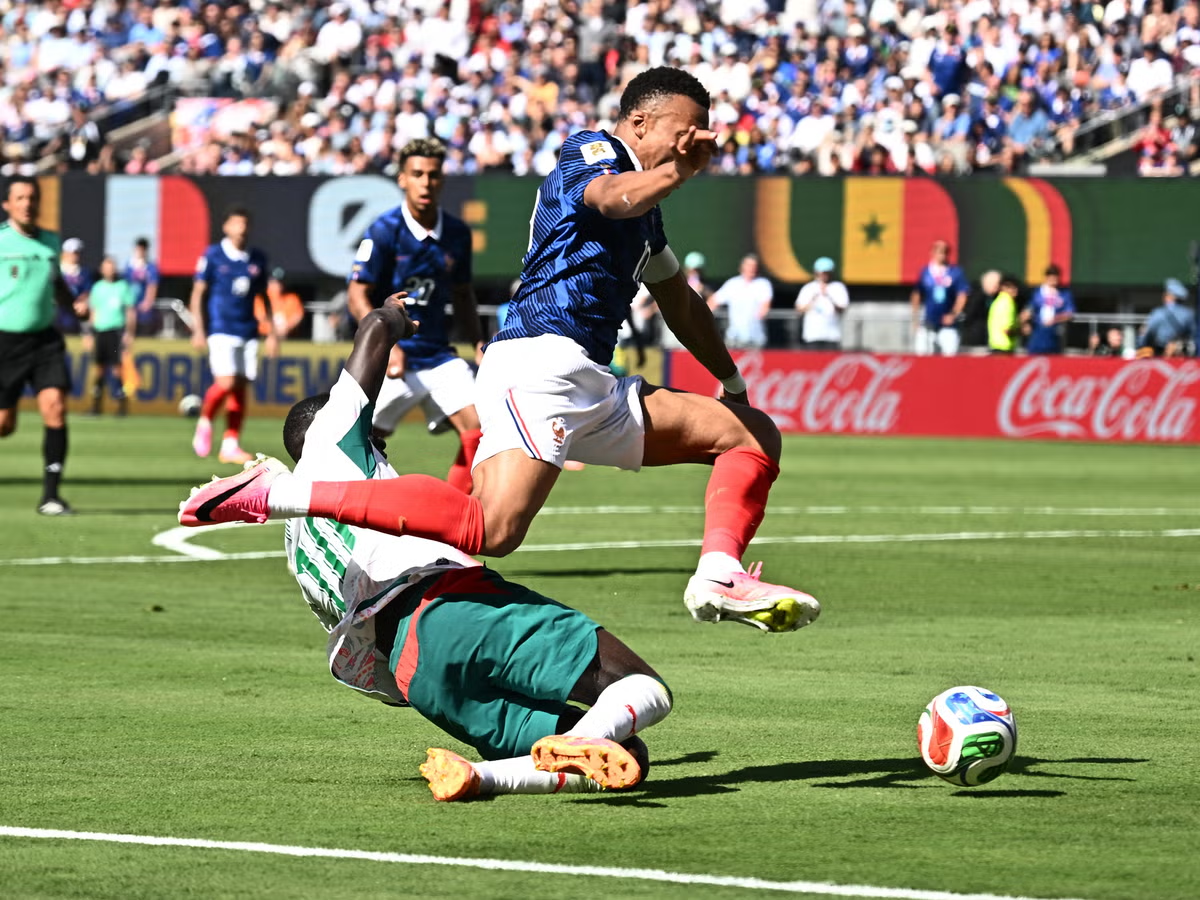
Referee Alireza Faghani initially allowed play to continue. VAR recommended an on-field review, but Faghani maintained his original decision after watching the replays, concluding that Mbappé had initiated the contact.
A referee is not required to change a decision simply because VAR recommends a review. The final authority always remains with the referee. In fact, maintaining an original decision can demonstrate strength when the video evidence does not justify a change.
In this case, however, Mané appeared to arrive late and make contact without clearly winning the ball. Mbappé was moving naturally towards the available space rather than extending his leg unnaturally to create a collision.
A late, careless challenge inside the area should result in a penalty even when the defender has no intention of committing a foul.
The VAR Verdict: Faghani should have changed his decision and awarded France a penalty. His willingness to reject VAR was admirable, but the final interpretation was not convincing.
9. Vinícius Júnior’s Goal Disallowed Against Scotland
Decision: Attacking foul awarded after VAR review
Verdict confidence: High
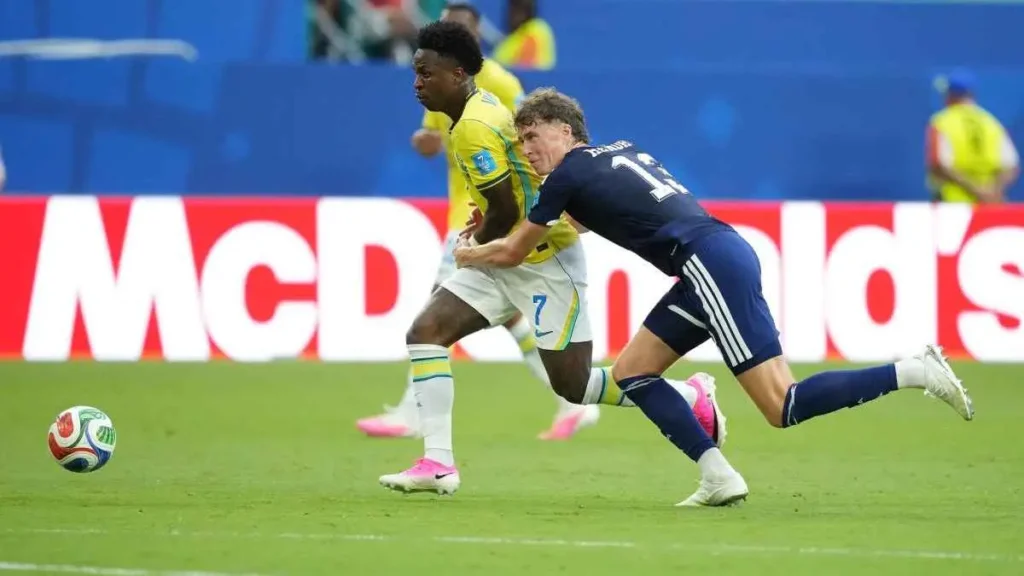
Vinícius Júnior took possession from Scotland defender Jack Hendry before finishing the move for Brazil. The goal was initially allowed, but VAR intervened and the referee ruled that Vinícius had fouled Hendry while winning the ball.
Replays showed only limited contact, and BBC refereeing analyst Darren Cann said Scotland had been fortunate. Brazil still won 3-0, but the lack of impact on the final score does not make the decision less important from a refereeing perspective.
Football allows players to compete physically for possession. A defender losing balance after being surprised or dispossessed does not prove that an offence occurred.
The decisive VAR question was not whether some contact existed. It was whether the original decision to allow the goal was clearly and obviously wrong.
The evidence did not reach that threshold. At most, the replay showed a subjective physical contest that different referees might interpret differently.
The VAR Verdict: The goal should have stood. VAR replaced one reasonable interpretation with another rather than correcting an obvious mistake.
10. Belgium Awarded a Late Penalty Against Senegal
Decision: Penalty awarded after on-field review
Verdict confidence: Medium
Belgium and Senegal appeared to be heading towards a penalty shootout when Youri Tielemans went down inside the area late in extra time.
Referee Saíd Martínez initially allowed play to continue. VAR recommended a review, and Martínez awarded a penalty after deciding that Lamine Camara had made contact with Tielemans. The Belgian midfielder converted, completing a 3-2 comeback and eliminating Senegal.
There was contact, which makes this decision more difficult than Ghana’s missed penalty or Vinícius’ disallowed goal. However, the contact appeared light and did not clearly explain the attacker’s fall.
VAR is not supposed to ask whether a penalty could be supported. It must ask whether the original no-penalty decision was clearly and obviously wrong.
When replays require prolonged analysis and several angles to identify minor contact, the intervention threshold has probably not been met. The video team effectively encouraged the referee to reconsider a subjective judgment rather than correct an unmistakable error.
The VAR Verdict: The original no-penalty decision should have remained. This was a possible penalty, but not a clear enough error to justify VAR intervention.
Other Refereeing Errors That Narrowly Missed the Ranking
Mac Allister’s Challenge on Dani Olmo
Alexis Mac Allister was fortunate to avoid a yellow card after an early open-footed challenge on Dani Olmo in the World Cup final. Several former players and pundits criticised the decision, arguing that the absence of a caution created a dangerously permissive disciplinary threshold.
Under Law 12, a reckless challenge must result in a yellow card. The challenge did not require a red card, meaning VAR could not intervene, but Vinčić should have cautioned Mac Allister.
Argentina’s Persistent Fouling Against England
Argentina committed 12 first-half fouls in its semi-final against England but received only one yellow card. Enzo Fernández and Giuliano Simeone were among the players who escaped cautions despite repeated or reckless offences.
Persistent offending does not require a fixed number of fouls. The referee must consider the pattern, frequency and effect on the opposition. A stronger disciplinary response was required.
Controversial Decisions That Were Not Referee Mistakes
A professional analysis must separate unpopular decisions from incorrect ones.
Egypt’s Disallowed Goal Against Argentina
Egypt’s goal was disallowed because Marwan Attia stepped on Lisandro Martínez’s foot during the attacking possession phase. FIFA explained that there is no fixed time or distance limit when reviewing an offence in the build-up to a goal.
The review felt unusually long because the foul occurred early in the move, but the decision was supported by FIFA’s interpretation of the attacking phase. For that reason, we have not classified it as one of the tournament’s ten worst errors.
Croatia’s Disallowed Equaliser Against Portugal
Connected-ball technology detected a faint touch by Igor Matanović before the ball reached Joško Gvardiol, placing the eventual scorer in an offside position. The touch was almost impossible to see, but its strength was irrelevant once the technology confirmed it.
The decision was painful and raised legitimate questions about technology’s influence, but it was correct under Law 11.
Iran’s Late Goal Against Egypt
Shoja Khalilzadeh’s stoppage-time goal was ruled out for an extremely narrow offside. The margin was tiny, but offside remains a factual decision once the moment of the pass and the players’ positions have been established.
Why VAR Did Not Eliminate World Cup Referee Mistakes
VAR was created to reduce major injustice, but the 2026 World Cup demonstrated that more intervention does not automatically produce more consistency.
Reuters reported that the number of interventions quickly exceeded the totals from the 2018 and 2022 tournaments. Critics questioned whether the system had moved beyond correcting obvious errors and started searching for technical reasons to change acceptable on-field decisions.
The most convincing interventions occur when the evidence is factual and immediate. Clear offsides, mistaken player identification and unseen serious fouls are areas where technology can provide decisive assistance.
Problems develop when VAR attempts to measure the intensity of minor contact in slow motion. The Belgium penalty, the Vinícius foul and Germany’s disallowed goal all involved subjective physical contact. In each case, the replay offered another interpretation, but did not necessarily prove that the referee’s original judgment was clearly wrong.
The Clear and Obvious Standard Must Still Matter
The IFAB VAR protocol says that assistance should be provided for a clear and obvious error or serious missed incident in reviewable categories such as goals, penalties, red cards and mistaken identity.
This standard does not mean VAR must ignore a foul because it is subjective. It means the video official must identify strong evidence that the original decision cannot reasonably be supported.
If both a penalty and no penalty are defensible after several minutes of replay analysis, the on-field decision should normally remain.
Frequently Asked Questions
What was the worst referee decision at the 2026 World Cup?
The VAR Verdict ranks Germany’s disallowed extra-time goal against Paraguay as the worst decision. The contact on the goalkeeper was minimal, the original goal decision was supportable and the VAR intervention directly preceded Germany’s elimination.
What was the biggest VAR error at the World Cup?
The intervention that cancelled Jonathan Tah’s goal and the use of mistaken identity to dismiss Breel Embolo were the two biggest VAR-related errors. One changed a goal decision, while the other changed the direction of a foul and produced a second yellow card.
Was Egypt’s disallowed goal against Argentina a mistake?
In our assessment, no. FIFA showed that Marwan Attia stepped on Lisandro Martínez’s foot during the attacking possession phase. The length of the move made the intervention controversial, but the foul supported the final decision.
Was Croatia’s disallowed goal against Portugal correct?
Yes. Connected-ball technology detected a touch that placed the scorer in an offside position. It was an extremely harsh decision, but technically correct under the current offside law.
Are these official FIFA referee ratings?
No. This ranking represents The VAR Verdict’s independent analysis based on the Laws of the Game, VAR protocol, match impact and available video evidence.
The VAR Verdict
The 2026 World Cup did not suffer from one single type of officiating problem.
Ghana were denied a clear penalty because both the referee and VAR missed a careless challenge. Germany and Brazil had goals cancelled because VAR treated marginal physical contact as a clear attacking offence. Balogun received a red card because slow motion exaggerated the severity of a challenge. Embolo was dismissed after an experimental protocol allowed VAR to completely reinterpret the original decision.
The most important lesson is not that technology failed. It is that technology cannot replace a consistent refereeing philosophy.
VAR should intervene strongly when the evidence is clear. It should remain silent when the replay merely offers a second reasonable opinion. Until that distinction is applied consistently, World Cup referee mistakes will continue to exist even with more cameras, connected balls and expanded review powers.

0 Comments
Join the conversation with respect. Comments are moderated and must follow our community rules.
Want to join the discussion?
Please log in or create an account to comment and reply. This keeps the conversation cleaner and safer.