
Who was the worst referee at the 2026 World Cup?
It is an uncomfortable question because every official selected for a FIFA World Cup has already passed years of physical testing, technical preparation and international assessment. One difficult match should not define an entire refereeing career.
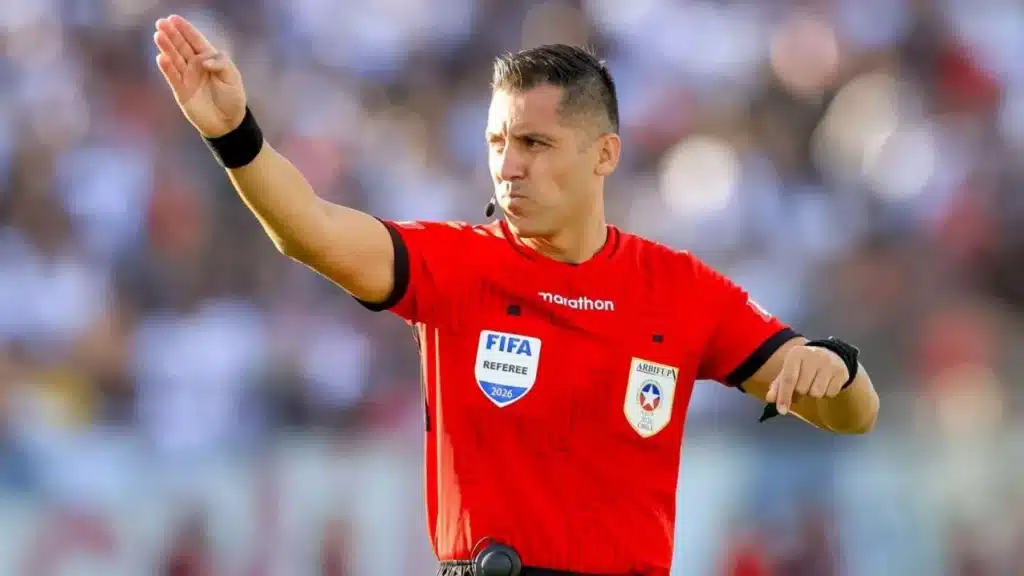
However, tournament ratings must be based on what happened on the field. After reviewing match control, disciplinary consistency, major decisions, positioning and the referee’s dependence on VAR, The VAR Verdict has given its lowest 2026 World Cup referee rating to Cristian Garay of Chile.
Garay’s only match in the middle was Canada’s 6-0 group-stage victory over Qatar. The match included two Qatari red cards, two major corrections after video intervention, a serious injury to Canadian midfielder Ismaël Koné and confrontations involving the teams during and after the match.
The VAR Verdict’s Lowest World Cup Referee Rating
| Category | Rating |
|---|---|
| Key decision accuracy | 4.5/10 |
| Match control | 2.5/10 |
| Disciplinary consistency | 3.5/10 |
| Positioning and movement | 4.0/10 |
| Communication and authority | 2.5/10 |
| Cooperation with VAR | 5.5/10 |
| Overall rating | 4.0/10 |
This is an independent editorial rating, not an official FIFA mark.
A specialist assessment published by Law 5 also gave Garay a grade of four and described Canada against Qatar as the worst performance of the tournament up to that stage. In the same review, other heavily criticised performances by Tori Penso, Felix Zwayer and Omar Al-Ali received grades of five.
Who Is Cristian Garay?
Cristian Garay arrived at the tournament as an experienced South American official with appointments in the Copa Libertadores, Copa América and World Cup qualifying.
His selection was also significant for Chilean refereeing. Canada against Qatar made him the first referee from Chile to take charge of a men’s World Cup match since Enrique Osses in 2014. Garay was assisted by José Retamal and Miguel Rocha, with Juan Lara working as VAR.
Unfortunately, his World Cup debut became one of the most difficult matches of the group stage.
Canada 6-0 Qatar: The Match That Defined Garay’s World Cup
Canada dominated Qatar from the beginning and eventually recorded a historic 6-0 victory. Cyle Larin opened the scoring before Jonathan David completed a hat-trick, while Nathan Saliba also scored and Qatar conceded an own goal.
The score, however, tells only part of the story. Qatar finished with nine players after Homam Ahmed and Assim Madibo were sent off. Koné suffered a broken leg following Madibo’s challenge, the Qatari bench reacted angrily to the dismissal and the teams became involved in another confrontation after full-time.
Garay was not responsible for the players’ actions. A referee cannot prevent every dangerous challenge or emotional reaction. His responsibility was to recognise the nature of the match early, establish a consistent disciplinary line and react strongly before the atmosphere deteriorated.
That is where the performance fell below the required World Cup standard.
9th Minute: A Correct Yellow Card That Was Not Followed by Consistency
Garay’s opening caution, shown to a Canadian player for stopping a promising attack, was supportable. It suggested that the referee intended to establish a firm disciplinary standard from the beginning.
The problem came only a few minutes later. Qatar committed another challenge that provided Garay with an obvious opportunity to apply the same standard, but no yellow card was shown.
This was not the most important missed decision of the match, but it sent an early message to the players that similar offences might not receive similar punishment. The specialist review identified the failure to caution Qatar in the 14th minute as an important turning point in Garay’s loss of authority.
A referee does not have to produce a card every time the opposition expects one. However, when an early caution establishes the disciplinary threshold, the same threshold should be maintained at both ends.
The VAR Verdict: The first caution was correct, but the failure to punish a comparable offence shortly afterwards damaged Garay’s consistency.
22nd and 40th Minutes: Player Crowding Was Not Controlled
Garay was surrounded by players on more than one occasion during the first half. Instead of taking decisive action, identifying the leading protester or using the captains to separate the groups, he allowed the incidents to pass without a meaningful disciplinary response.
Player crowding is not simply an image problem. When a referee accepts aggressive collective protests, the teams begin to believe that pressure can influence future decisions.
The incidents around the 22nd and 40th minutes were particularly important because they happened before the most serious event of the match. A stronger response at that stage might not have prevented the later challenges, but it would have made the referee’s authority much clearer. The independent match review concluded that Garay’s control was already disappearing before the first red card.
The VAR Verdict: Garay needed a clear public warning, captain involvement or a caution for dissent. Doing nothing allowed frustration to grow.
32nd Minute: Homam Ahmed’s Red Card Was Correct, but VAR Had to Repair the Decision
Tajon Buchanan was brought down by Homam Ahmed while moving towards goal. Garay initially awarded Canada a penalty and showed a yellow card.
VAR correctly established that the offence had occurred outside the penalty area. Once the restart changed from a penalty to a direct free kick, the disciplinary assessment also had to be reconsidered. Ahmed was the last defender and the challenge denied Buchanan an obvious goalscoring opportunity, so the yellow card was upgraded to a red.
Under Law 12, officials assessing a possible denial of an obvious goalscoring opportunity must consider the distance from goal, direction of play, likelihood of controlling the ball and the position of the remaining defenders. A DOGSO offence outside the penalty area is punished with a red card.
The final decision was correct. This should be recognised.
However, Garay had initially misjudged both the location and the required disciplinary sanction. VAR did its job, but the incident became the first major example of the referee needing video assistance to reach the correct outcome.
The VAR Verdict: Correct final decision after VAR intervention. Garay receives credit for accepting the correction, but not full marks for the original assessment.
51st Minute: Assim Madibo Initially Receives Only a Yellow Card
The match’s most serious moment arrived early in the second half when Assim Madibo challenged Ismaël Koné from behind.
Garay initially showed a yellow card. After the video review, the sanction was upgraded to a direct red. Koné was taken from the field, underwent surgery and was ruled out after suffering a broken leg. FIFA later imposed a five-match suspension on Madibo for serious foul play.
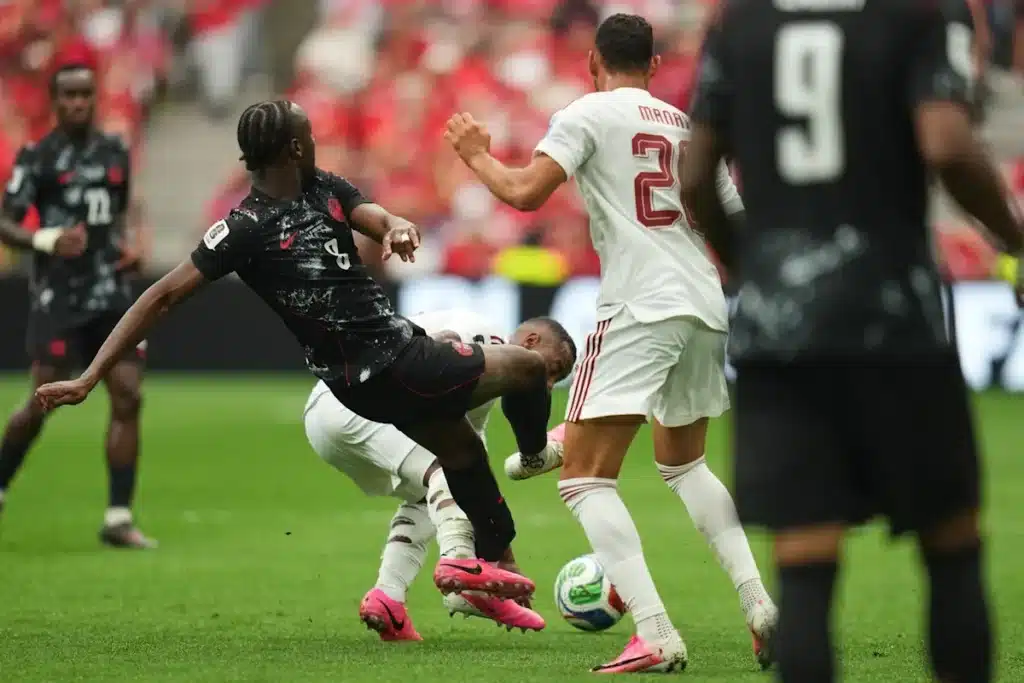
The injury itself does not automatically make a tackle a red-card offence. Referees must judge the action rather than the medical consequence. A fair challenge can unfortunately cause an injury, while a dangerous challenge may escape without injuring anyone.
In this case, the nature of the challenge justified the red card. Madibo arrived from behind with insufficient control and endangered the safety of his opponent. Law 12 states that a tackle using excessive force or endangering an opponent’s safety must be punished as serious foul play.
This was the second major decision in the match that Garay did not identify correctly in real time. The point of contact was partly obscured and the speed of the incident made it difficult, but an elite referee must recognise the intensity and danger of the action as accurately as possible.
The VAR Verdict: The red card was correct. Garay’s initial yellow was too lenient, and VAR prevented a major error.
Why Two Correct Red Cards Still Produced a Rating of 4/10
At first glance, it may appear unfair to criticise a referee when both red cards were ultimately correct.
The problem is that referee performance is not assessed only by the final decision displayed on the stadium screen. The evaluation must also consider:
- Whether the referee identified the offence on the field
- Whether VAR had to correct a clear error
- Whether earlier disciplinary action could have improved control
- How the referee responded to protests and confrontations
- Whether the players respected his authority
Garay required major assistance on both dismissals. More importantly, the match was already slipping from his control before the red cards occurred.
VAR can correct a penalty location or upgrade a challenge, but it cannot restore authority that has been lost over the previous 30 minutes.
Garay Became a Passenger After the Second Red Card
After Qatar were reduced to nine players, Garay faced an extremely difficult situation. The serious injury had affected Canada emotionally, while Qatar’s players and staff were furious about the dismissal.
This was the moment when the referee needed to slow the match, communicate with both captains, control the technical areas and make it clear that any further confrontation would be sanctioned.
Instead, the match continued with visible tension. Canada and Qatar were involved in a touchline altercation after the Madibo incident, and another confrontation broke out around the halfway line following the final whistle.
The Law 5 assessment described Garay as becoming a passenger rather than the controller of events. It also questioned whether his central positioning and limited movement prevented him from obtaining the strongest viewing angles during important incidents.
The VAR Verdict: This was the biggest weakness of the performance. The final score was already decided, but the referee still had a duty to protect the players and manage the emotional temperature.
Positioning and Movement Contributed to the Problems
Garay frequently operated through the central channel instead of creating wider viewing angles.
Central positioning is not automatically incorrect. It can keep a referee close to transitions and provide short movement distances. However, remaining too central can place players between the referee and the point of contact.
That appeared to happen during several challenges in Canada against Qatar. Garay was physically close to play, but proximity is valuable only when it provides a clear angle.
This distinction is important. A referee can be five metres from an incident and see less than an official positioned 12 metres away with an unobstructed side view.
The VAR Verdict: Garay’s fitness was not necessarily the issue. His movement choices and viewing angles reduced the quality of his decision-making.
Did VAR Help or Expose the Referee?
VAR unquestionably helped Garay reach the correct final decisions.
The first review moved the offence outside the penalty area and changed Ahmed’s sanction from yellow to red. The second upgraded Madibo’s yellow card to a dismissal for serious foul play. Both interventions were within the VAR protocol, which allows assistance for red-card incidents and serious missed offences.
However, two successful corrections do not transform the performance into a good one. They show that the safety net functioned.
The strongest World Cup referees made accurate initial decisions and used VAR only when incidents were genuinely difficult to detect. Garay’s two biggest disciplinary judgments both required important correction.
Was Cristian Garay Removed From the World Cup?
FIFA did not publicly announce that Garay had been punished or removed because of the Canada-Qatar performance.
The published appointment record indicates that Canada against Qatar remained his only match as the referee. He later appeared in supporting duties, and his team was included among the officials released following the quarter-finals.
It would be inaccurate to claim that FIFA officially sent him home because of a bad rating. FIFA does not publish detailed public assessments for every referee.
Nevertheless, not receiving a second match in the middle is significant. Officials who perform strongly in their opening assignment are normally considered for another group-stage game or a knockout appointment.
Why Garay Ranks Below Other Criticised Referees
Several officials produced controversial performances during the tournament.
Tori Penso was criticised for inconsistent warnings and missed disciplinary incidents. Felix Zwayer struggled to recognise the increasingly physical nature of the United States against Australia. Omar Al-Ali was too permissive during New Zealand against Egypt.
Those performances received grades of five in the same specialist review that gave Garay a four.
François Letexier also faced intense criticism following Argentina against Egypt, while decisions involving João Pinheiro, Saíd Martínez and Raphael Claus generated major debate during the knockout rounds.
The difference is that many of those referees still demonstrated periods of good control or correctly identified their major decisions on the field. In Garay’s case, the problems affected almost every part of the performance:
- Early disciplinary inconsistency
- Weak response to player crowding
- Two major on-field judgments corrected by VAR
- Limited authority after the serious injury
- Poor control of technical-area emotions
- A confrontation after the final whistle
That complete combination explains the lowest rating.
Does One Bad Match Make Cristian Garay a Bad Referee?
No.
A World Cup referee should be evaluated on the tournament, but an official’s entire career cannot be reduced to 90 minutes. Garay reached the World Cup after years of international appointments and demanding selection procedures.
The title “worst referee at the 2026 World Cup” refers only to The VAR Verdict’s tournament performance rating. It is not a judgment of his character, integrity or complete refereeing career.
That distinction is essential in professional referee analysis. Criticism should focus on positioning, foul recognition, discipline and match management rather than personal attacks.
Frequently Asked Questions
Who was the worst referee at the 2026 World Cup?
The VAR Verdict rated Chilean referee Cristian Garay lowest with 4.0/10 following his performance in Canada’s 6-0 victory over Qatar.
What match did Cristian Garay referee?
Garay refereed Canada against Qatar in Group B. Canada won 6-0, while Qatar finished with nine players following red cards for Homam Ahmed and Assim Madibo.
Were the two Qatar red cards correct?
Yes. Homam Ahmed correctly received a red card for denying an obvious goalscoring opportunity outside the penalty area. Madibo was correctly sent off for serious foul play. However, both decisions required major corrections after Garay’s original judgments.
What was the lowest World Cup referee grade?
The VAR Verdict gave Garay 4.0/10. An independent Law 5 assessment also awarded his performance a grade of four.
Did FIFA suspend Cristian Garay?
There was no public FIFA announcement suspending Garay. He did not receive another centre-referee appointment and was later included among the officials released after the quarter-finals.
Are these official FIFA referee ratings?
No. The World Cup referee ratings published by The VAR Verdict are independent editorial assessments based on decision accuracy, match management, disciplinary control, positioning and VAR cooperation.
The VAR Verdict
Cristian Garay finishes at the bottom of our final World Cup referee grades with a rating of 4.0/10.
The two red cards in Canada against Qatar were ultimately correct, but both required significant correction after the original on-field decisions. More damaging was Garay’s inability to establish a consistent disciplinary line, respond to player crowding and regain control after the match became emotionally charged.
VAR corrected the major technical errors. It could not correct the loss of authority.
That is why Cristian Garay is The VAR Verdict’s lowest-rated referee at the 2026 World Cup.

0 Comments
Join the conversation with respect. Comments are moderated and must follow our community rules.
Want to join the discussion?
Please log in or create an account to comment and reply. This keeps the conversation cleaner and safer.