
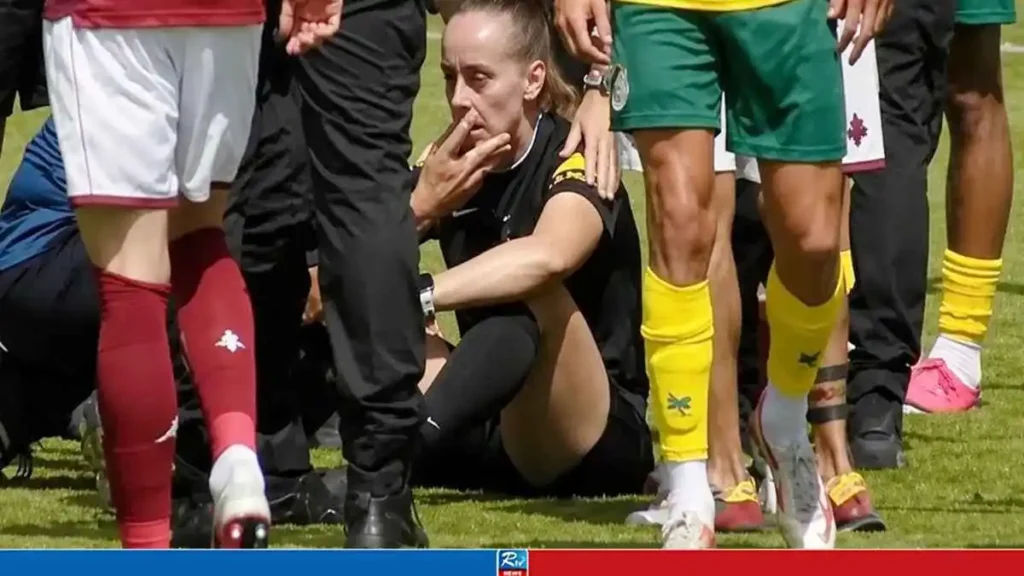
French referee Mathilde Demoncay suffered a concussion after being knocked to the ground while attempting to manage a confrontation between players during a preseason friendly between Metz and Fortuna Sittard.
The incident happened late in the first half at Schlossberg Stadium in Forbach, eastern France. A shirt-pulling offence involving Metz midfielder Jessy Deminguet and Fortuna Sittard forward Lequincio Zeefuik developed into a confrontation, with several players from both teams rushing towards the scene. Demoncay moved in to restore control but was caught among the players and fell heavily to the ground.
The 26-year-old remained on the pitch for several minutes while medical staff, security personnel and the other match officials responded. She briefly resumed duties as an assistant referee after play restarted but left the field at half-time. Reports later confirmed that she had suffered a concussion.
Metz went on to win the friendly 3–1, but the result quickly became secondary to a troubling question: when a mass confrontation becomes physically dangerous, who is responsible for protecting the referee?
What happened to referee Mathilde Demoncay?
The confrontation began after Zeefuik was strongly pulled back by Deminguet. The Fortuna player reacted angrily, and opposing players quickly gathered around the incident.
Demoncay entered the group in an effort to separate the players and control the situation. Video described by multiple reports showed her being knocked backwards in the crowded confrontation before striking the ground. There is currently no reliable evidence that a specific player deliberately targeted or attacked her, so the incident should not be presented as an intentional assault unless an investigation establishes that fact.
That distinction matters. The consequences were serious, but accurate reporting must separate a referee being dangerously knocked over during a melee from an allegation that an identified player intentionally struck her.
Players from both teams reportedly apologised to Demoncay afterwards, and Metz presented her with a club shirt.
The disturbing irony behind the incident
The confrontation occurred directly in front of a large advertising board carrying the message “Respect the referee.”
The image was difficult to ignore. Football organisations regularly promote respect campaigns, captain-referee communication and stronger punishment for dissent. Yet in this match, the referee was physically injured while trying to control players who had allowed an ordinary shirt-pulling offence to become a mass confrontation.
A slogan beside the pitch cannot protect an official.
Respect must be demonstrated through player behaviour, captain intervention, effective security arrangements and meaningful disciplinary consequences.
Should a referee enter a mass confrontation?
A referee has several responsibilities when players confront one another.
The official must identify serious misconduct, prevent escalation where possible, separate the original offenders from the wider group and record which players become involved. Assistant referees and the fourth official can also help identify offences that the referee cannot clearly see.
However, match officials should not be expected to place themselves physically in the centre of a large group of powerful professional players.
There is an important difference between approaching a confrontation to observe and manage it and attempting to act as the primary physical barrier between the players.
Once numerous players are pushing from different directions, the referee can easily be knocked down without any single person intentionally aiming at them. That appears to be the central safety concern raised by the Demoncay incident.
The officiating team should maintain enough distance to identify misconduct while captains, team staff and trained security personnel take greater responsibility for physically separating players.
What do the Laws of the Game say about mass confrontations?
Law 12 gives referees the authority to caution or dismiss players for misconduct committed during a confrontation.
A player who pushes or strikes another person recklessly may be cautioned. A player who uses excessive force or commits violent conduct must be sent off. Physical or aggressive behaviour directed towards a match official is also a sending-off offence.
The referee’s disciplinary authority begins before the match and continues until the officials leave the field after the game. Other match officials are also expected to report serious misconduct that occurred outside the referee’s view.
IFAB guidance specifically addresses situations in which a player commits an offence during a mass confrontation but cannot be identified. In that case, an uninvolved coach cannot simply be punished as a substitute offender. The incident should instead be reported to the appropriate competition authorities for further investigation.
That is important for this case. Any disciplinary decision should be based on clear video evidence, match-official reports and identification of the individuals responsible. Authorities should not punish someone merely because they were standing close to the referee when she fell.
Could players face retrospective punishment?
Potentially, but only after the relevant authorities establish what each person did.
Possible offences during a confrontation may include:
- Violent conduct
- Aggressive behaviour
- Entering the confrontation unnecessarily
- Failing to respect the referee’s instructions
- Deliberately pushing or striking a match official
- Provoking or escalating the original dispute
The Laws provide the framework for on-field sanctions, while the competition’s disciplinary regulations determine whether further punishment can be imposed after the match.
Video footage can help identify conduct missed by the referee, but investigators must distinguish between deliberate actions and accidental contact created by the movement of the crowd.
At the time of publication, the available reporting had not identified a player as deliberately causing Demoncay’s injury or confirmed formal sanctions relating to the incident.
Who should protect the referee?
The referee is responsible for managing the match, but referee safety is a shared responsibility.
The players
Players must control their behaviour and obey the referee’s instructions. Running into a confrontation usually makes the incident harder to manage, even when the player claims to be protecting a teammate.
Substitutes and players who were not involved in the original dispute should remain away. When ten or more people enter the same small area, the risk of accidental injury increases immediately.
The team captains
IFAB states that players carry major responsibility for football’s image and that captains should help ensure that referees and their decisions are respected.
A captain’s role should not be limited to discussing decisions. Captains must also remove teammates from confrontations, communicate the referee’s instructions and help stop an emotional incident from spreading across both teams.
The captain-referee communication approach is supposed to reduce the number of players surrounding officials and place responsibility on one recognised team representative. UEFA has described that cooperation as a way to build trust and protect the image of the game.
The other match officials
Assistant referees and the fourth official should observe the incident from different positions, identify offenders and communicate clearly with the referee.
They may help calm individual players, but they should also avoid all officials becoming trapped inside the same confrontation.
Maintaining separate viewing angles is important because the referee may miss the original offence after becoming surrounded.
Security and competition organisers
Security personnel should have a clear protocol for responding when a confrontation becomes a safety risk.
They should not enter every disagreement between players. But when a mass gathering continues, players are pushing violently or a referee is placed in danger, a rapid and organised response may be necessary.
Competition organisers must decide before the match:
- Who is authorised to enter the pitch
- When security should intervene
- How medical assistance reaches an injured official
- Who replaces a referee who cannot continue
- How video footage and reports are preserved for disciplinary review
These arrangements should exist even during preseason friendlies. A match being described as “friendly” does not remove the risk of serious misconduct.
Could the referee suspend the match?
Yes. The referee has full authority to enforce the Laws and may stop, suspend or abandon a match when safety or control can no longer be maintained.
IFAB has also developed cooling-off period trials specifically for confrontations involving players or team officials that threaten safety and match control. Under that approach, the referee can temporarily suspend play and direct both teams away from one another while tensions decrease.
A cooling-off period will not prevent every incident, especially when a confrontation develops suddenly. However, it gives officials another option when restarting immediately could produce further conflict.
In this match, the game continued after Demoncay received treatment, with the officiating team being reorganised. That does not necessarily mean continuing was wrong, but the referee’s health must always take priority over completing a preseason fixture.
Why continuing after a suspected concussion is concerning
Reuters reported that Demoncay briefly resumed as an assistant referee before leaving at half-time, while other reports said it quickly became clear that she could not continue as the referee.
Without access to her medical assessment, it would be wrong to judge the exact decision made at pitch level. However, the incident raises a wider question about whether match officials receive the same immediate head-injury protection expected for players.
A referee may feel pressure to continue because replacing the official is difficult, particularly in a friendly match with a smaller officiating team.
That pressure should not influence a medical decision.
When a match official suffers a significant fall or possible head injury, the decision about continuing should be made conservatively and independently of the importance of completing the game.
Does it matter that Demoncay is a female referee?
The injury has attracted additional attention because a female referee was knocked down during a men’s match.
That context is relevant, but the fundamental issue should remain referee safety rather than gender.
Every official, male or female, should be able to manage a match without being placed in physical danger by players who lose control.
At the same time, incidents involving female officials can carry an additional impact. Football is actively trying to recruit and develop more women as referees. Images of an official being injured during a mass confrontation may discourage potential referees if the sport appears unable to protect those already working at a high level.
Football authorities regularly say that they want more people to become referees. That message must be supported by visible action when officials are abused, surrounded or injured.
Are apologies from the teams enough?
The reported apologies were appropriate, but an apology cannot be the entire response.
The relevant authorities should review the complete footage and determine:
- Who started the confrontation
- Which players escalated it
- Whether anyone acted violently
- How Demoncay was knocked down
- Whether the referee team followed an appropriate safety procedure
- Whether stadium security reacted quickly enough
- Whether disciplinary sanctions are required
The objective should not be to create a public scapegoat. It should be to establish responsibility and reduce the chance of a similar injury happening again.
The wider problem of referee protection
Elite football often discusses referees only when a decision is controversial.
Their safety receives much less attention.
The culture surrounding officiating is shaped by what supporters see at the professional level. When players surround, intimidate or physically crowd referees without meaningful consequences, the behaviour is copied further down the football pyramid.
UEFA has repeatedly stated that mobbing referees and placing pressure on officials is unacceptable. It has also emphasised that protecting football’s image requires players and coaches to show respect rather than treating abuse as a normal expression of emotion.
The Demoncay incident demonstrates that uncontrolled confrontations are not merely unattractive. They can cause real physical harm.
The VAR Verdict opinion
The VAR Verdict believes football must stop expecting referees to act as both decision-makers and physical peacekeepers.
Mathilde Demoncay was right to respond when the confrontation began. A referee cannot simply ignore players pushing one another.
But once a mass of players forms, the responsibility for de-escalation must be shared.
Captains should pull teammates away. Assistant referees should identify offences from safe positions. Security personnel should be ready when the confrontation becomes dangerous. Competition authorities should impose clear sanctions on players who unnecessarily enter or escalate melees.
The incident should also be reviewed without premature accusations.
The available footage shows that Demoncay was knocked down inside the confrontation. It does not, based on the reporting currently available, prove that a particular player deliberately attacked her.
Accurate disciplinary action requires evidence.
What is already beyond dispute is that the safety system failed. A referee entered an ordinary preseason friendly and left with a concussion because players could not control their behaviour.
A shirt pull should never lead to that outcome.
Final verdict
The female referee suffers concussion story is more than a disturbing moment from an otherwise unimportant preseason match.
It exposes a gap between football’s public respect campaigns and the reality officials can face on the pitch.
Mathilde Demoncay was knocked to the ground while trying to control a player confrontation. She received medical treatment, briefly changed roles and was eventually replaced after suffering a concussion.
The response must go beyond sympathetic messages.
The authorities should review the footage, identify any misconduct and examine whether better procedures could have kept the referee outside the most dangerous part of the confrontation.
Football constantly asks referees to protect the players and the game.
It must be equally serious about protecting the referees.

0 Comments
Join the conversation with respect. Comments are moderated and must follow our community rules.
Want to join the discussion?
Please log in or create an account to comment and reply. This keeps the conversation cleaner and safer.