
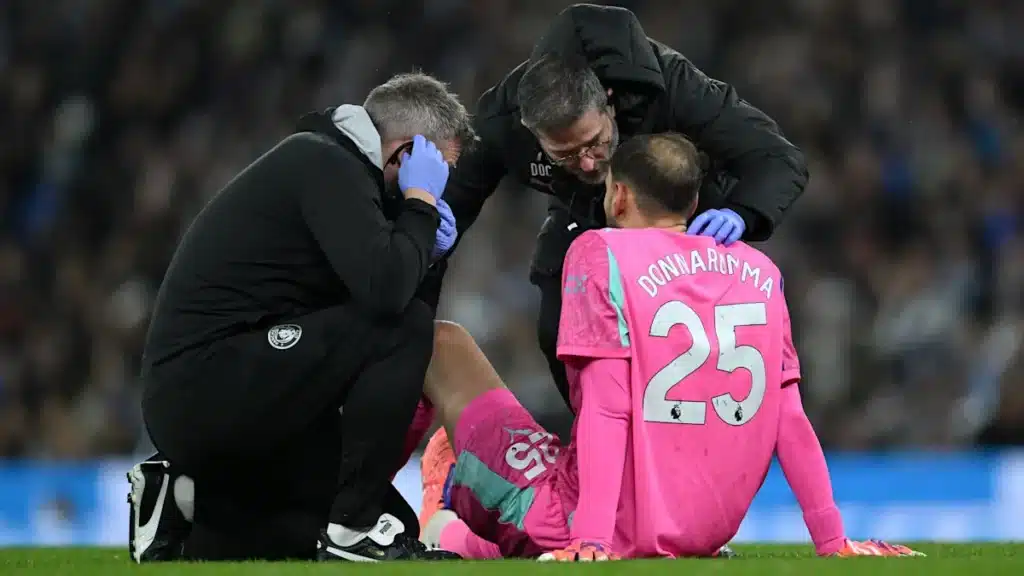
The Premier League goalkeeper injury rule will introduce an unusual punishment for teams whose goalkeeper requires treatment during the 2026/27 season.
When a match is stopped because of a goalkeeper injury, the manager will normally be required to nominate an outfield player to leave the pitch. That player must remain off the field for at least one minute after play restarts.
The goalkeeper can continue playing once treatment has been completed, but their team will temporarily continue with only ten players.
The trial has been approved by the International Football Association Board and will be introduced across England’s professional men’s and women’s competitions. It is designed to stop teams from using apparent goalkeeper injuries to interrupt an opponent’s momentum, waste time or provide players with tactical instructions.
It may sound like one of the strangest football rules introduced in recent years, but the authorities believe a strong sporting consequence is needed to close a loophole that has become increasingly common.
How will the Premier League goalkeeper injury rule work?
The process begins when the referee stops play because a goalkeeper requires medical attention.
Once the referee allows the medical staff to enter, the goalkeeper’s manager or head coach must nominate one outfield player to leave the pitch. Reports explaining the protocol state that the coach will have ten seconds to select that player. If no player is nominated, the team captain will be required to leave instead.
The nominated player cannot immediately return when the goalkeeper’s treatment finishes. They must stay off the field for a minimum of one minute after play has restarted.
For example, imagine that Arsenal’s goalkeeper sits down and requires treatment while Arsenal are under pressure. If the referee stops the match and allows the physio onto the field, Arsenal would have to nominate an outfield player to leave.
The goalkeeper would remain in goal, but Arsenal could be forced to defend with ten players for at least one minute after the restart.
That temporary numerical disadvantage is intended to remove any tactical benefit gained from the stoppage.
Why has the new rule been introduced?
Goalkeepers have traditionally been treated differently from outfield players because they cannot simply leave the pitch without another player taking over their position.
Under the general injury rules, an outfield player whose injury causes play to be stopped, or who receives assessment or treatment on the pitch, must usually leave the field and wait for one minute after play restarts before returning. Goalkeepers are among the exceptions because every team must have someone acting as goalkeeper.
That exception created a possible loophole.
A goalkeeper could sit down, request treatment and cause the referee to stop the game without having to leave the field afterwards. During the stoppage, teammates could move towards the technical area, speak to the manager, receive new tactical instructions and recover physically.
Even when additional time was eventually added, the interruption could still stop the momentum of the opposition.
The Premier League says the new trial is designed to address situations where goalkeeper injuries have been used to slow the game, disrupt momentum or create an opportunity for tactical coaching.
What is a goalkeeper tactical timeout?
A goalkeeper tactical timeout is not an official part of football.
The term is used when a goalkeeper appears to require treatment at a convenient moment, allowing the rest of the team to gather near the coaching staff.
This can effectively create an unofficial timeout in a sport that does not normally allow coaches to stop the match for tactical discussions.
The tactic has attracted increasing criticism because it is difficult for referees to prove whether a goalkeeper is genuinely injured. Match officials must prioritise player safety, which means they cannot simply ignore a goalkeeper who says they require treatment.
The new approach avoids asking the referee to decide whether the injury is genuine. Instead, it introduces a sporting consequence whenever the non-exempt protocol is triggered.
A genuinely injured goalkeeper will still receive treatment. However, the team will no longer gain a free tactical break without any disadvantage.
Which competitions will use the rule?
Despite being described as a Premier League rule, the trial will not be limited to England’s top division.
The Premier League, Football Association, English Football League, National League, Women’s Super League and Pro Ref have collectively supported its introduction. It will therefore operate across the professional men’s and women’s game in England during the 2026/27 season.
The system is expected to appear for the first time during the opening round of the League Cup on August 1, before being used during the Premier League season.
The trial will be monitored throughout the campaign by English football’s governing bodies and IFAB. Its effect on match flow, tactical behaviour and player welfare will then be assessed before any decision is made about its future.
Are genuine goalkeeper injuries excluded?
The Premier League goalkeeper injury rule contains several important exceptions.
A team will not automatically lose an outfield player whenever its goalkeeper receives treatment. The trial will not apply in certain situations where there is a clear and immediate reason for the injury.
The Premier League has confirmed exceptions when a free kick is awarded for a foul on the goalkeeper and the goalkeeper requires immediate treatment, when the goalkeeper collides with an outfield player who also needs medical attention, or when the goalkeeper is bleeding.
Reuters also reports that the trial will not apply when the goalkeeper is injured because of a physical offence for which a free kick is awarded and immediate treatment is required.
These exceptions are important because the rule is intended to discourage tactical stoppages, not punish teams for obvious injuries caused by opponents.
What happens if a goalkeeper is seriously injured?
Player welfare remains the priority.
Medical staff will still be permitted to enter the pitch and assess the goalkeeper. The referee should not delay necessary treatment simply because the team may later be required to remove an outfield player.
When an injury is serious, the goalkeeper may need to be substituted. The normal substitution process would then apply.
The temporary one-player reduction is primarily aimed at stoppages where the goalkeeper receives treatment and then remains in the match.
The rule does not mean an injured goalkeeper must continue playing, nor does it prevent medical staff from taking the time needed to assess a potentially serious condition.
Could managers exploit the rule?
The trial may create new tactical questions.
Because the manager chooses which outfield player leaves, teams could nominate a player who is less important during the following minute. A striker might be removed when the team expects to defend, while a defender might leave if the team has possession and is unlikely to face an immediate attack.
A manager might also choose a player who was already preparing to be substituted.
However, even when the least damaging option is selected, the team will still have only ten active players. The opposition may also adjust quickly and attempt to exploit the numerical advantage before the player can return.
The captain rule is another important detail. If the coach does not nominate an outfield player within the required period, the captain must leave the field.
This prevents managers from delaying the restart by refusing to make a decision.
Will the goalkeeper receive a yellow card?
The trial does not automatically require the referee to caution the goalkeeper simply because treatment is requested.
Referees are not doctors and cannot safely assume that an injury is fake.
Instead of forcing the referee to judge the goalkeeper’s honesty, the protocol creates an automatic sporting consequence for the team. An outfield player leaves temporarily, regardless of whether the stoppage was tactical or the goalkeeper genuinely felt discomfort.
A caution could still be possible if the referee independently concludes that a player has committed a clear disciplinary offence, such as deliberately delaying the restart or acting in an obviously unsporting manner.
However, the one-minute removal of a teammate is the central deterrent created by the trial.
Is this now a permanent Law of the Game?
No. It is important to describe this measure as a trial rather than a permanent worldwide law.
IFAB has given English football permission to test the system during the 2026/27 season. The results will be monitored before football’s lawmakers decide whether the idea should be changed, expanded, abandoned or eventually incorporated into the Laws of the Game.
Other competitions are not automatically required to use the same system simply because it will operate in the Premier League.
This also means the details could be adjusted after officials, clubs and players gain practical experience with the protocol.
Other Premier League time-wasting changes
The goalkeeper injury trial forms part of a larger attempt to increase ball-in-play time and reduce avoidable delays.
The goalkeeper eight-second rule will continue after being implemented during the previous season. Referees will also use a five-second countdown when players unfairly delay a goal kick or throw-in.
A delayed throw-in can be awarded to the opposing team, while an excessively delayed goal kick may be changed into a corner kick for the opposition.
Players being substituted will also have ten seconds to leave the field. If they delay excessively, the incoming substitute may be prevented from entering until the first stoppage after one minute has passed following the restart.
Together, these measures show that football authorities are increasingly willing to use direct sporting punishments rather than relying only on yellow cards and added time.
Could the rule create unfair situations?
The biggest concern is that a team could be temporarily reduced to ten players even when its goalkeeper is genuinely experiencing pain.
Not every genuine injury follows a foul, collision or visible bleeding. A goalkeeper can suffer a muscular problem or feel sudden discomfort without contact from another player.
In that situation, the goalkeeper may genuinely require treatment, but an innocent teammate could still be required to leave.
Supporters of the trial will argue that this is necessary because referees cannot reliably separate genuine injuries from tactical stoppages.
Critics may argue that the punishment affects an outfield player who has done nothing wrong and could create a major goalscoring opportunity for the opposition.
The success of the trial may therefore depend on how carefully the exceptions are applied and whether teams accept that the temporary reduction is a reasonable price for preventing abuse.
Will the rule actually stop tactical timeouts?
It should significantly reduce the attraction of using a goalkeeper injury as an unofficial timeout.
Under the previous system, a team could potentially stop an opponent’s momentum, receive tactical instructions and continue with eleven players.
Under the new system, the same stoppage could leave that team defending with ten players for at least one minute.
That consequence may be particularly dangerous when the opposition has a free kick, corner or sustained possession immediately after the restart.
However, teams may search for other ways to create breaks. An outfield player could go down instead, although that player would then have to leave for one minute under the wider injury protocol.
Coaches may also decide that temporarily losing a player is still worthwhile in extreme circumstances, especially when their team is disorganised or under intense pressure.
The trial may not eliminate tactical stoppages completely, but it should make them much less attractive.
The VAR Verdict
The new Premier League goalkeeper injury rule is unusual, but it addresses a genuine refereeing problem.
Officials cannot ignore a goalkeeper who requests treatment, and they cannot always determine whether the injury is real. This made goalkeeper stoppages an easy way for teams to interrupt matches without facing a meaningful consequence.
Temporarily removing an outfield player changes that calculation. The goalkeeper can receive proper medical attention, but the team cannot automatically benefit from the interruption.
The major concern is fairness. A team could be reduced to ten players because of a genuine non-contact goalkeeper injury, while the nominated outfield player is punished despite having no involvement in the stoppage.
The VAR Verdict: The idea is logical as a deterrent, but its success will depend on consistent refereeing and sensible use of the exceptions. It should reduce obvious tactical timeouts, although one season of testing will be necessary before it can be judged as a suitable permanent rule.

0 Comments
Join the conversation with respect. Comments are moderated and must follow our community rules.
Want to join the discussion?
Please log in or create an account to comment and reply. This keeps the conversation cleaner and safer.