
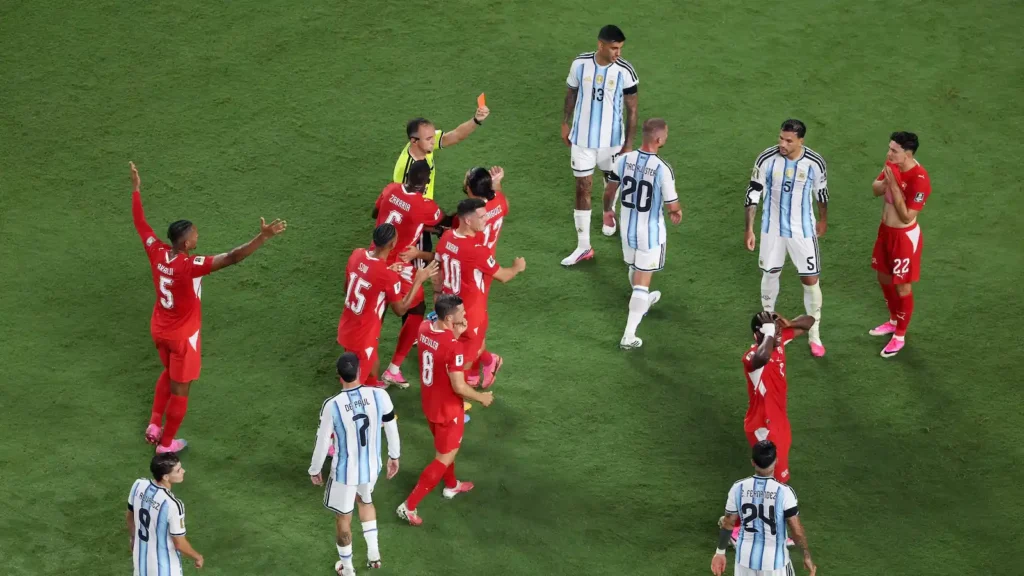
The dispute surrounding Breel Embolo’s controversial dismissal against Argentina has deepened after FIFA defended the intervention, despite IFAB saying the current VAR protocol did not permit officials to change the decision in that way.
According to a statement from a FIFA spokesperson reported by AS, FIFA does not consider the FIFA Embolo VAR decision to have been an error. The governing body argued that its interpretation of the mistaken identity protocol was applied consistently during the World Cup and that the intervention “restored justice.”
That defence places FIFA and football’s law-making body in an unusual position. Both appear to agree that Embolo’s actions could be regarded as simulation and that an Argentine player should not have been punished for an offence FIFA believes he did not commit. However, they disagree over whether VAR had the legal authority to correct the situation under the written protocol.
The controversy is therefore no longer only about whether Embolo dived. It is about who defines the limits of VAR, how tournament-specific interpretations should be introduced and whether achieving a fair outcome can justify using a review process that the published rules did not clearly authorise.
What did FIFA say about the Embolo VAR decision?
FIFA’s response was built around three main arguments.
First, FIFA said its mistaken identity interpretation was used consistently during the World Cup. The governing body referred to two incidents in which VAR corrected a yellow-card decision after determining that an opponent’s simulation had caused the wrong player to be punished. The other reported example involved Paraguay’s Miguel Almirón during the group stage.
Second, FIFA argued that simulation should not result in an innocent opponent receiving a disciplinary punishment that could produce additional consequences. Those consequences could include dismissal through a second yellow card or suspension through accumulated cautions.
Third, FIFA said it did not consider the referee or VAR to have made an error. Its position is that the video officials corrected a factual injustice rather than improperly reviewing an ordinary yellow-card offence. FIFA also said the interpretation had been discussed with IFAB and would form part of future talks about revising the VAR protocol.
The most important phrase in the response was FIFA’s claim that the intervention “restored justice.”
That wording reveals the central philosophy behind FIFA’s defence. Its argument focuses on the final football outcome: Paredes had not committed the offence, Embolo had simulated, and therefore allowing the original yellow card to stand would have punished the wrong team.
What happened during Argentina vs Switzerland?
The incident occurred in the second half of the World Cup quarter-final with Argentina and Switzerland level at 1-1.
Embolo went to ground following a challenge involving Argentina midfielder Leandro Paredes. Portuguese referee João Pinheiro initially awarded Switzerland a free kick and showed Paredes a yellow card. VAR then reviewed the incident through the mistaken identity protocol.
Following the intervention, the original foul was cancelled, Paredes’ yellow card was withdrawn and Embolo was cautioned for simulation. Because the Swiss forward had already been booked earlier in the match, the new caution became his second yellow card and he was sent off.
Switzerland had recently equalised through Dan Ndoye and were enjoying a strong period before the dismissal. Argentina eventually took advantage of the extra player and won 3-1 after extra time through goals from Julián Álvarez and Lautaro Martínez. Argentina coach Lionel Scaloni later acknowledged that the dismissal had helped his team.
The importance of the incident is therefore beyond dispute. It changed the numerical balance of a World Cup quarter-final and directly affected how Switzerland could approach the remainder of the match.
Why did IFAB say the intervention was wrong?
IFAB’s objection was based on the written limits of the VAR protocol.
In its clarification, football’s law-making body said VAR can intervene for mistaken identity when the referee has punished the wrong player for an offence. However, the review can identify who committed the penalised offence; it cannot normally replace the original offence with a completely different one.
IFAB explained that a yellow card which is not initially a second yellow can be reviewed to identify the player responsible for the offence that the referee punished. The offence itself cannot simply be reviewed and changed through the mistaken identity category.
That distinction is crucial.
The referee’s original decision was:
Paredes fouled Embolo.
VAR’s final conclusion was:
Paredes did not foul Embolo; Embolo simulated.
This was not a simple correction of the player’s identity. It changed the offending team, the identity of the offender and the nature of the offence.
IFAB therefore concluded that the review went beyond the current mistaken identity provision. The organisation said the expanded use of the rule had been positively received and would be considered during a detailed review, but it could not continue to be used in that way until the review was completed.
The central disagreement: correct outcome or correct protocol?
FIFA and IFAB are effectively answering two different questions.
FIFA is asking:
Did the final decision produce the fairest football outcome?
IFAB is asking:
Did VAR have authority under the current written protocol to reach that outcome?
FIFA’s answer is that an Argentine player should not receive a yellow card because an opponent simulated. From that perspective, correcting the decision protected fairness and prevented Paredes from potentially suffering consequences caused by an offence he did not commit.
IFAB’s answer is that VAR is not permitted to intervene merely because video footage may reveal a better decision. Every review must first fit within an authorised category. Under the current wording, mistaken identity does not provide unrestricted permission to replace one yellow-card offence with another.
This is the fundamental problem with FIFA’s defence.
A decision can appear fair in football terms while still being reached through an unauthorised process. VAR was deliberately designed with limited review categories because allowing video officials to correct every perceived mistake would transform the system into continuous re-refereeing.
Was this really mistaken identity?
Traditional mistaken identity is relatively straightforward.
Imagine that two defenders are standing close together and one commits a reckless tackle. The referee correctly identifies the tackle as an offence but accidentally cautions the defender next to the actual offender. VAR may correct the identity because the offence itself remains unchanged.
In the Embolo incident, that is not what happened.
The referee did not correctly penalise simulation but caution the wrong player. He penalised Paredes for a foul. VAR then decided there had been no foul and introduced simulation as a separate offence against the opposing player.
FIFA treated the situation as the referee having punished the wrong team for an incident caused by Embolo. That interpretation reflects the expanded wording introduced for 2026/27, under which mistaken identity can apply when the referee penalises the wrong team and consequently cautions or dismisses the wrong player.
However, IFAB’s published protocol still makes clear that only the offender’s identity may be reviewed within that category and that the actual offence cannot normally be reassessed unless it independently belongs to another reviewable category.
This is why IFAB concluded that FIFA stretched the new interpretation beyond its written boundary.
Does the second-yellow rule justify the review?
One possible defence is that Embolo’s caution became a second yellow card and therefore produced a dismissal.
The 2026 changes expanded VAR’s authority to correct a clearly incorrect second yellow card. The purpose is to prevent a player from being sent off because of an obviously wrong caution.
However, that does not fully support FIFA’s position.
Pinheiro did not initially show Embolo a second yellow card. He showed Paredes a first yellow card. VAR then introduced a new caution against Embolo, which became his second.
The second-yellow provision permits VAR to cancel a clearly incorrect second caution already issued by the referee. It does not automatically allow VAR to search for an unpunished yellow-card offence and create a dismissal.
That difference protects the original structure of VAR. Otherwise, video officials could examine every incident involving a player already on a yellow card and search for another cautionable offence.
The Embolo review was therefore justified by FIFA through mistaken identity, not through the separate second-yellow correction rule.
Did IFAB say Embolo had not simulated?
No.
IFAB did not necessarily decide that Embolo was fouled, nor did it rule that simulation was an impossible interpretation.
Its clarification focused on the review process.
A referee watching the incident live could have decided that Embolo simulated, shown him a yellow card and consequently dismissed him. In that situation, the decision would have been an on-field judgement.
The problem arose because the referee made the opposite decision and VAR needed a valid protocol category before it could replace that judgement.
FIFA’s statement strongly supports the simulation interpretation and describes it as a factual error caused by the attacker.
But even an obvious act of simulation is not automatically reviewable. Under the traditional VAR system, a yellow card for simulation can normally be reviewed only when connected to a goal, penalty, direct red card or another authorised incident.
This leads to the most important analytical conclusion: the accuracy of the simulation judgement and the legality of the VAR intervention are separate questions.
Can FIFA use its own VAR interpretation?
FIFA organises the World Cup and controls the competition’s refereeing operation, but IFAB is the body responsible for football’s Laws of the Game and the global VAR protocol. IFAB describes itself as the only organisation authorised to decide and approve changes to the Laws.
FIFA is not separate from IFAB’s decision-making structure. FIFA holds four of IFAB’s eight votes, while the English, Scottish, Welsh and Northern Irish associations each hold one. A three-quarters majority is required for a Law change.
This makes the public disagreement particularly unusual.
FIFA says it remained in contact with IFAB and that the interpretation was considered valid and positively received. IFAB says the same approach cannot be used again until the protocol review has been completed.
The two positions may be less contradictory about the future than they first appear. Both organisations seem open to allowing VAR to correct this type of simulation incident in a later version of the protocol.
The conflict concerns the present: whether that expanded interpretation was already legally available during the World Cup.
Why FIFA believes the decision restored justice
FIFA’s concern is understandable.
Had the original decision remained, Paredes would have received a yellow card for a foul FIFA believes did not occur. That caution could have affected his participation through accumulation or influenced how he played the remainder of the match.
Meanwhile, Embolo would have avoided punishment for simulation.
From a sporting-justice perspective, that outcome appears difficult to defend. Technology had shown officials what FIFA regarded as a clear deception, yet the protocol seemingly prevented them from correcting it.
This exposes a genuine weakness in the VAR framework.
Supporters regularly criticise VAR when officials see an obvious mistake but cannot act because the incident falls outside a reviewable category. FIFA’s expanded interpretation attempted to solve that problem by treating the player who caused the incorrect caution as the true offender.
The difficulty is that changing the protocol through interpretation creates uncertainty. Teams, referees and supporters must know before a tournament which incidents are reviewable. A World Cup knockout match should not become the testing ground for an interpretation whose exact limits remain disputed after the competition.
Why IFAB’s position is stronger under the written protocol
FIFA’s argument may be persuasive as a proposal for the future, but IFAB’s position appears stronger when the current written protocol is applied strictly.
The protocol states that mistaken identity allows VAR to identify the correct offender for the offence penalised by the referee. It also states that the underlying offence cannot simply be reviewed unless it belongs to another authorised category.
In Argentina vs Switzerland, the underlying offence was completely changed.
The original foul by Paredes disappeared. A new simulation offence against Embolo was introduced. The direction of the free kick changed, the punished team changed, and a player was dismissed.
That resembles a full re-refereeing of the incident more than a narrow identity correction.
FIFA’s statement explains why officials wanted to change the decision. It does not completely answer IFAB’s central legal objection: where did the existing protocol explicitly authorise them to change the offence itself?
What happens next?
IFAB has said that this use of mistaken identity will be included in the detailed review of the VAR protocol. FIFA’s response also indicated that the incident will form part of future discussions.
A future amendment could create a specific review category for clear simulation that causes an opponent to be wrongly cautioned or sent off.
Such a rule would need strict limits. VAR should not review every possible dive around the field. A sensible version could apply only when:
- Simulation directly causes an opponent to receive a card
- The evidence is clear and indisputable
- The incorrect card could produce dismissal or suspension
- The review can be completed without searching for minor contact
That would protect innocent players while preventing VAR from becoming involved in every disputed fall.
Until such wording is formally approved, officials need one consistent interpretation. FIFA competitions, UEFA competitions and domestic leagues cannot operate with different understandings of the same VAR category.
Could Switzerland demand a replay?
The disagreement does not automatically invalidate Argentina’s victory.
Refereeing and VAR errors do not normally result in matches being replayed, even when a governing body later accepts that the protocol was applied incorrectly. The result remains official unless competition rules identify an exceptional administrative or eligibility violation.
The more realistic consequences are clarification, changes to future referee instructions and possible revision of the VAR protocol.
For Switzerland, that will offer little comfort. The team was level, had momentum and was preparing an attacking change before losing Embolo and eventually conceding twice in extra time.
The VAR Verdict
FIFA is defending the football logic behind the intervention. IFAB is defending the written limits of the review system.
FIFA has a reasonable argument that Paredes should not have been punished because of Embolo’s simulation. Allowing an innocent player to retain a caution when video evidence proves the decision wrong does not feel like justice.
However, VAR cannot intervene only because officials believe a different decision would be fairer. It must operate within the categories approved before the competition.
The FIFA Embolo VAR decision replaced one offence with another rather than simply correcting the identity of the player responsible for the same offence. Under the current published wording, IFAB’s interpretation is more convincing.
Football decision: Embolo may have deserved a caution for simulation.
VAR protocol decision: The review did not fit cleanly within mistaken identity.
FIFA’s position: The intervention corrected a factual injustice and was consistently applied.
IFAB’s position: The offence itself could not be changed through that review category.
Final verdict: FIFA’s desired outcome may have been fair, but IFAB is right that the current protocol did not clearly authorise the process used to reach it.
The solution is not to ignore obvious simulation. It is to amend the VAR protocol openly, precisely and before the next major competition.

0 Comments
Join the conversation with respect. Comments are moderated and must follow our community rules.
Want to join the discussion?
Please log in or create an account to comment and reply. This keeps the conversation cleaner and safer.