
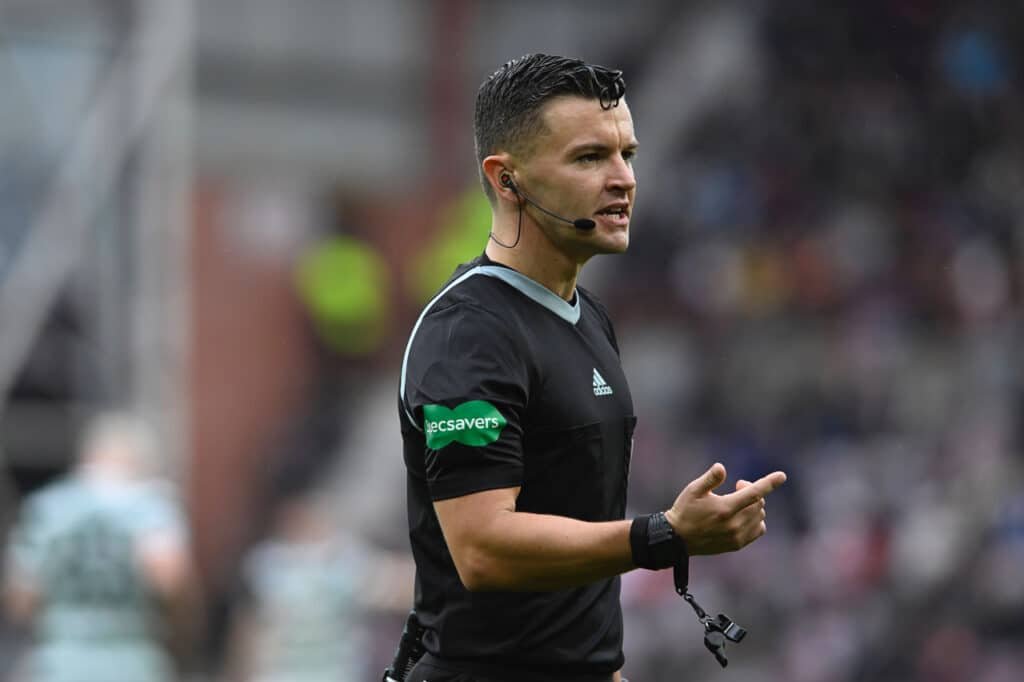
The Nick Walsh Champions League appointment has attracted extra attention after UEFA selected the Scottish referee for Mjällby’s qualifying match against Slovan Bratislava only days after his controversial evening involving Rangers and Derek McInnes.
UEFA’s official match information confirms that Walsh will referee the first leg of the Champions League third qualifying-round tie between Swedish champions Mjällby and Slovakian side Slovan Bratislava on Tuesday, August 4. The fixture is scheduled for 18:00 CET.
The assignment arrives shortly after Walsh rejected Rangers’ late penalty appeal during their 1–1 Scottish Premiership draw with Dundee United. Rangers manager Derek McInnes approached the referee on the pitch after the final whistle before later admitting that he should have waited and discussed the incident privately.
The timing creates an interesting refereeing story, but the appointment should not be interpreted as UEFA publicly ruling on the Rangers decision. There is no evidence that Walsh was selected because of the controversy or that the European assignment represents an official defence of his performance.
It does, however, show that the Scottish official remains trusted with an important European fixture while discussion around the Tannadice incident continues.
Nick Walsh Champions League appointment confirmed
UEFA has listed Walsh as the referee for Mjällby against Slovan Bratislava at Strandvallen.
He will be supported by an entirely Scottish officiating team:
Referee: Nicholas Walsh
Assistant referee 1: Francis Connor
Assistant referee 2: Daniel McFarlane
Fourth official: Donald Robertson
VAR: Andrew Dallas
Assistant VAR: Duncan Nicolson
The presence of VAR is particularly notable after Walsh’s latest domestic controversy involved a rejected penalty appeal that was checked but did not result in an on-field review.
Andrew Dallas will lead the video team for the Champions League qualifier. His role will be to review potential goals, penalties, direct red cards and mistaken-identity incidents under the UEFA VAR protocol.
Walsh will remain the final decision-maker. Dallas can recommend a review when he identifies a possible clear and obvious error, but the referee is responsible for deciding whether to change a subjective on-field decision.
An important Champions League qualifying match
Mjällby and Slovan Bratislava are competing in the champions path of the third qualifying round.
The first leg is part of the August 4 and 5 Champions League schedule, with the return matches due to be played on August 11. The winner will move closer to a place in the league phase, while the defeated side’s European route will depend on the qualifying structure and subsequent competition entry rules.
This is therefore not a ceremonial appointment.
Champions League qualifying matches can carry major sporting and financial consequences. A penalty, red card or disputed goal can affect not only one match but an entire club’s European season.
Walsh and his team will need to manage a competitive fixture involving two domestic champions, while dealing with the additional scrutiny generated by the Rangers incident.
What happened during Dundee United vs Rangers?
Walsh refereed Rangers’ opening Scottish Premiership match against Dundee United at Tannadice on July 31.
The match finished 1–1 after Dundee United took the lead before Rangers equalised in the second half. The most controversial moment arrived late in the game when Mohamed Diomande went down inside the penalty area following a challenge involving Emmanuel Agyei.
Rangers appealed for a penalty, but Walsh awarded a goal kick.
The incident was checked by the video officials, but Walsh was not sent to the pitch-side monitor and his original decision remained unchanged. Reports from the match noted that the referee completed the game without conducting an on-field review.
The decision immediately frustrated Rangers’ players and coaching staff.
McInnes approached Walsh after the final whistle and argued his case on the field. The Rangers manager later acknowledged that this was not the correct way to handle the situation and said he subsequently spoke to the referee inside the officials’ room.
Was Rangers’ penalty appeal clearly rejected correctly?
The incident remains debatable rather than an established refereeing error.
The central question was whether Agyei committed a careless challenge on Diomande or legally contested the ball before the two players came together.
For VAR to intervene, the video team needed clear evidence that Walsh’s no-penalty decision was wrong. It was not enough for the video referee to believe that a penalty might also have been supportable.
This distinction is important.
A referee may view contact as a normal consequence of a fair challenge. Another official may believe the same contact was careless and deserving of a penalty. When both interpretations remain reasonably possible, the clear-and-obvious threshold normally protects the original decision.
The absence of a monitor review indicates that the video officials did not believe the available footage clearly established a missed offence.
That does not necessarily mean they believed the decision was perfect. It means they did not identify sufficient evidence to justify overturning it.
What does the UEFA appointment tell us?
The appointment confirms that Walsh remains part of UEFA’s active refereeing plans.
UEFA would not normally remove an official from a scheduled European fixture merely because a domestic penalty decision generated criticism. Match officials make numerous subjective decisions, and controversy alone does not establish that a referee performed incorrectly.
It is also important not to treat the assignment as proof that UEFA approved every decision Walsh made at Tannadice.
European appointments are normally based on wider assessments, including previous performances, fitness, experience, competition requirements and the availability of officials.
The Mjällby assignment should therefore be viewed as a normal professional appointment that has become more newsworthy because of its timing.
There is no public indication that UEFA reviewed the Rangers incident before confirming Walsh for this match, nor that the Champions League appointment was issued as a response to McInnes’s complaints.
Why the timing matters
Referees regularly move from controversial domestic fixtures into European competition.
The challenge is psychological as well as technical.
Walsh must begin the Champions League match without allowing the attention surrounding the Rangers incident to affect his decision-making. He cannot become more likely to award a penalty simply because his previous no-penalty call was questioned.
He also cannot become overly cautious when dealing with player protests or penalty-area contact.
The best response to controversy is not to referee differently. It is to apply the same threshold consistently.
That means:
- Allowing fair physical challenges
- Punishing careless contact
- Managing dissent early
- Communicating clearly with captains
- Working efficiently with VAR
- Avoiding unnecessary delays
- Retaining authority without becoming confrontational
A strong performance would move the discussion away from the post-match confrontation and back toward Walsh’s refereeing.
Andrew Dallas takes the VAR role
The appointment of Andrew Dallas as VAR will also attract interest in Scotland.
Dallas will be responsible for checking all major match-changing incidents and communicating with Walsh from the video operations room. Duncan Nicolson has been appointed as assistant VAR.
Their cooperation will be especially important during penalty-area incidents.
After the Rangers controversy, attention will naturally focus on whether Walsh receives a monitor recommendation in Sweden. However, supporters should not expect every penalty appeal to produce a visible review.
Most incidents are checked silently.
A pitch-side review should be recommended only when the VAR believes the referee may have made a clear and obvious error in a subjective decision.
The quality of the VAR process should therefore be measured by whether the correct incidents are reviewed, not simply by the number of times Walsh visits the monitor.
Could the Rangers controversy affect Walsh?
Referees are expected to treat each fixture independently, but modern officials are fully aware of the public debate surrounding their decisions.
Social media, television coverage and comments from managers can create significant external pressure. A referee may be criticised for intervening too frequently in one match and then accused of ignoring an obvious offence in the next.
That is why consistent thresholds are essential.
Walsh should not attempt to compensate for the Rangers decision. Any penalty or red-card incident involving Mjällby and Slovan Bratislava must be judged entirely on its own evidence.
The referee’s task is not to avoid criticism. It is to make the strongest decision available under the Laws and use VAR only when the intervention threshold is satisfied.
McInnes’s confrontation remains part of the story
McInnes’s reaction gave the Rangers incident far greater visibility.
Had the manager expressed his disagreement only during a private post-match conversation, the penalty appeal may have remained one of several disputed decisions from the opening Premiership weekend.
Instead, the on-field confrontation became a major part of the coverage.
McInnes later admitted that approaching Walsh publicly was a mistake. That acknowledgement was important because referees must be protected from aggressive post-match confrontations, even when managers have a legitimate reason to seek an explanation.
Managers should be allowed to ask what the referee saw and why VAR did not intervene. However, those conversations are more productive after both sides have had time to calm down.
The wider issue is transparency.
Supporters rarely hear a full explanation after these private discussions. That creates a vacuum in which assumptions about referees and VAR quickly become accepted as fact.
A short official explanation confirming why the no-penalty decision remained would have helped separate technical analysis from emotional reaction.
A test for Scottish refereeing
The appointment also provides another opportunity for Scottish officials to demonstrate their quality in UEFA competition.
Walsh is joined by five other Scottish match officials, meaning the performance will reflect on the entire team rather than the referee alone.
Assistant referees Connor and McFarlane will have important responsibilities involving offside decisions, fouls near their touchlines and communication during penalty-area incidents.
Robertson will manage the technical areas as fourth official, while Dallas and Nicolson will operate VAR.
Modern refereeing performances are collective.
A referee may make the final decision, but the accuracy and efficiency of the process depend on communication across the complete team.
What Walsh must manage in Mjällby vs Slovan Bratislava
European qualifying matches often produce different challenges from domestic league fixtures.
The teams may use contrasting styles, the atmosphere can be intense and players know that one major incident could shape the entire two-legged tie.
Walsh will need to establish his disciplinary threshold early without interrupting the match unnecessarily.
Particular areas to watch include:
Penalty-area contact
After the Rangers incident, every penalty appeal will receive additional attention. Walsh must judge the action rather than the reaction of players.
Tactical fouls
Transitions can produce holding or trips designed to stop promising attacks. Early consistency will help prevent frustration.
Dissent and surrounding the referee
Players may place pressure on the official after major decisions. Clear captain communication will be important.
VAR review speed
UEFA has recently emphasised that video officials should avoid microscopic reviews and intervene only for clear errors. Walsh and Dallas must keep checks efficient while ensuring that serious incidents are not missed.
Managing the two-legged context
Players may become increasingly cautious or confrontational depending on the score. The referee must avoid allowing the importance of the tie to change the Law 12 threshold.
The appointment is not a punishment or reward
Referee assignments are sometimes interpreted too emotionally.
When an official receives a major match after a controversial decision, supporters may see it as a reward or an attempt to protect the referee. When the official is absent from the next round, others may assume a secret suspension.
Those conclusions are rarely justified without official confirmation.
The Nick Walsh Champions League appointment should not be presented as UEFA clearing him of wrongdoing. It should also not be treated as evidence that criticism of the Rangers decision was irrelevant.
It is simply a confirmed European assignment taking place shortly after a highly publicised domestic controversy.
The most meaningful judgement will come from his performance during the match.
The VAR Verdict
Nick Walsh enters his latest Champions League assignment under greater scrutiny than usual.
The Scottish referee’s decision to reject Rangers’ penalty appeal against Dundee United was controversial, while Derek McInnes’s post-match confrontation ensured that the incident remained in the headlines.
However, controversy does not automatically equal error.
The video officials did not identify clear evidence requiring an on-field review, and no official body has publicly declared Walsh’s decision incorrect.
His appointment to Mjällby against Slovan Bratislava confirms that he remains active at UEFA level, but it should not be misrepresented as a formal judgement on the Rangers incident.
Our verdict: The assignment is a normal but important European appointment made more significant by its timing. Walsh must now deliver a calm, consistent performance and avoid allowing the Rangers debate to influence his penalty or disciplinary threshold.
The strongest answer to controversy is not another statement. It is an accurate and well-managed match.

0 Comments
Join the conversation with respect. Comments are moderated and must follow our community rules.
Want to join the discussion?
Please log in or create an account to comment and reply. This keeps the conversation cleaner and safer.