
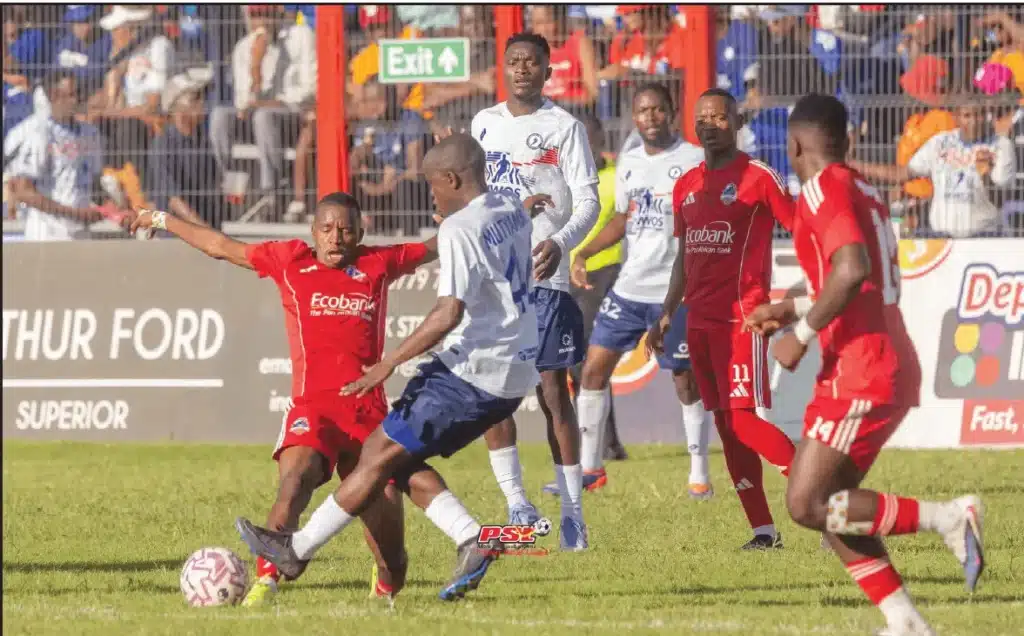
Calls for VAR in Zimbabwean football have intensified after a controversial missed penalty placed domestic refereeing standards under renewed scrutiny.
Why VAR in Zimbabwean Football Is Back Under Debate
The latest debate followed a disputed incident during the match between Scottland and MWOS, where many observers believed MWOS should have been awarded a penalty. Instead, play continued, and the decision quickly became the central talking point after the final whistle.
The moment has reignited an important question for Zimbabwean football. How long can a top domestic league continue without video assistance when major decisions are increasingly shaped by limited angles, human error and post-match controversy?
The incident that reignited the debate
The key moment came when an MWOS attacker went down inside the penalty area following a challenge involving goalkeeper Nelson Chadya.
Initial reactions were mixed, especially because one television angle did not appear fully conclusive. However, further discussion intensified after another angle reportedly suggested that the goalkeeper made contact with the attacker rather than cleanly winning the ball.
That changed the tone of the debate.
What first looked like a difficult real-time decision quickly became a wider conversation about whether the referee had missed a clear penalty and whether VAR would have corrected the error if it had been available.
This is exactly the type of incident that fuels public frustration in competitions without video review. A major decision shapes the narrative of the match, supporters examine replays from different angles, and the final conclusion becomes more about what technology could have done than what the referee was able to judge in real time.
Why this incident matters
Penalty decisions are among the most important calls in football.
A penalty can change the result, alter momentum and directly affect league standings, title races or relegation battles. That is why modern officiating increasingly faces pressure to combine referee authority with technological support.
In this case, the controversy is not only about whether the referee made a mistake. It is about the system around the referee.
When officials work without VAR, they must make an instant judgement based only on their angle, positioning and the support of the assistant referees. If the view is blocked or the contact is difficult to read at full speed, an error can happen. That does not automatically make the referee poor. It simply shows the limits of human officiating in a fast and complex sport.
The problem is that football audiences no longer consume matches in the same way referees do. Viewers at home can slow incidents down, freeze frames and compare multiple angles. Once that happens, any major error becomes more damaging to trust.
Was it really a missed penalty?
From the available discussion, this appears to be a credible penalty claim.
The most important questions in any such situation are simple:
- Did the goalkeeper make contact with the ball first?
- Did he make contact with the attacker first?
- Was the challenge careless?
- Did the attacker go down because of the challenge or through normal momentum?
- Did the referee have a clear angle to judge the incident?
If the goalkeeper made contact with the attacker before legally winning the ball, then a penalty would normally be the correct decision.
If the ball was played cleanly and any later contact was a natural consequence of a fair challenge, then the referee could justify allowing play to continue.
That is why this incident matters so much. It does not appear to be a completely invented appeal or a soft claim with no basis. It seems to be the kind of penalty decision that deserves close analysis and could easily have been corrected by VAR if the replays clearly showed an offence.
Why the pressure for VAR is growing
Calls for VAR in Zimbabwe are not new, but incidents like this increase the pressure.
Supporters accept that referees can make mistakes. What they increasingly struggle to accept is that major mistakes remain uncorrected when video evidence appears to exist.
VAR was introduced to deal with exactly these match-changing moments:
- penalty decisions
- direct red cards
- mistaken identity
- goals and attacking offences
A possible foul by a goalkeeper inside the area is one of the clearest examples of a reviewable incident under modern VAR logic.
That does not mean VAR would solve every problem. It would not. VAR itself creates debate, especially when reviews are lengthy or subjective. But the presence of VAR would at least give officials a second opportunity to assess a decisive moment with better visual evidence.
Without it, the match is left to one live decision, and the debate continues long after the final whistle.
The bigger issue is infrastructure
The debate also highlights a more difficult reality. Calling for VAR is easy. Implementing it is expensive.
For many leagues, especially outside Europe’s wealthiest competitions, the challenge is not a lack of desire. It is a lack of infrastructure.
A functional VAR system requires:
- multiple high-quality camera angles
- trained video officials
- replay technology
- communication equipment
- operational staff
- testing and certification
- financial investment across multiple stadiums
That is why some leagues remain stuck between two unsatisfying realities.
On one hand, the sport is judged by modern global standards, where fans expect major decisions to be reviewed. On the other hand, the financial and technical requirements for VAR remain difficult to meet.
Zimbabwean football therefore faces a strategic choice.
It can continue with the current model and accept repeated controversy, or it can begin building toward video support step by step.
Could a lighter version of VAR help?
Full VAR may be difficult to introduce immediately, but this does not mean there are no alternatives.
Football authorities could consider a phased approach such as:
- using enhanced broadcast coverage in major matches
- improving referee communication systems
- investing in better camera placement
- developing a limited review model for selected fixtures
- training more specialist video officials for future rollout
Even if full VAR cannot be introduced tomorrow, the league can still show that it is moving in that direction.
Supporters are often more patient when they believe there is a genuine long-term plan. What frustrates them most is the feeling that the same controversies repeat every season without structural improvement.
Referees also need protection
It is also important to make one point clearly. Incidents like this should not turn into abuse of referees.
Criticism of a decision is fair. Personal attacks are not.
Referees in leagues without VAR carry an even greater burden because they know every controversial call will later be judged by replay, even though they themselves did not have the benefit of replay in the moment.
That is why better officiating support is not only about helping clubs and supporters. It also helps referees.
VAR, when used correctly, protects referees from being permanently defined by one missed angle or one difficult live judgement. It does not remove responsibility, but it creates a stronger and fairer decision-making process.
Why Zimbabwean football cannot ignore this debate
This latest missed penalty is not only a refereeing story. It is a credibility story.
When supporters, players and coaches repeatedly lose trust in major decisions, the credibility of the competition suffers. That damages not only referees but the league itself.
Modern football is increasingly built on professionalism, transparency and competitive integrity. If the domestic game wants to continue growing, it must show that it takes those principles seriously.
A disputed penalty may seem like a single moment. In reality, moments like this shape how people view the fairness of the entire competition.
The VAR Verdict
The controversy from Scottland vs MWOS has once again exposed the growing gap between the demands of modern football and the limitations of officiating without video support.
The referee had to make an immediate live decision. That should be acknowledged. But if replay footage genuinely shows that the goalkeeper made illegal contact with the attacker, then the penalty was missed and the frustration is understandable.
This is why the debate matters.
The issue is no longer only whether one penalty was wrongly denied. The bigger question is whether Zimbabwean football can continue asking referees to carry the full burden of match-changing decisions without technological assistance.
Our verdict: the incident has created a legitimate fresh argument for VAR in Zimbabwe. Even if full implementation cannot happen immediately, the league and football authorities should now begin presenting a clear plan for how officiating support will improve in the coming years.
One controversial penalty should not define a season. But repeated controversies without progress will eventually define a league.

0 Comments
Join the conversation with respect. Comments are moderated and must follow our community rules.
Want to join the discussion?
Please log in or create an account to comment and reply. This keeps the conversation cleaner and safer.