
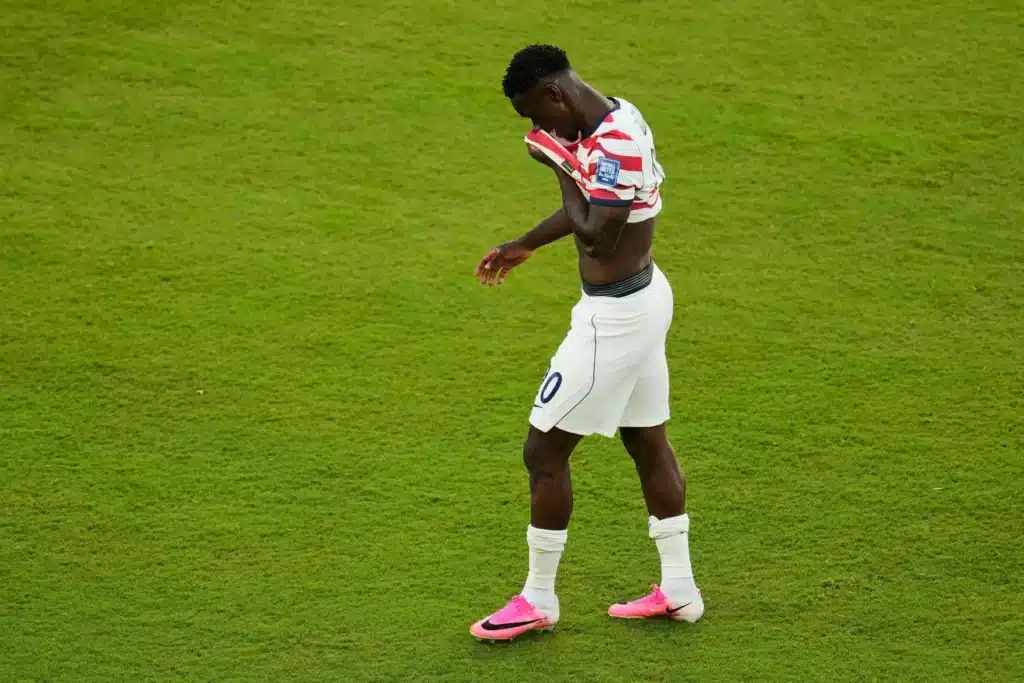
FIFA has been told to rebuild public trust after former vice-president Jim Boyce condemned the organisation’s handling of the Balogun red card controversy and warned that the current use of VAR is becoming increasingly difficult for supporters to understand.
Boyce’s criticism formed part of a wider interview about FIFA’s governance, ticket prices and the organisation’s abandoned proposal to sell a minority stake in a new commercial entity controlling competitions including the World Cup. However, the former FIFA official also directly addressed Folarin Balogun’s disciplinary case and the broader direction of video refereeing.
Boyce described FIFA’s decision to suspend Balogun’s automatic one-match ban as a “terrible decision” and argued that it should never have happened. He also said the wider VAR situation was becoming “absolutely crazy,” calling for video intervention to be restricted to unmistakable refereeing errors.
The comments reopen one of the most controversial episodes of the 2026 World Cup: a red card issued after an on-field review, an extraordinary disciplinary ruling, a phone call involving the United States president and a decision that UEFA said had crossed a red line.
What did Jim Boyce say about FIFA and VAR?
Boyce, who previously served as a FIFA vice-president, said the governing body now faces considerable “repair work” if it wants to restore credibility among supporters and national associations.
His central argument was that FIFA must return its focus to promoting football for ordinary supporters rather than damaging confidence through controversial commercial, disciplinary and refereeing decisions. He specifically identified the Balogun case and the current application of VAR as examples of issues that require examination.
Boyce believes VAR should be used only when the referee has made an unmistakable error. His wording is not identical to the official IFAB protocol, which permits intervention for a “clear and obvious error” or a “serious missed incident,” but the underlying philosophy is similar: VAR should correct major mistakes rather than replace every subjective judgement made on the field.
His criticism is significant because the Balogun controversy involved two separate processes.
The first was the referee and VAR team’s decision to issue the red card during the match.
The second was FIFA’s later disciplinary decision to suspend the automatic punishment that normally followed that dismissal.
Those two decisions must be analysed separately.
What happened in the Balogun red card controversy?
Balogun was dismissed during the United States’ 2–0 World Cup round-of-32 victory over Bosnia and Herzegovina on July 1.
Brazilian referee Raphael Claus initially did not show a red card after Balogun stepped on the ankle of Bosnia defender Tarik Muharemović. Following VAR intervention and an on-field review, Claus upgraded the punishment and dismissed the United States forward.
The red card triggered an automatic one-match suspension, which meant Balogun was expected to miss the United States’ round-of-16 match against Belgium.
Balogun later said he believed a yellow card would have been a fairer punishment, although he accepted that the challenge was an offence.
The controversy escalated when U.S. President Donald Trump contacted FIFA president Gianni Infantino and asked for the red-card decision to be reviewed. Trump publicly described the dismissal as a poor decision but said he had requested a review rather than demanded a particular outcome.
FIFA then announced that Balogun’s automatic one-match suspension would not be enforced immediately, making him available to face Belgium.
Did FIFA overturn Balogun’s red card?
It is important to describe FIFA’s decision precisely.
FIFA did not formally erase the red card from the match record or declare that referee Raphael Claus had made an incorrect decision.
The FIFA Disciplinary Committee found Balogun guilty of the relevant disciplinary infringements. It imposed a one-match suspension and a fine of $40,000, but used Article 27 of the FIFA Disciplinary Code to suspend the implementation of the match ban for a probationary period of one year.
That meant the punishment remained dormant. It could be activated if Balogun committed another infringement of a similar nature and seriousness during the probationary period.
Therefore, common descriptions such as “FIFA overturned the red card” simplify what happened.
A more technically accurate explanation is:
- The red card remained part of the match.
- FIFA found Balogun guilty.
- A one-match suspension was imposed.
- Enforcement of that suspension was suspended for one year.
- Balogun was consequently permitted to play against Belgium.
This distinction does not remove the controversy. In some ways, it makes the situation more difficult to explain because FIFA accepted the offence but applied an exceptional mechanism that prevented the automatic sporting consequence from being served during the tournament.
Why was FIFA’s decision so controversial?
Red cards normally produce an automatic suspension for the player’s next match. That principle creates certainty for teams, players and tournament officials.
The controversy arose because FIFA used its disciplinary discretion to postpone that consequence during an active World Cup knockout stage.
Balogun was one of the United States’ most important attacking players, and the ruling made him available only shortly before the match against Belgium. The decision appeared to be the first time since 1962 that a World Cup red-card punishment had been suspended during the tournament.
The timing also created serious concerns about independence.
Trump had contacted Infantino and requested a review. FIFA then issued a ruling favourable to the host nation’s player. FIFA maintained that its disciplinary committee operated independently, while Trump said he did not demand a specific result. Nevertheless, the sequence created a powerful perception that political access may have influenced a football disciplinary process.
There is no publicly established evidence that Infantino personally ordered the committee to suspend Balogun’s punishment. But protecting integrity requires more than proving that no improper instruction was given. FIFA must also operate in a way that prevents reasonable doubts about political influence.
That was the central damage caused by the case.
UEFA said FIFA crossed a red line
UEFA reacted unusually strongly to the decision.
European football’s governing body described FIFA’s ruling as unprecedented and unjustifiable and said that suspending the automatic ban had crossed a red line. UEFA warned that a competition’s credibility is threatened when the certainty of its rules is no longer guaranteed.
The Belgian Football Association also contested Balogun’s eligibility. Belgium argued that FIFA’s disciplinary rules provided for an automatic suspension following a dismissal.
FIFA’s Appeal Committee rejected Belgium’s challenge as inadmissible, concluding that the Belgian association did not have the necessary standing to contest the decision. Balogun subsequently started the match, although Belgium defeated the United States 4–1.
The result did not resolve the wider issue.
Whether Balogun changed the outcome is irrelevant to the integrity question. Competition rules must be predictable regardless of whether a controversial decision ultimately helps the team involved.
Was the original red card a VAR mistake?
The original dismissal remains open to refereeing debate.
VAR was authorised to intervene because the incident involved a possible direct red card for serious foul play. Under the IFAB protocol, a direct-red-card decision can be reviewed when the video official identifies a possible clear and obvious error or serious missed incident.
The protocol also provides specific guidance on replay speed.
Slow motion can help officials establish the exact point of contact, but normal-speed footage should normally be used to judge the intensity and nature of a challenge. This matters because slow motion can make an accidental or mistimed contact appear more severe than it looked in real time.
Claus viewed the incident at the pitch-side monitor and decided that Balogun’s challenge met the threshold for a red card. As the on-field referee, he retained responsibility for the final decision. The VAR could recommend a review, but only Claus could change the original punishment.
Without complete access to the referee communication and every replay shown during the review, it is difficult to declare the dismissal an undeniable mistake.
The central considerations would have included:
- The location of Balogun’s contact
- Whether his studs made contact with the ankle
- The level of force
- The speed and direction of the challenge
- Whether the opponent’s safety was endangered
- How the incident appeared at normal speed
Reasonable referees may differ over whether the challenge deserved yellow or red. That makes the incident a legitimate subject for technical debate.
However, disagreement with the original red card does not automatically justify suspending the resulting punishment through a separate disciplinary process.
The real problem was not only VAR
Boyce connected the controversy with the wider debate over VAR, but the most damaging part of the Balogun case occurred after the video review had ended.
VAR produced a refereeing decision during the match. The referee reviewed the footage and showed a red card.
FIFA’s Disciplinary Committee later decided how the resulting suspension would be enforced.
Those are different systems:
VAR process: Determines whether the on-field match decision should change.
Disciplinary process: Determines the punishment that follows the match decision.
Even when the VAR decision is considered questionable, football normally protects the finality of a referee’s judgement. Disciplinary bodies can review certain sanctions, but doing so during a World Cup knockout stage requires transparent and consistently applied criteria.
The public was left asking several important questions:
- Why was Article 27 applied in this particular case?
- Which previous World Cup cases established the same precedent?
- Did the committee believe the red card was technically wrong?
- Why was Balogun found guilty if the automatic punishment was considered inappropriate?
- What role, if any, did communication between Trump and Infantino play?
- Would the same mechanism have been available to a less influential football nation?
FIFA’s explanation confirmed the legal mechanism but did not completely eliminate those concerns.
Article 27 is now under intense scrutiny
Article 27 gives a FIFA judicial body power to suspend all or part of a disciplinary measure under certain circumstances.
FIFA relied on that authority to place Balogun’s one-match ban under a one-year probationary period. The legal power therefore existed within FIFA’s disciplinary framework.
The more difficult question is not whether FIFA possessed the power. It is how that power was selected and applied.
Rules that provide broad discretion require strong explanations. Otherwise, similar cases may produce very different outcomes depending on the player, association or political attention involved.
FIFA needs to explain what conditions must be satisfied before an automatic World Cup suspension can be placed on probation.
Without a clear standard, Article 27 risks being viewed as an emergency escape route rather than a consistently applied disciplinary provision.
Political pressure and referee independence
The case also exposed the pressure placed on match officials when political leaders publicly criticise decisions.
Raphael Claus made the red-card decision after viewing the replay himself. Public criticism questioning the legitimacy or professionalism of a referee can create consequences far beyond one match.
The Brazilian Football Confederation defended Claus after Trump criticised the dismissal and raised doubts about the decision.
Referee decisions should be open to technical analysis. Officials are not above criticism, and major tournament incidents should be explained transparently.
However, there is a difference between analysing whether a challenge met the serious-foul-play threshold and using political access to seek a change in the sporting consequences.
FIFA must protect its referees from the perception that an influential national leader can reach the organisation’s president and trigger an exceptional disciplinary outcome.
Even where the committee acts independently, that perception can undermine every future decision.
Why trust matters more than whether Balogun played
Belgium defeated the United States convincingly, meaning Balogun’s eligibility did not ultimately carry the Americans into the quarter-finals.
But football integrity cannot depend on the final score.
Had the United States won with Balogun scoring the decisive goal, the controversy would have become even more explosive. Belgium and other teams would have questioned whether the knockout stage had been influenced by inconsistent application of FIFA’s rules.
A competition requires participants to believe that:
- The same disciplinary rules apply to every team.
- Political figures cannot influence sporting rulings.
- VAR decisions are judged under a consistent threshold.
- Exceptional disciplinary powers are used according to published principles.
- Appeals are handled fairly and transparently.
Once those assumptions disappear, every close decision becomes vulnerable to claims of favouritism.
What FIFA must do to rebuild trust
Boyce’s warning is important because FIFA cannot restore credibility through statements alone.
The governing body should publish a full and accessible explanation of the criteria used in the Balogun ruling. It should clarify when Article 27 may be applied to an automatic match suspension during a tournament and provide comparable previous cases.
FIFA should also explain the separation between its president and its judicial bodies. When an outside political figure contacts the president about a disciplinary case, a transparent record of how that communication was handled would help protect the independence of the process.
VAR transparency is equally important.
Publishing referee audio or detailed technical explanations for major reviews would allow supporters to understand why an intervention was recommended and what the referee considered at the monitor.
The objective should not be to expose referees to additional abuse. It should be to show that the protocol was followed consistently.
Balogun red card controversy: what should happen next?
The Balogun case should lead to a formal review of both FIFA’s disciplinary procedures and its communication with political officials.
That review should not be designed to punish Balogun. The player did not control the process and was entitled to play once FIFA declared him eligible.
The questions concern FIFA’s decision-making:
- Was the automatic suspension treated consistently with previous cases?
- What exceptional circumstances justified probation?
- Was the disciplinary committee given complete independence?
- Were communications involving Infantino disclosed to the committee?
- Should automatic World Cup bans be eligible for suspension during the tournament?
- How can future political intervention be prevented?
Clear answers would be more valuable than another general defence of FIFA’s authority.
The VAR Verdict
Jim Boyce is right that FIFA has significant work to do to restore trust.
The Balogun red card controversy cannot be reduced to a simple argument over whether Raphael Claus should have shown yellow or red. The original challenge was subjective and can be debated under the serious-foul-play criteria.
The larger problem was FIFA’s response.
Balogun was found guilty, given a one-match suspension and fined, yet the ban was placed on probation after the president of the host country contacted FIFA’s president. Even when Article 27 legally permitted that outcome, the timing and lack of a clearly understood precedent damaged confidence in the process.
Our verdict: The original red card was debatable, but FIFA’s suspension of the automatic ban created a much greater integrity problem. Football cannot allow access, influence or political pressure to appear more powerful than consistent competition rules.
VAR should correct clear refereeing mistakes. Disciplinary committees should apply transparent standards. FIFA’s leadership must protect both processes from political influence.
Rebuilding trust will require more than defending the decision. FIFA must show exactly how it was reached and demonstrate that the same rules would apply to every country at every World Cup.

0 Comments
Join the conversation with respect. Comments are moderated and must follow our community rules.
Want to join the discussion?
Please log in or create an account to comment and reply. This keeps the conversation cleaner and safer.