
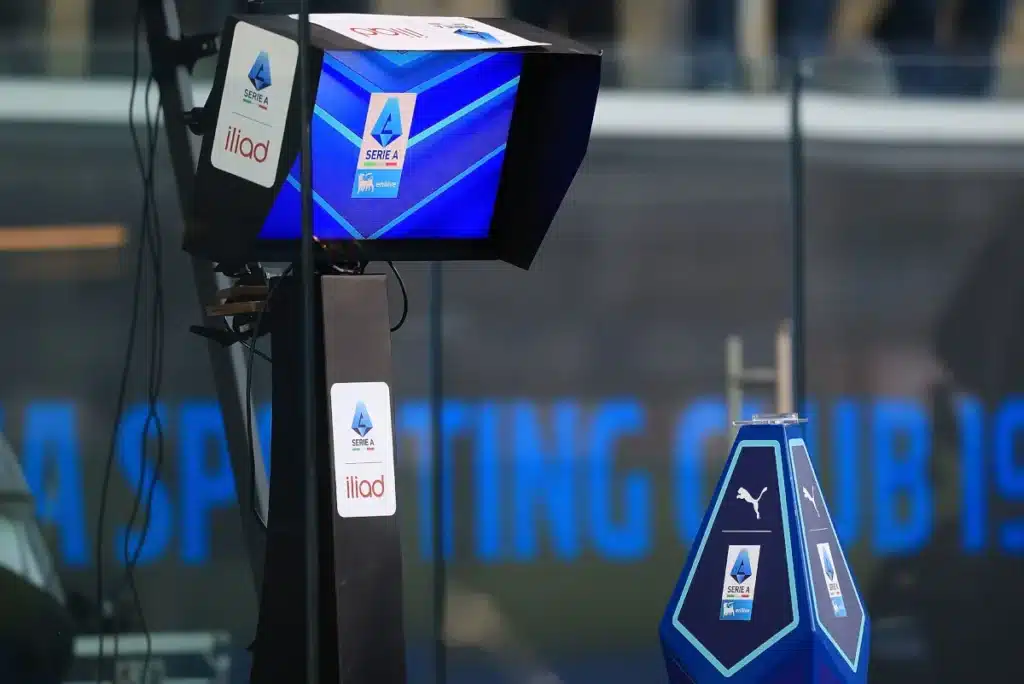
Italian football has adopted two significant VAR changes for the 2026/27 season, expanding the situations in which video officials can correct decisions connected to corner kicks and attacking set pieces.
The Italian Football Federation confirmed that its Federal Council had approved two optional changes introduced by IFAB. The first allows VAR to correct a corner kick that was clearly awarded incorrectly. The second permits VAR to disallow a goal when the attacking team committed a clear offence shortly before the ball was put into play from a corner or free kick.
The Serie A VAR changes are designed to prevent goals from being influenced by obvious mistakes that previously fell outside VAR’s traditional review categories. However, they will also revive concerns about delays, increased intervention and the risk of video officials examining every set piece in excessive detail.
Italy’s decision is especially interesting because it comes only days after UEFA reminded European officials that VAR must not re-referee matches and that lengthy, microscopic reviews often indicate that the original decision was not clearly wrong.
The two approaches are not legally contradictory. IFAB has explicitly made the corner-kick review an option that individual competitions can adopt. Nevertheless, Serie A will now test whether VAR can be given additional responsibilities without creating more interruptions and confusion.
What are the new Serie A VAR changes?
The FIGC’s announcement confirmed the adoption of two additional optional IFAB measures for the 2026/27 season:
- VAR assistance when a corner kick has clearly been awarded incorrectly.
- VAR intervention to disallow a goal when an attacking player committed an offence shortly before a corner or free kick was taken.
The federation’s announcement applies to Italian football’s use of the new protocol. Serie A, where full VAR infrastructure is already established, will be the competition in which the changes receive the greatest attention.
The measures do not give VAR unrestricted permission to review every corner, block, push or act of holding. Both powers are intended for clear incidents that directly affect an important outcome.
VAR can now correct a clearly wrong corner kick
The first new power concerns situations where the referee or assistant referee awards a corner even though the ball was last touched by an attacking player.
Previously, VAR could identify that the corner decision was incorrect but could not normally intervene merely to change it into a goal kick. If the attacking team scored from the resulting corner, the goal could still stand because the incorrect restart itself was outside the standard review protocol.
That created one of VAR’s most difficult credibility problems.
Supporters could watch replays showing that a corner had been wrongly awarded, then see a goal scored from that corner while being told that video officials were not authorised to correct the original mistake.
Under the new competition option, VAR can inform the referee that a corner has clearly been awarded incorrectly. However, IFAB has imposed an important condition: the correction must be completed immediately and must not delay the restart.
What happens when the corner is taken quickly?
If the attacking team takes the corner before VAR can complete the check, the decision cannot be changed.
IFAB’s protocol states that the option applies only when the information can be provided immediately. A quickly taken corner prevents VAR from returning play to the previous restart.
This is crucial because it prevents every corner from becoming a formal review.
The expected process should be brief:
- The referee awards a corner.
- VAR immediately checks the available replay.
- If there is clear evidence that the attacking team touched the ball last, the VAR informs the referee.
- The referee changes the restart to a goal kick and displays the television-screen signal.
- If there is no immediate clear evidence, the corner proceeds.
The instruction is not to search through multiple angles for a marginal touch. The decision should change only when the mistake is obvious and the correction can be made without disrupting the match.
Will every Serie A corner now be checked?
Technically, the video team can monitor corner decisions, but that does not mean every corner should produce a noticeable delay.
Most checks should take place silently while the players prepare for the restart. The referee should be contacted only when the footage provides immediate and conclusive evidence that the corner was wrongly awarded.
The difference between a check and a review is important.
VAR checks incidents continuously throughout a match. A check does not necessarily stop play or require the referee to visit the monitor. A formal review occurs only when the VAR identifies a potential clear error that requires the referee’s attention.
Because determining who touched the ball last is usually factual, most corner corrections should not require a long on-field review.
However, difficulties could arise when:
- Two players make contact with the ball almost simultaneously.
- The available camera angle is obstructed.
- The ball changes direction only slightly.
- The referee allows the corner to be taken quickly.
- The video team cannot identify the final touch immediately.
In those situations, the original decision should remain.
Why the wrong-corner rule is controversial
Supporters of the change will argue that it prevents an avoidable injustice.
A wrongly awarded corner can lead directly to a goal. When video evidence can correct the mistake in seconds, allowing the incorrect restart to proceed can appear unreasonable.
Critics will argue that football contains many incorrectly awarded restarts. If VAR can correct corners, why should it not also correct free kicks or throw-ins that lead to goals?
That is the slippery-slope concern.
An incorrect throw-in near the halfway line could eventually lead to a goal after a long attacking move. A wrongly awarded free kick could produce the same consequence. Expanding VAR to every disputed restart would create constant interruptions and fundamentally change the role of the video official.
IFAB has therefore limited the corner option to immediate corrections before the restart. The intention is to correct a clear factual mistake without creating a new attacking-phase review that reaches far back into the match.
The success of the rule will depend on discipline inside the video operations room. When the final touch is not immediately clear, officials must resist the temptation to investigate further.
Attacking fouls before set pieces can now cancel goals
The second change concerns offences committed before the ball is in play at an attacking corner or free kick.
Set pieces often involve pushing, holding, blocking and obstruction before the taker touches the ball. Under the traditional VAR process, an offence committed before the restart could create a difficult protocol problem because the attacking phase had not technically begun.
The new measure allows VAR to intervene when a clear attacking offence before the restart has a direct impact on a goal.
A typical example would involve an attacker deliberately holding or blocking a defender before a corner is taken. If that action prevents the defender from challenging for the ball and the attacking team subsequently scores, VAR can advise the referee to cancel the goal.
IFAB introduced the clarification for clear attacking-team offences committed before the ball is in play when those offences directly affect a major outcome.
Example of how the set-piece rule works
Imagine the following situation:
A Serie A team prepares to take a corner. Before the ball is kicked, an attacker grabs a defender and prevents them from following the eventual goalscorer.
The referee does not see the holding. The corner is delivered and the unmarked attacker scores.
Under the expanded protocol, VAR can examine the pre-restart offence. When the holding is clear and directly responsible for the defender being unable to challenge, the referee can disallow the goal.
The restart would be based on the offence committed before the ball entered play.
The essential test is not simply whether contact occurred. The offence must be clear and must have a direct impact on the goal.
Minor pushing that does not affect the defender should not be enough. Normal positional contact should not trigger intervention. The provision is intended for obvious conduct that creates the scoring advantage.
VAR should not examine every act of holding
This will be the most difficult part of the new system.
Almost every corner includes some form of contact between attackers and defenders. Players compete for position, place their arms across opponents and attempt to block runs.
If video officials analyse every movement in slow motion, very few set-piece goals will survive without controversy.
The threshold must therefore remain high.
VAR should intervene only when:
- The offence is clearly visible.
- It occurred before the ball was put into play.
- It was committed by the attacking team.
- It directly affected the scoring opportunity.
- The referee clearly missed the offence.
- The evidence meets the clear-and-obvious standard.
VAR should not intervene when the contact is mutual, minimal, doubtful or unrelated to the goal.
The challenge is ensuring that the same threshold is applied in every match.
What is the difference from an attacking-phase review?
VAR can already review offences committed by the attacking team during the attacking phase before a goal.
For example, if an attacker fouls a defender after the corner has been taken and the team scores moments later, VAR may recommend that the goal be disallowed.
The new power closes the gap for offences that occur just before the ball enters play.
The timing is the key difference:
Old reviewable situation: The attacker commits the foul after the corner or free kick has been taken.
New reviewable situation: The attacker commits a clear and influential foul immediately before the corner or free kick is taken.
The change prevents an obvious offence from escaping review simply because it happened a moment before the formal restart.
Could defenders exploit the new rule?
There is a risk that defenders will exaggerate contact before corners, knowing that VAR may examine the incident if a goal is scored.
A defender who loses their opponent could fall and claim they were blocked or held. Players may also appeal immediately after conceding, hoping to persuade the video officials to inspect an earlier confrontation.
However, protesting should not determine whether an incident is reviewed. VAR will check the attacking phase and the relevant pre-restart conduct independently.
The video official must distinguish between:
- A genuine holding or blocking offence.
- Normal physical competition for position.
- Mutual contact involving both players.
- A defender attempting to create the appearance of a foul.
- Contact that occurred but did not influence the goal.
Slow motion can make ordinary contact appear more serious than it was. Officials should therefore use full-speed footage and consider the complete movement rather than relying only on a frozen image.
Does this conflict with UEFA’s new VAR philosophy?
UEFA recently instructed its 55 national associations that VAR should intervene only for blatantly incorrect decisions or clear missed incidents. UEFA also warned against lengthy, microscopic reviews and stressed that the referee must remain at the centre of decision-making.
Italy’s adoption of additional VAR powers may appear to move in the opposite direction, but the two positions can operate together.
IFAB has officially authorised the corner-kick review as a competition option. Italy is therefore not inventing a review category outside the Laws.
The real question is how the option will be applied.
A correction completed in several seconds after an obvious final touch would fit UEFA’s minimum-interference philosophy. A 90-second examination of several unclear angles would not.
The same applies to pre-set-piece offences. Cancelling a goal because an attacker clearly pulled a defender to the ground may be justified. Searching for minimal contact that had no obvious effect would amount to re-refereeing the match.
Italy has expanded VAR’s jurisdiction. It must now ensure that the intervention threshold remains narrow.
Will Serie A have more VAR interventions?
The number may increase slightly, especially early in the season while players and officials adjust.
Incorrect corners are relatively common, but only a small number should meet the immediate and clearly wrong threshold. Pre-restart attacking fouls that directly contribute to goals should also be unusual.
The bigger impact may be behavioural.
Attackers could become more careful about:
- Holding defenders before corners.
- Creating illegal blocks.
- Preventing opponents from following runners.
- Pushing defenders before the ball is delivered.
- Using coordinated obstruction routines.
Coaches may also need to revise set-piece routines to ensure that blocking movements remain legal.
Defenders, meanwhile, may become more willing to draw attention to contact before the restart. Referees will need to warn players early and manage penalty-area confrontations proactively.
Will referees use the pitch-side monitor?
A clearly incorrect corner is primarily a factual decision concerning who touched the ball last. In most obvious cases, the referee should be able to change the restart after receiving information from VAR without conducting a long monitor review.
The updated protocol requires the referee to use the television-screen signal when a corner decision is changed following VAR information.
Pre-set-piece fouls are more subjective. The referee may need to view the incident at the monitor when the severity, impact or legality of the contact requires personal judgement.
That distinction should help preserve efficiency:
- Factual final-touch error: rapid VAR information.
- Subjective holding or blocking offence: possible on-field review.
- Doubtful or marginal contact: original decision remains.
What happens if the wrong corner produces a goal?
The new rule is intended to prevent that sequence before it develops.
When VAR can immediately see that the corner was wrongly awarded, the restart should be changed to a goal kick before the corner is taken.
When the corner is taken quickly before the check is completed, IFAB states that the original corner decision cannot be changed.
VAR could still review a separate offence connected to the resulting goal, such as:
- Attacking handball.
- Offside.
- A foul after the corner was taken.
- A clear attacking offence before the restart under the new provision.
But the fact that the corner itself was incorrect would not automatically be enough once play had restarted too quickly for an immediate correction.
This could create controversy when television footage later confirms that the corner should never have been awarded. However, the time limit is necessary to prevent VAR from taking the match backwards after every restart.
Why Italy adopted the options
The FIGC’s official announcement did not provide a detailed explanation of its reasoning beyond confirming adoption of the two optional IFAB modifications.
The likely objective is to prevent clear procedural mistakes from directly producing goals.
Italian football has historically been willing to adopt and develop video officiating. The new changes continue that approach by allowing technology to correct a small number of obvious incidents that previously fell outside the protocol.
The decision also gives Serie A an opportunity to test how the changes function during a full domestic season rather than only in a short tournament.
Whether the experiment succeeds will depend less on the written rules and more on operational discipline.
Potential benefits of the new VAR powers
The changes could improve fairness in several ways.
Clearly wrong corners are corrected
Teams should not receive a dangerous attacking restart when video footage immediately proves that the decision was wrong.
Illegal set-piece tactics are discouraged
Attackers may be less willing to hold or block defenders before the ball is taken.
Protocol gaps are closed
VAR will no longer be forced to ignore a clear attacking offence merely because it occurred a second before the ball entered play.
Major outcomes become more defensible
A goal produced by an obvious error or illegal action can be corrected before it changes the result.
Potential problems for Serie A
The risks are equally clear.
More delays
Even an optional immediate check may slow matches if video officials become too cautious.
More subjective analysis
Determining whether pre-set-piece contact directly affected a goal can be difficult.
Inconsistent thresholds
One VAR may regard a block as normal football contact, while another recommends a review.
More player appeals
Defenders may ask for every corner goal to be examined for holding or obstruction.
Expansion of VAR expectations
Once corners are reviewable, supporters may demand checks of other incorrect restarts.
The first weeks of the season will be important. Clear public guidance and transparent examples could prevent confusion before controversial incidents occur.
The VAR Verdict
The Serie A VAR changes attempt to solve two genuine problems.
Allowing a goal to stand after a clearly incorrect corner damages confidence in officiating, especially when everyone watching television can immediately see the mistake. Correcting that decision before the restart is reasonable, provided the process takes only a few seconds.
Reviewing clear attacking fouls committed before set pieces also closes an important loophole. An attacker should not be allowed to create a goal by illegally holding or blocking a defender simply because the offence happened moments before the ball entered play.
However, the danger is obvious.
Corner kicks and free kicks contain constant physical contact. If VAR begins examining every block, arm position and movement in microscopic detail, Serie A will experience longer reviews and more disputed goals.
The VAR Verdict: Both powers can improve fairness, but only under a strict intervention threshold. Wrong corners must be corrected immediately or not at all. Pre-set-piece goals should be cancelled only when the attacking offence is clear, significant and directly connected to the goal.
The new rules should help VAR correct obvious injustices. They must not become an invitation to re-referee every set piece.

0 Comments
Join the conversation with respect. Comments are moderated and must follow our community rules.
Want to join the discussion?
Please log in or create an account to comment and reply. This keeps the conversation cleaner and safer.