
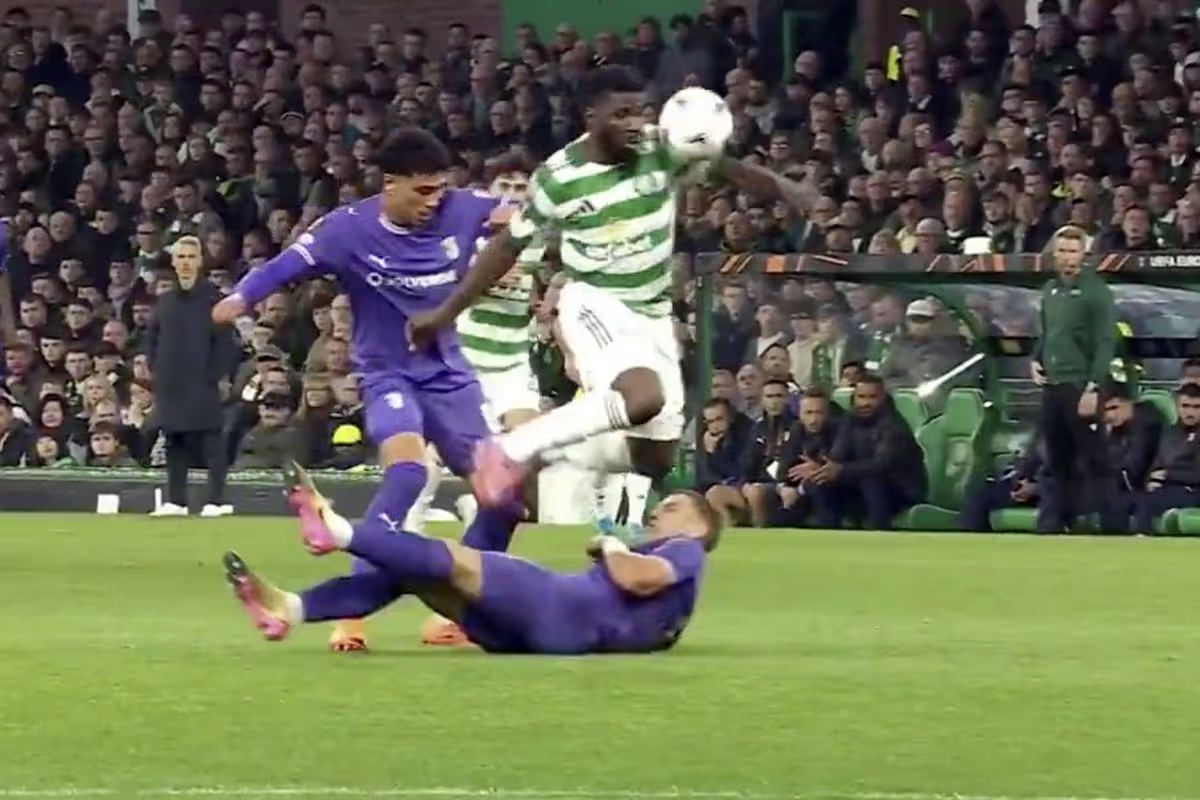
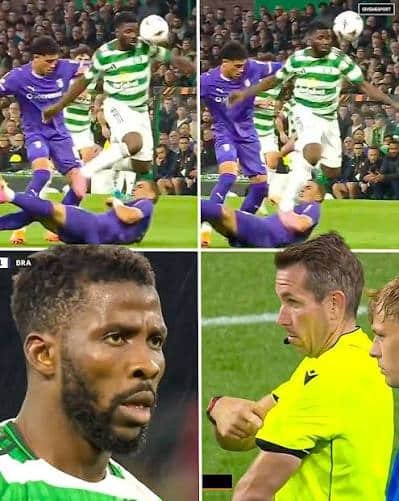
Celtic’s 4-0 Premier Sports Cup victory over Dundee United produced a major VAR handball controversy after Camilo Duran’s second goal was allowed to stand despite the ball clearly striking Kasper Hogh’s arm in the build-up. The incident was checked by VAR, but referee Steven McLean was not sent to the monitor and the goal remained on the scoreboard, prompting protests from Dundee United and a post-match explanation from Scottish refereeing chief Willie Collum.
Celtic had taken the lead through Auston Trusty in the 22nd minute before the controversial second arrived just two minutes later. Hogh slid in attempting to reach the cross and the ball ricocheted off his forearm before falling to Duran, who finished from close range. Replays confirmed the arm contact, but the crucial question for VAR was not whether the ball touched Hogh’s arm. It was whether that contact constituted a handball offence under Law 12.
Why Did VAR Allow Celtic’s Goal?
The Scottish FA confirmed that VAR checked the entire attacking sequence, including Hogh’s handball. According to the explanation provided by Collum, the contact was considered completely accidental and a consequence of Hogh’s normal playing action. Crucially, Hogh was not the player who scored the goal.
This distinction is extremely important under the current handball law. IFAB removed the rule that automatically penalised every accidental attacking handball which subsequently resulted in a teammate scoring. An accidental handball that leads to another player scoring is therefore not automatically an offence.
The automatic restriction applies when the player whose hand or arm accidentally touches the ball then scores directly or immediately afterwards. In this case, Hogh handled the ball accidentally but Duran was the player who scored. Therefore, VAR still had to judge Hogh’s action using the normal handball criteria rather than disallowing the goal simply because the arm contact occurred before it.
The VAR Verdict: Correct Decision
THE VAR VERDICT: CORRECT DECISION. ✅
This is one of those incidents that can look wrong when watched in isolation because the ball clearly hits an attacker’s arm immediately before a goal. However, the current Laws of the Game do not say that every attacking handball in the build-up automatically cancels a goal.
If Hogh deliberately moved his arm toward the ball or made his body unnaturally bigger, it would still be a punishable handball and VAR should disallow the goal. But the officials judged his arm contact to be accidental and a natural consequence of his attempt to play the ball. Once that assessment is accepted, Duran scoring afterwards does not transform the accidental contact into an offence. The decision to allow the Celtic goal is therefore consistent with the wording and intention of the current Law 12.
Why Has the Decision Caused So Much Confusion?
The controversy became even bigger because pundits Michael Stewart and Scott Brown compared the Celtic incident with a recent Falkirk goal that was disallowed following a handball review. Stewart argued that the situations appeared very similar, while Brown questioned why VAR reached different outcomes. Dundee United manager Jim Goodwin was also frustrated, arguing that Hogh’s hand contact had a direct impact on Celtic scoring their second goal.
Collum rejected that comparison. The Scottish FA’s position was that the Falkirk incident involved a handball which VAR considered punishable under the normal handball criteria, whereas Hogh’s contact was considered accidental and non-punishable. That is the key difference. The identity of the eventual goalscorer matters for the automatic accidental-handball rule, but officials must still separately decide whether the original arm contact itself was an offence.
That explains why two incidents that may look very similar can produce different outcomes. It also highlights one of VAR’s continuing communication problems: supporters often see “ball hits arm before goal” and expect the goal to be disallowed, while the actual law requires officials to consider who scored, whether the contact was deliberate, the position of the arm and whether the player made their body unnaturally bigger.
Celtic ultimately cruised into the Premier Sports Cup quarter-finals with a 4-0 victory, with Trusty, Duran, Sebastien Tounekti and Benjamin Nygren all scoring. But the Hogh handball is likely to remain the most discussed refereeing moment of the match because it provides a perfect example of how the modern handball law can produce a legally correct decision that still appears controversial to players and supporters.

0 Comments
Join the conversation with respect. Comments are moderated and must follow our community rules.
Want to join the discussion?
Please log in or create an account to comment and reply. This keeps the conversation cleaner and safer.