
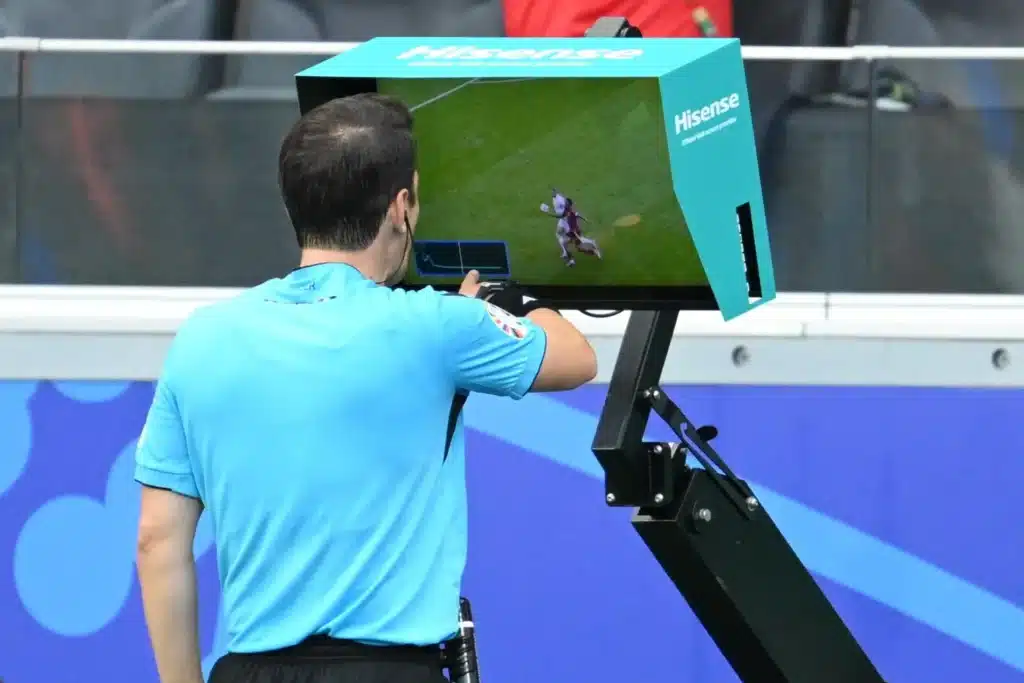
The football rule changes for 2026/27 could have a bigger impact on refereeing than anything we have seen for several seasons. After many of the new ideas were tested on the biggest stage at the 2026 World Cup, domestic competitions are now beginning to apply them. VAR can correct some second yellow cards, substitutions are being timed, injured players can be forced to remain off the pitch for a full minute and referees have new weapons against teams deliberately delaying throw ins and goal kicks. But perhaps the most interesting part is that the Premier League, La Liga, Serie A, Bundesliga and UEFA are not all choosing exactly the same approach.
That difference matters. IFAB sets the Laws of the Game, but some additions to the VAR protocol are optional for competition organisers. It means a corner decision could potentially be corrected by VAR in one major European league but remain completely outside the VAR protocol in another. For supporters already frustrated by inconsistency, the 2026/27 season could therefore solve some old problems while creating an entirely new debate about why identical incidents are treated differently depending on the competition.
The biggest VAR change: second yellow cards can finally be corrected
One of the most important VAR rule changes for 2026/27 concerns second yellow cards. Until now, a referee could incorrectly send a player off after showing a second caution and VAR was generally powerless to fix it. That changes this season. When the referee shows a clearly incorrect second yellow and that caution results in a red card, VAR can intervene. Importantly, this does not mean VAR will search for missed second yellow offences. If a player who is already booked commits another possible yellow card offence and the referee decides not to caution him, VAR cannot step in simply to produce the second yellow. The new power is designed to correct a clearly wrong dismissal, not to allow the video referee to referee every caution from the VAR room.
The VAR Verdict: Very good change. A wrong red card can completely change a match, so leaving VAR unable to correct an obvious mistake never made much sense. The limitation is also important. Allowing VAR to search for every missed second yellow would create endless reviews and effectively turn every challenge involving a booked player into a potential VAR incident. The only problem will be explaining why VAR can cancel an incorrect second yellow but cannot recommend a second yellow that the referee completely missed. Technically the distinction is logical, but supporters will inevitably question it.
Premier League 2026/27: less time wasting and a high VAR threshold
The Premier League rule changes for 2026/27 focus heavily on protecting the speed and physical nature of the competition. Players being substituted will have ten seconds to leave the field after the substitution is indicated. If they deliberately take too long, their replacement must wait until the first stoppage after one full minute has passed. Referees can also begin a visible five second countdown when a team is clearly delaying a throw in or goal kick. Failure to take the restart can result in the throw in changing teams or a delayed goal kick becoming a corner for the opposition. Players whose injury stops play or requires treatment will normally have to remain outside the field for one minute after play resumes.
There are also important refereeing instructions. The Premier League will maintain a high threshold for both normal fouls and VAR intervention. Officials have been told to pay greater attention to holding that has a genuine impact on an opponent, particularly inside the penalty area, and to attackers who unfairly block or challenge goalkeepers without attempting to play the ball. Hair pulling also gets more proportionate guidance. A deliberate hair pull without excessive force or brutality can result in a yellow card, while excessive force or brutality remains a red card offence. The Premier League will use the new second yellow VAR review, but it has specifically decided not to allow VAR to correct wrongly awarded corners.
The VAR Verdict: Mostly positive. We particularly like the Premier League keeping a high bar for VAR intervention. Correct the big mistakes and leave subjective football decisions with the referee whenever the evidence is not clear. The time wasting measures also make sense because they create a real sporting consequence rather than simply adding another yellow card. The biggest test will be consistency. Ten seconds needs to mean ten seconds whether a team is winning in the 89th minute or making a normal tactical substitution in the 60th.
La Liga 2026/27: connected ball technology changes what VAR can see
Spain is taking one of the most technologically ambitious approaches in Europe. La Liga will use Connected Ball technology in every top division match, making it the first national professional league to deploy the system on this scale. A sensor inside the official match ball supplies precise information about the location of the ball and, crucially, the exact moment it is touched. That data will be integrated with VAR and semi automated offside technology. It can assist officials with offsides, deflections, possible handballs, double touches at penalties and situations where determining the exact moment of contact is essential.
Spain is also taking advantage of the expanded VAR protocol. The RFEF’s new 2026/27 refereeing manual includes clearly incorrect second yellow dismissals, mistaken identity and clearly wrongly awarded corners among the incidents that can now be corrected. A corner can only be changed when the error is very clear and the correction can happen immediately without delaying the restart. Spain is also participating in an IFAB trial aimed at tactical goalkeeper injuries. When a goalkeeper causes play to stop for an injury or receives medical attention, a field player can be required to leave the pitch for one minute after play restarts, with the coach choosing the player under the Spanish version of the protocol. There are exceptions for genuine serious situations.
The VAR Verdict: Connected Ball is one of the best developments of the season. VAR is at its strongest when technology provides objective information. Knowing the precise moment the ball was touched can remove some of the uncertainty that has surrounded offside frame selection and double touch decisions. The danger comes if officials start using microscopic sensor information to manufacture subjective offences that nobody would reasonably consider significant. Technology should help establish facts. It should not replace football judgement.
The goalkeeper injury trial is more controversial. Tactical injuries have clearly become a method of creating unofficial coaching timeouts, so attempting to remove the incentive makes sense. However, punishing an outfield teammate when the goalkeeper is genuinely hurt could feel unfair. This is exactly the type of experiment that should be judged after a meaningful sample of matches rather than declared a success immediately.
Serie A 2026/27: Italy gives VAR more responsibility
Serie A is also adopting the expanded second yellow review and, unlike the Premier League and Bundesliga, Italy has chosen to allow VAR to correct clearly wrongly awarded corners when the correction can happen immediately. Italian refereeing authorities are also introducing the ten second substitution requirement, five second countdowns for delayed goal kicks and throw ins, and the one minute period outside the field following qualifying injury treatment. There is also a DOGSO adjustment. If the referee applies advantage after an offence denying an obvious goalscoring opportunity and the attacking team goes on to score, the offender will no longer receive the disciplinary sanction that would previously have followed simply for the unsuccessful attempt to prevent the goal.
Italy has made another decision that will attract attention. Serie A is adopting the option that allows a referee to send off a player who deliberately covers his mouth during a provocative or offensive confrontation in circumstances covered by the new guidance. That is notably different from the approaches chosen in Germany, Spain and UEFA competitions, where covering the mouth is not automatically treated as a sending off offence.
The VAR Verdict: Mixed. Correcting a completely wrong corner is defensible if the VAR can do it within seconds using an obvious replay. Nobody benefits when everyone watching television knows the ball came off an attacker but the defending team still has to face a dangerous corner. The problem begins when VAR needs several angles and thirty seconds to determine which player’s boot the ball brushed. At that point we are solving a relatively small error by introducing another interruption.
We are much less convinced by making the mouth covering offence potentially worthy of an immediate red card. Referees must deal strongly with discriminatory or abusive language, but sanctioning the gesture itself risks judging what might have been said rather than what can actually be established. It gives referees another highly subjective disciplinary decision in already heated confrontations.
Bundesliga 2026/27: Germany chooses the more conservative VAR model
The Bundesliga and Bundesliga 2 will introduce the main time management changes, including the five second countdown for delayed restarts, the ten second substitution requirement, the one minute injury rule and VAR intervention for a clearly incorrect second yellow dismissal. Germany, however, has rejected all of IFAB’s new optional measures. VAR will not review corner kick decisions, covering the mouth will not automatically result in a red card and leaving the field in protest will not automatically trigger a dismissal under the optional provision.
The VAR Verdict: Good approach. Germany is fixing high impact errors while resisting the temptation to make VAR responsible for every possible mistake. The second yellow change deals with a decision that can leave a team playing with ten men for a large part of a match. A wrongly awarded corner is usually far less significant. Keeping those two situations separate helps preserve the original idea of minimum interference.
UEFA Champions League and European competitions: less microscopic VAR
Perhaps the most important change in UEFA competitions is not another piece of technology but a change of philosophy. UEFA has launched Clear Line, a public refereeing library containing more than 150 situations showing how officials are expected to interpret the Laws and when VAR should intervene. UEFA says the framework has been endorsed by the refereeing chiefs of its member associations and is intended to encourage more consistent decision making across both domestic and European football. Above everything else, it reinforces that VAR intervention should be reserved for clear and obvious errors.
UEFA refereeing director Roberto Rosetti has made the message even clearer at the start of the new season. He wants referees to regain control of matches and VAR to stop analysing what he describes as microscopic incidents. UEFA will use the new possibility of correcting clearly incorrect second yellow dismissals and can also correct an obviously wrong corner when this can be done quickly, but Rosetti’s wider instruction is that VAR should support the referee rather than re referee the match. UEFA will not automatically send players off simply for covering their mouths during confrontations, and Football Video Support will not replace the standard VAR system in UEFA competitions.
The VAR Verdict: This is the direction VAR needs. Technology has improved decision accuracy, but accuracy cannot be measured only by how many incidents can be examined in slow motion. Football still contains judgement, context and physical contact. If an incident requires several minutes, multiple freeze frames and extreme magnification before officials can identify an alleged clear and obvious error, it is fair to ask whether the original decision was genuinely clearly wrong at all.
Are the new football rules for 2026/27 actually better?
Overall, we believe the football rule changes for 2026/27 are positive. Correcting an obviously wrong second yellow dismissal is overdue. The ten second substitution rule and stronger restart countdowns attack time wasting without forcing referees to produce endless cautions. The new injury protocol may discourage tactical stoppages, while La Liga’s Connected Ball technology can provide VAR with better factual information.
The concern is VAR expansion. The technology was introduced to correct major mistakes, but football has gradually allowed the definition of a reviewable incident to grow. Corner kicks are the clearest example this season. Serie A and Spain are prepared to correct them, UEFA can use the option when the answer is immediate, while the Premier League and Bundesliga have chosen not to. None of those approaches is necessarily unreasonable, but supporters will again watch similar situations handled differently from one competition to another.
That is why UEFA’s attempt to create a clearer common refereeing philosophy might ultimately be more important than any individual law change. VAR works best when everyone understands its limits. The goal for 2026/27 should not be to achieve a football match in which technology searches for every possible error. It should be to give referees the tools to correct the decisions that genuinely change games while allowing football to remain football.
The VAR Verdict
Overall rating for the 2026/27 changes: 8/10.
The second yellow review is an excellent addition. Measures against obvious time wasting are necessary. Connected Ball technology has enormous potential for factual decisions. UEFA’s move toward fewer microscopic VAR interventions is also exactly what the game needs.
Our biggest concern is the gradual expansion of VAR into smaller decisions such as corner kicks. If those checks remain instant and factual, they can work. If they become another reason to stop matches and analyse tiny contacts from five camera angles, football will quickly find itself back in the same VAR debate it is trying to solve.

0 Comments
Join the conversation with respect. Comments are moderated and must follow our community rules.
Want to join the discussion?
Please log in or create an account to comment and reply. This keeps the conversation cleaner and safer.