
Sunday, August 23 produced exactly the type of refereeing night VAR was created for.
Liverpool rescued a 2-2 draw at Newcastle with a penalty in the 99th minute, Atlético Madrid were reduced to ten after a VAR review against Villarreal, João Gomes was sent off following another video intervention and Manchester City won after VAR overturned an offside decision on their stoppage-time goal.
Barcelona’s 5-0 victory over Elche also began with a penalty.
Not all of these decisions were controversial. Some were excellent examples of VAR correcting or supporting an important decision.
Here is The VAR Verdict analysis.
Newcastle vs Liverpool: was the late penalty really enough?
The most discussed Premier League decision came deep into stoppage time at St James’ Park.
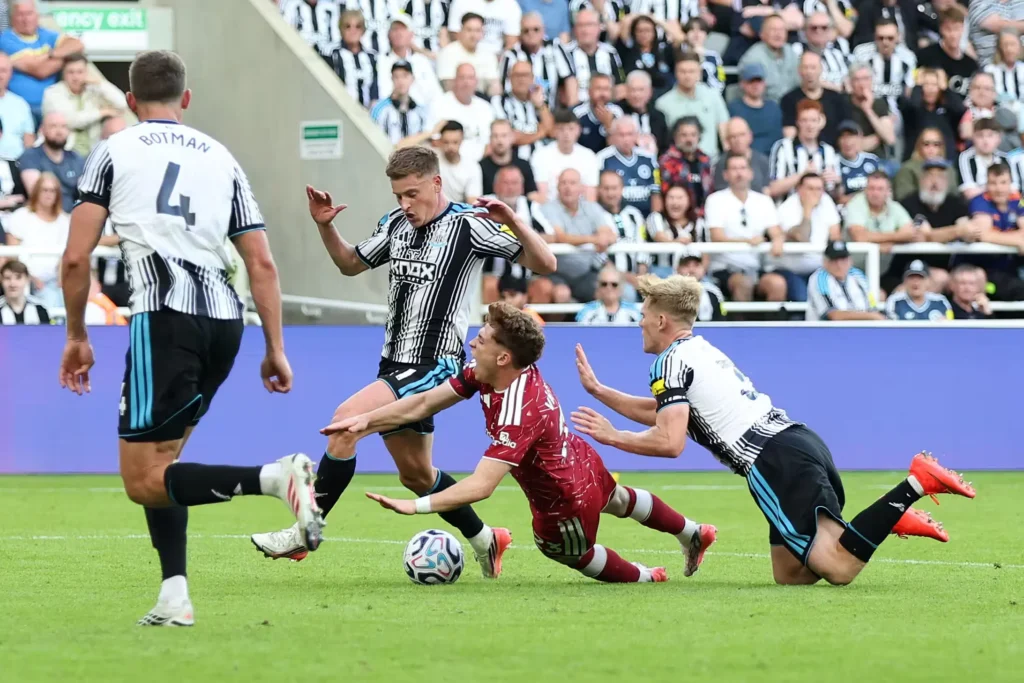
Newcastle were leading Liverpool 2-1 when substitute Victor Muñoz entered the penalty area and Lewis Hall challenged him.
Referee Stuart Attwell immediately pointed to the penalty spot.
VAR James Bell checked the incident before confirming the decision.
The Premier League later released part of the officials’ communication.
Attwell’s assessment was that Hall did not play the ball and made clear contact. VAR identified knee-to-thigh contact and supported the original penalty decision. Dominik Szoboszlai converted in the 99th minute to make it 2-2.
The VAR Verdict: Debatable, but supportable ⚖️✅
This is exactly the type of penalty where two statements can both be true:
The penalty feels soft.
And:
The decision is not clearly wrong.
Hall does not win the ball. His leg makes contact with Muñoz as the Liverpool attacker is moving through the penalty area.
The real question is not whether contact exists. We can clearly see that it does.
The question is whether that contact constitutes a careless challenge that causes Muñoz to go down.
For us, there is enough.
But there is also an important VAR principle here.
Because Attwell awarded the penalty on the field, VAR needs clear evidence that his interpretation was wrong before overturning him. It did not have that evidence.
If Attwell had waved play on, this might have been a much more complicated discussion about whether VAR should intervene in the opposite direction.
That distinction matters.
VAR is not supposed to decide which of two reasonable interpretations it prefers.
Our verdict: Penalty is supportable. VAR was correct not to overturn it.
Why Newcastle supporters will still call it soft
Newcastle’s frustration is understandable.
When a penalty decides a match in the 96th minute, supporters naturally expect the offence to be obvious.
But the Laws do not contain a different foul threshold for stoppage time.
A foul in the second minute should also be a foul in the 97th.
Likewise, the score cannot matter.
The difficult part is consistency. If this level of knee-to-thigh contact is punished as a careless challenge at St James’ Park, Premier League referees need to apply the same threshold elsewhere.
That will ultimately determine whether this decision ages well.
Atlético Madrid vs Villarreal: first penalty
Atlético’s 2-2 draw with Villarreal produced even more major decisions.
The first penalty came when Morten Hjulmand caught Tajon Buchanan around the edge of Atlético’s penalty area.
Hernández Hernández pointed to the spot and Gerard Moreno converted to make it 1-1.
Former La Liga referee Eduardo Iturralde González also backed the decision, describing the challenge as a clear foul.
The VAR Verdict: Correct penalty ✅
There is little reason to overcomplicate this one.
Hjulmand makes a poor challenge and catches Buchanan.
Once the foul occurs inside the penalty area, the consequence is a penalty.
No red card is required because this is not an obvious goalscoring opportunity.
Verdict: Correct decision.
Le Normand penalty and red card: why both decisions were correct
The biggest La Liga incident arrived later.
Georges Mikautadze broke towards goal and found himself in a very dangerous position inside the Atlético penalty area.
Robin Le Normand came from behind and pushed the Villarreal striker with both arms.
Initially, Hernández Hernández did not give the penalty.
VAR intervened and recommended an on-field review.
After watching the replay, the referee awarded Villarreal a penalty and showed Le Normand a straight red card for denying an obvious goalscoring opportunity.
Mikautadze scored from the spot before ten-man Atlético later recovered to draw 2-2.
The VAR Verdict: Correct penalty AND correct red card ✅🟥
This incident gives us an excellent opportunity to explain the so-called “double jeopardy” rule.
Many supporters believe that whenever a penalty is awarded for DOGSO, the defender should receive only a yellow card.
That is not correct.
The reduced punishment applies when the defender attempts to play or challenge for the ball.
IFAB’s current Law 12 specifically states that when a player denies an obvious goalscoring opportunity inside the penalty area through holding, pulling, pushing or another action with no genuine possibility of playing the ball, the player must still be sent off.
That is exactly what matters here.
Le Normand does not make a football challenge for the ball.
He pushes Mikautadze from behind.
The Villarreal striker is moving towards goal, is close to goal, has an excellent chance to maintain control and has a clear opportunity to shoot.
Those are classic DOGSO elements.
Penalty: correct.
Red card: correct.
VAR intervention: correct.
The only criticism is the length of the review. Once the decisive angle was available, this should not have required an extended discussion.
Why there was no “double punishment” reduction
This is worth making completely clear.
Imagine Le Normand had stretched his leg towards the ball, narrowly missed it and accidentally tripped Mikautadze.
If the referee judged that challenge as DOGSO and awarded a penalty, the punishment could be reduced to yellow because there was an attempt to play the ball.
But a deliberate push is different.
IFAB even gives essentially this exact example in its current guidance: if a defender pushes an attacker in a one-on-one situation without the possibility of playing the ball, the correct decision is penalty plus red card.
So despite Atlético’s protests, the disciplinary outcome is correct.
Brighton vs Aston Villa: João Gomes sent off after VAR
VAR also produced a major intervention at the Amex Stadium.
Aston Villa were already being demolished by Brighton when João Gomes became involved in an incident with Georginio Rutter.
Rutter dispossessed Gomes and the Villa midfielder then kicked out at him.
Referee Peter Bankes initially allowed play to continue.
VAR Matt Donohue reviewed the footage and sent Bankes to the monitor.
After the review, Gomes was shown a straight red card.
The Premier League Match Centre confirmed that the final decision was red for the kick-out. Brighton eventually won 4-0.
The VAR Verdict: Clear red card 🟥✅
There is very little controversy here.
The important detail is that Gomes is no longer genuinely challenging for the ball.
The kick is a separate action following the initial footballing duel.
That changes the disciplinary interpretation considerably.
Under Law 12, an action using excessive force or brutality against an opponent when not challenging for the ball can constitute violent conduct. The Premier League communication described the decision as serious foul play, but whichever disciplinary classification was used internally, the important outcome is the same:
Gomes had to be sent off.
VAR did exactly what it should.
The referee missed a potential direct-red-card offence.
VAR identified it.
The referee watched the relevant replay and corrected the decision.
This is good VAR.
An important detail: Gomes was already booked
Gomes had already been cautioned earlier in the game.
But that should not influence the decision.
This was not a case where the referee simply needed to show him a second yellow.
VAR was examining the incident as a potential direct red card offence.
That distinction matters because video review should focus on the nature of the new offence, not on finding a convenient way to remove an already-booked player.
The final sanction was correctly based on the kick itself.
Manchester City vs Bournemouth: VAR rescues the winning goal
Manchester City’s dramatic 2-1 victory over Bournemouth produced a very different type of VAR intervention.
City were trailing until the 84th minute before Marc Guéhi equalised.
Then Josko Gvardiol scored in stoppage time.
The assistant referee initially flagged the goal for offside.
VAR checked the position and determined that Gvardiol was onside, meaning the goal was awarded and Manchester City completed the comeback.
The VAR Verdict: Exactly what VAR is for ✅
There is almost no subjective interpretation here.
Offside is fundamentally a factual decision.
If technology and the available camera evidence demonstrate that the attacker is onside, the goal should be restored.
Without VAR, Manchester City would have lost a legitimate winning goal because of an incorrect offside flag.
This is one of VAR’s strongest functions.
Verdict: Correct overturn. Goal correctly awarded.
Elche vs Barcelona: was Raphinha’s penalty correct?
Barcelona’s league opener also produced an early penalty decision.
In the 13th minute, Raphinha entered the Elche penalty area and was brought down by Víctor Chust.
Alejandro Quintero González immediately awarded the penalty.
Raphinha converted to give Barcelona the lead and later scored again as Barça won 5-0.
The foul was also backed in post-match Spanish referee analysis, with Iturralde González agreeing that the contact was sufficient for a penalty.
The VAR Verdict: Correct penalty ✅
This is considerably clearer than the Newcastle–Liverpool incident.
Chust catches Raphinha and does not make a successful play on the ball.
The contact affects the attacker’s movement and causes the fall.
There is no need for VAR to intervene when the referee has already identified the offence correctly.
One of the signs of good VAR is knowing when to do nothing.
Verdict: Correct penalty.
Sunday’s referee verdicts
Newcastle 2-2 Liverpool
Lewis Hall on Victor Muñoz: PENALTY SUPPORTABLE ⚖️✅
It is a soft-looking decision, but Hall makes clear contact without winning the ball. There is nowhere near enough evidence for VAR to overturn Attwell.
Atlético 2-2 Villarreal
Hjulmand on Buchanan: CORRECT PENALTY ✅
Le Normand on Mikautadze: CORRECT PENALTY + RED 🟥✅
The push denies a clear goalscoring opportunity and is not an attempt to play the ball. The DOGSO red therefore remains.
Brighton 4-0 Aston Villa
João Gomes kick on Rutter: CORRECT RED 🟥✅
A deliberate kick-out after losing the ball is exactly the type of serious misconduct VAR should identify.
Manchester City 2-1 Bournemouth
Gvardiol offside overturn: CORRECT VAR ✅
The assistant’s offside decision was factually wrong and VAR restored a legitimate goal.
Elche 0-5 Barcelona
Penalty on Raphinha: CORRECT ✅
A straightforward foul inside the area and a good immediate decision from Quintero González.
Which decision was the most debatable?
The Liverpool penalty.
Not because it was clearly wrong, but because it sits in the difficult space between contact and punishable contact.
Attwell saw Hall’s challenge and decided it was careless.
VAR found clear knee-to-thigh contact and no touch on the ball.
Once that on-field decision exists, overturning it would require convincing evidence that Attwell had made a clear and obvious mistake.
That evidence was not there.
This is why saying “I wouldn’t give that penalty” is different from saying “VAR should overturn that penalty.”
VAR protocol depends on that distinction.
Best referee decision of the day
For us, the Le Normand incident is probably the strongest piece of officiating once VAR became involved.
Hernández Hernández missed the offence initially, but the video process corrected both parts of the decision.
Penalty.
DOGSO.
Red card.
And importantly, officials correctly understood why the usual penalty-area DOGSO downgrade did not apply.
The offence was a push rather than an attempt to play the ball.
That is a detail supporters often misunderstand.
Final VAR Verdict
Sunday showed almost every side of modern VAR.
At Newcastle, VAR supported a highly subjective penalty.
At Atlético, it corrected a missed penalty and red card.
At Brighton, it identified serious misconduct away from the normal challenge.
At Manchester City, it corrected a factual offside error.
And in Barcelona’s match, it stayed away because the referee had already made the right call.
That final point matters.
Good VAR is not measured by the number of interventions.
Sometimes the correct decision is to intervene.
Sometimes the correct decision is to confirm.
And sometimes the best decision is to stay completely silent.
For us, none of Sunday’s major VAR interventions represents a clear VAR mistake.
The Newcastle penalty is absolutely open to debate, but once Stuart Attwell awards it on the field, the decision falls comfortably within the range VAR can support.
The most technically interesting call was Le Normand’s dismissal.
The most controversial was Liverpool’s late penalty.
And the clearest VAR correction came with João Gomes.
A busy Sunday for the officials, but overall a considerably stronger day for VAR than some of the controversy might suggest.

0 Comments
Join the conversation with respect. Comments are moderated and must follow our community rules.
Want to join the discussion?
Please log in or create an account to comment and reply. This keeps the conversation cleaner and safer.