
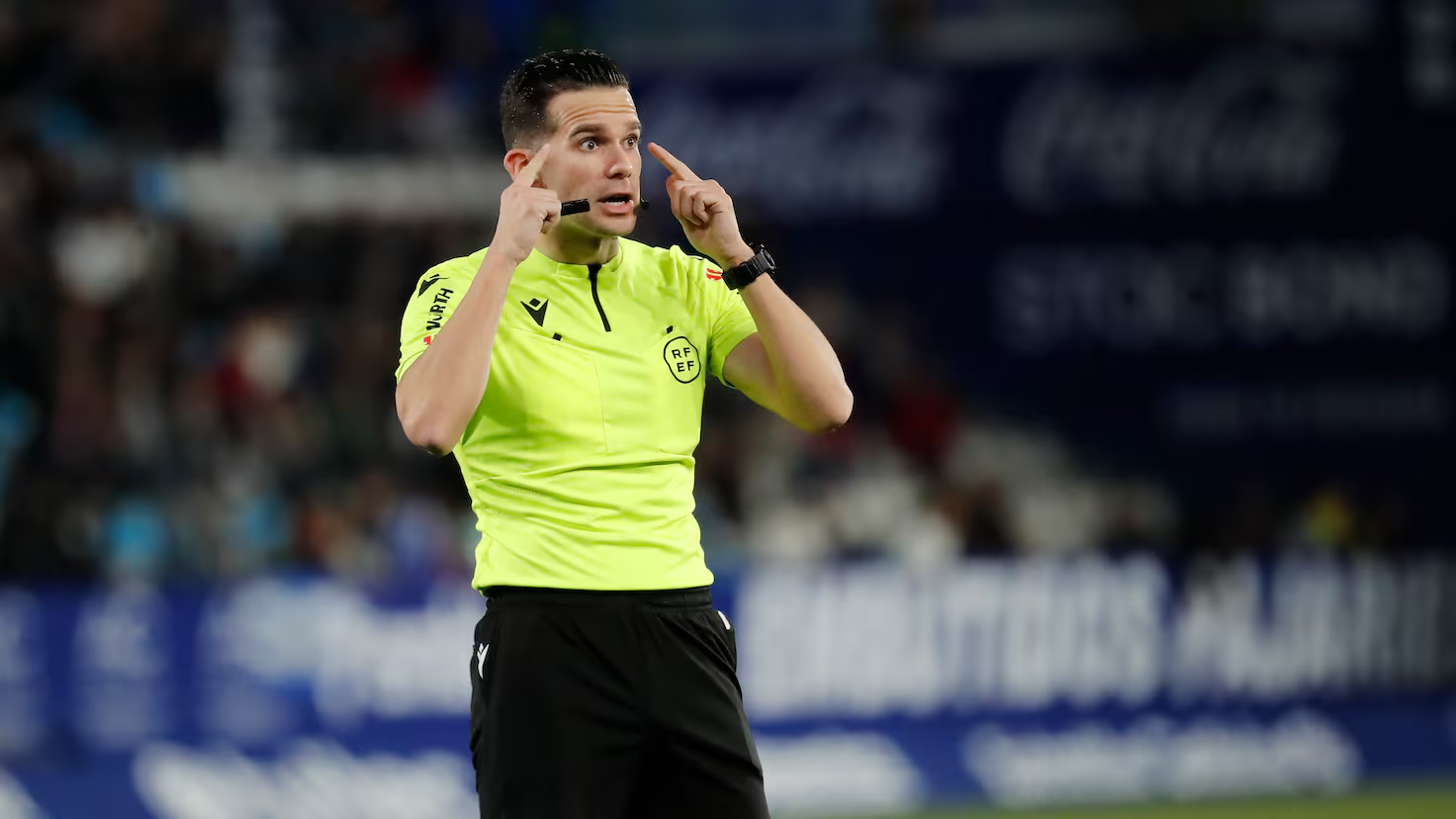
Barcelona begin their 2026/27 La Liga campaign on Sunday night at Martínez Valero, and the referee appointment immediately gives us something interesting to analyse.
The RFEF has appointed Alejandro Quintero González as the referee for Elche vs Barcelona, with experienced former La Liga referee Guillermo Cuadra Fernández operating as VAR.
Barcelona have already experienced very different matches under Quintero. They have won two and lost one of their three previous games with him in charge, while one of those matches included an early straight red card to their opponents.
More importantly, Quintero’s numbers from last season show an official who is not afraid of disciplinary action.
That could matter against an Elche side that will almost certainly try to make Barcelona uncomfortable in their first league match of the season.
Who is the referee for Elche vs Barcelona?
Alejandro Quintero González will take charge at the Martínez Valero.
The official RFEF appointment is:
Referee: Alejandro Quintero González
Assistant referee 1: Guillermo Santiago
Assistant referee 2: José Francisco García
Fourth official: Juan Antonio Campos
VAR: Guillermo Cuadra Fernández
AVAR: Luis Mario Milla
Referee observer: Gregorio Bernabé
The match kicks off on Sunday, August 23 at 21:30 CEST.
Although this is officially La Liga Matchday 2, it will be Barcelona’s first league game of the season. Their Matchday 1 fixture against Athletic Club was moved to August 27 because Barcelona’s preparations were affected by the World Cup schedule.
Who is Alejandro Quintero González?
Quintero is one of the younger referees on the current La Liga list.
Born in Huelva on May 3, 1993, he worked his way through Segunda B and Segunda División before being promoted to La Liga for the 2024/25 season.
That means he is entering only his third season as a Primera División referee.
The RFEF lists three seasons in Segunda División before his promotion to the Spanish top flight.
He may still be relatively new compared with officials such as Sánchez Martínez or Martínez Munuera, but he has already received several difficult assignments and shown that he is prepared to make major decisions.
His disciplinary numbers make that particularly clear.
Alejandro Quintero González referee statistics
Quintero was one of La Liga’s stricter referees during the 2025/26 season.
19 league matches, 97 yellow cards and 11 dismissals, which works out at just over five yellow cards per match and 0.58 red cards per game. Other statistical providers produce slightly different yellow-card totals depending on how second-yellow dismissals are counted, but the overall picture is the same: Quintero’s matches tend to produce plenty of disciplinary action.
That red-card figure is especially interesting.
A referee averaging more than half a dismissal per match is not somebody players should expect to repeatedly test with reckless challenges.
But statistics alone should never be interpreted as evidence that a referee is simply “card happy.”
Some of Quintero’s appointments last season became unusually difficult matches. The important question for Sunday is how quickly he identifies tactical fouling and whether he can maintain the same disciplinary threshold for both teams.
Barcelona’s record with Alejandro Quintero González
This will be only the fourth Barcelona match Quintero has refereed in La Liga.
The previous three produced two Barcelona wins and one defeat.
Barcelona 0-1 Leganés — December 2024
Barcelona 4-0 Real Sociedad — March 2025
Barcelona 3-0 Mallorca — February 2026
So Barcelona’s overall record under Quintero is:
3 matches, 2 wins, 0 draws, 1 defeat.
The Real Sociedad match is particularly relevant from a refereeing perspective.
Quintero sent off Aritz Elustondo after only 17 minutes as Barcelona went on to win 4-0.
It was another example of the referee being prepared to make an early game-changing decision rather than trying to “manage” an obvious red-card situation simply because it happened early in the match.
His most recent Barcelona appointment was far quieter.
Barcelona beat Mallorca 3-0 in February, and available match data records no cards at all in the game.
That contrast is useful.
Quintero can produce a very high card count when the match requires it, but he is not automatically looking for reasons to caution players.
Quintero also knows Elche
Quintero has previous experience with Elche from the club’s time in Segunda División and more recently in the Copa del Rey.
Last December he refereed Eibar 0-1 Elche in the Copa del Rey.
That match contained around 40 fouls and five yellow cards, again fitting the profile of a referee willing to stop physical play when necessary. Elche won the game through Adam El Mokhtari’s first-half goal.
He also refereed Elche’s 2-1 home victory against Sporting Gijón in Segunda División in April 2024.
So while Barcelona supporters may still see Quintero as a relatively unfamiliar referee, both clubs have previous experience with him.
Why Sunday’s match could be difficult to referee
Elche already have competitive minutes.
They opened the season with a 1-1 draw away against Deportivo La Coruña, while Barcelona have yet to play a league match.
Elche committed 12 fouls and received two yellow cards in that opening fixture. They also drew 17 fouls from Deportivo.
Against Barcelona, the physical demands should be very different.
Elche are likely to spend long periods defending without the ball. That creates repeated situations where defenders have to decide whether to allow Barcelona’s attacking players to turn and accelerate or stop the transition early.
This is where Quintero’s disciplinary management becomes important.
One tactical foul may be manageable.
Repeated fouls against the same attacking player, even when committed by different defenders, can eventually become persistent infringement.
Quintero must recognise the pattern rather than judge every foul completely in isolation.
Lamine Yamal will be one of Quintero’s biggest tests
Few players create more difficult foul decisions than Lamine Yamal.
He changes direction quickly, protects the ball extremely well and often invites defenders into challenges close to the penalty area.
For Quintero, there are two opposite mistakes to avoid.
The first is giving a free kick every time Yamal goes down simply because contact exists.
Football remains a contact sport.
The second is allowing defenders to repeatedly make small tactical fouls because none of the individual challenges looks particularly serious.
Persistent infringement does not require one brutal tackle.
Sometimes three or four seemingly minor fouls are being used deliberately to prevent the same player from building attacking momentum.
If Elche use that strategy, Quintero needs to recognise it early.
Barcelona’s high defensive line creates another challenge
Barcelona’s defensive line will also put pressure on the assistant referees and VAR.
Hansi Flick’s team have repeatedly used an aggressive offside line, meaning extremely tight decisions can occur several times in one match.
Assistants Guillermo Santiago and José Francisco García will therefore have an important role.
In close attacking situations, the modern instruction is to delay the flag when an immediate offside call could incorrectly stop a possible goal.
That can look strange inside the stadium. A defender may believe an attacker is clearly offside and still see play continue for several seconds.
But the reason is simple.
If a goal is scored, VAR can check the offside.
If an assistant incorrectly raises the flag too early and stops a legitimate attack, technology cannot restore the goalscoring opportunity.
Guillermo Cuadra Fernández on VAR is an interesting appointment
The VAR appointment may actually be just as interesting as the referee selection.
Guillermo Cuadra Fernández has enormous top-flight experience.
He first refereed in La Liga in 2018 and became a FIFA international referee in 2020. For the 2026/27 season, the Spanish refereeing authorities moved Cuadra into a specialist VAR role rather than continuing to use him regularly as the main on-field referee.
That means Quintero will have one of Spain’s most experienced officials supporting him from the video room.
In theory, that is a strong combination.
But experience does not mean VAR should become more active.
The opposite is preferable.
Cuadra should intervene only when the evidence shows a clear and obvious error involving a goal, penalty, direct red card or another reviewable situation.
Quintero must remain the referee of the match.
Penalty-area contact will need a consistent threshold
Barcelona will probably spend plenty of time around the Elche penalty area.
That naturally creates penalty appeals.
Holding, shirt pulling, handball and challenges on players running at speed could all become relevant.
The most important principle is consistency.
A small amount of upper-body contact that Quintero allows in midfield should not suddenly become a penalty simply because it happens inside the box.
At the same time, referees should not create an artificially higher foul threshold in the penalty area.
If a defender clearly trips an attacker, the fact that awarding the foul produces a penalty should not change the decision.
VAR also needs to avoid the slow-motion trap.
Seeing contact on a replay does not prove an offence occurred.
The officials still have to judge the nature and consequence of that contact.
Quintero’s red-card numbers are worth watching
The statistic that stands out most before kickoff is Quintero’s dismissal rate last season.
Eleven dismissals across 19 La Liga appointments is significant.
For both teams, that makes control in transition particularly important.
Stopping a promising attack can mean yellow.
A reckless challenge can mean yellow.
Serious foul play can mean red.
And denying an obvious goalscoring opportunity can completely change a match.
Barcelona have enough pace in attacking areas to create exactly those types of decisions.
Quintero’s job is not to maintain his statistical average. It is to recognise the difference between a normal tactical foul, a reckless challenge and an offence that genuinely meets the threshold for dismissal.
The VAR Verdict prediction
This is an interesting appointment for Barcelona’s first league game.
Alejandro Quintero González is still part of the newer generation of Spanish referees, but he already has two complete La Liga seasons behind him and is clearly trusted with significant decisions.
His Barcelona history is small but eventful: two wins, one defeat and an early opposition red card in one of those three matches.
His 2025/26 statistics also suggest that players will not be given unlimited opportunities to make tactical or reckless challenges.
For Barcelona, the main refereeing questions should be the treatment of repeated fouls on their wide attackers, penalty-area contact and tight offside calls created by their aggressive defensive line.
For Elche, the challenge is different.
They need to make the game uncomfortable without crossing the line between physical football and repeated tactical fouling.
And for Guillermo Cuadra Fernández on VAR, the best performance will probably be a quiet one.
Correct the clear mistakes. Leave subjective but defensible decisions with Quintero. Do not turn every piece of contact into a video review.
The VAR Verdict pre-match view: a demanding but logical appointment.
Quintero’s disciplinary profile means this could become an interesting refereeing night if the match turns physical. The first 20 minutes should tell us a great deal about the threshold he intends to use.
After the final whistle, The VAR Verdict will analyse every major referee and VAR decision from Elche vs Barcelona.

0 Comments
Join the conversation with respect. Comments are moderated and must follow our community rules.
Want to join the discussion?
Please log in or create an account to comment and reply. This keeps the conversation cleaner and safer.