
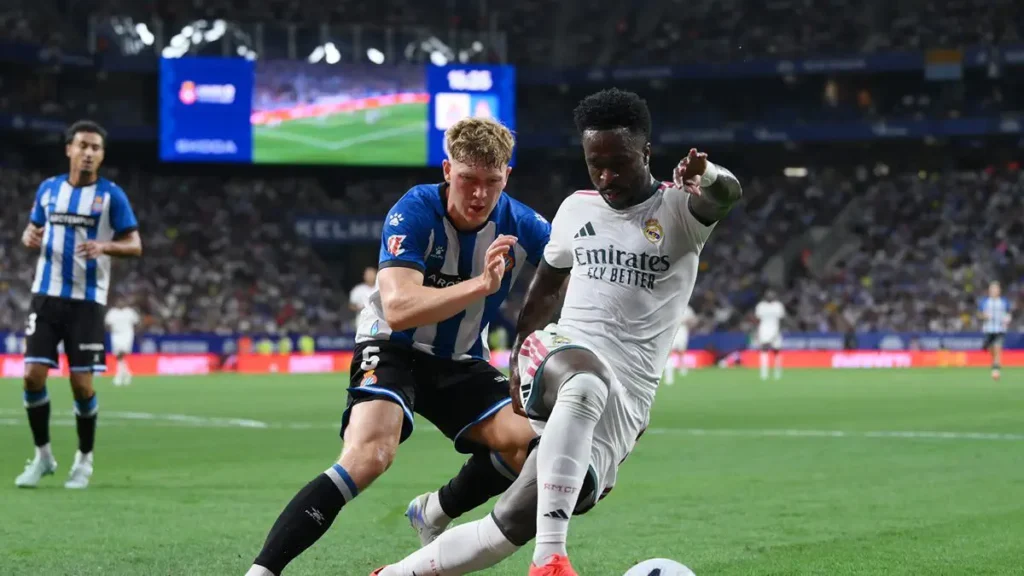
Saturday produced several major refereeing talking points across La Liga and the Premier League, but two matches stand above the rest.
Espanyol against Real Madrid included repeated incidents involving Vinicius Junior, two penalty appeals and a major disciplinary question surrounding Álex Calatrava. Earlier at San Mamés, Yuri Berchiche’s early red card fundamentally changed Athletic Club’s 3-1 defeat to Sevilla.
Here is The VAR Verdict analysis of the decisions that actually deserve discussion.
Espanyol vs Real Madrid: should Calatrava have been booked after three minutes?
José María Sánchez Martínez had his first difficult decision almost immediately.
Less than three minutes into the match, Vinicius was fouled by Álex Calatrava. After the initial challenge and with the Real Madrid winger on the ground, Calatrava made additional kicking contact with him.
No card was shown.
Former Spanish international referee Iturralde González described it as a clear yellow card, but not a red because the action lacked the excessive force required for the more serious sanction.
The VAR Verdict: Yellow card missed 🟨
We agree.
There is a distinction between an unnecessary kick and violent conduct.
Calatrava’s action has no footballing purpose once Vinicius is already on the ground. That makes it misconduct. However, a straight red for violent conduct requires the referee to judge the nature and force of the action as sufficiently serious.
On the available evidence, yellow is the more proportionate sanction.
That also explains why VAR did not automatically intervene.
VAR cannot simply call Sánchez Martínez to the monitor because it believes a yellow card was missed. It would need to consider the incident a potential straight-red offence.
So this looks primarily like an on-field refereeing mistake rather than a VAR failure.
Verdict: Yellow card should have been shown. No clear basis for a mandatory VAR red-card intervention.
Why that missed yellow became much more important
This is where the first decision affected the rest of the match.
Calatrava was eventually booked in the 32nd minute following another confrontation with Vinicius. Then, shortly after the second half began, he arrived late and strongly in a challenge on Álvaro Carreras.
Again, no second yellow followed.
Iturralde considered the Carreras challenge cautionable and actually described it as more deserving of a yellow than the earlier incident.
The VAR Verdict: Espanyol were fortunate ⚠️
This is the most significant refereeing issue from the match.
Taken independently, the Carreras challenge has a strong argument for a yellow card.
And once Calatrava is already booked, the consequence should not influence the referee’s threshold.
Officials should not think:
“He already has a yellow, so this challenge needs to be worse before I book him again.”
If an offence deserves a yellow in isolation, it should still deserve a yellow when the player already has one.
Had Sánchez Martínez cautioned Calatrava, Espanyol would have been reduced to ten.
There is another important VAR point here.
The new 2026/27 Laws allow VAR to review a clearly incorrect second yellow that has actually resulted in a red card. They do not allow VAR to manufacture a second yellow that the referee never showed in the first place.
So again, if this was a mistake, it belonged principally to the referee.
Verdict: Second yellow was justified. Espanyol were fortunate to remain with eleven players.
Was the kick on Vinicius actually a red card?
This is where we would be slightly more conservative than some of the reaction online.
Because the action occurred away from a genuine attempt to play the ball, it naturally looks bad.
But not every deliberate kick is automatically violent conduct.
The referee must consider force, brutality, intensity and the actual nature of the contact.
For us, the stronger criticism is not that VAR definitely missed a red card.
The stronger criticism is that Sánchez Martínez failed to punish obvious misconduct at all.
A yellow would have established the correct disciplinary line immediately and, importantly, changed Calatrava’s position for the rest of the match.
Sometimes the biggest refereeing mistake is not the spectacular red-card error. It is an early missed yellow that changes how every later challenge has to be managed.
Dumfries penalty appeal: was the holding enough?
Real Madrid also wanted a penalty shortly before half-time when Denzel Dumfries complained of being held by Omar El Hilali inside the area.
Sánchez Martínez allowed play to continue and VAR did not intervene.
Iturralde’s assessment was straightforward: no penalty.
The VAR Verdict: No penalty ✅
Holding inside the penalty area is not automatically an offence.
Defenders and attackers are allowed physical contact when competing for position. Referees need to punish holding when it clearly restricts an opponent’s movement or ability to challenge for the ball.
A brief grab without a meaningful consequence is not enough.
This is also exactly where VAR should maintain a high threshold.
If the referee sees the contact and judges it insufficient for a penalty, VAR should not search frame by frame for evidence of a hand on a shirt.
Verdict: Correct no-penalty decision.
Vinicius goes down in the area: penalty or too easy?
Vinicius had another penalty appeal in the 62nd minute after contact with Edu Expósito.
Once again, Sánchez Martínez said no.
Iturralde agreed, arguing that the Espanyol player put a hand on Vinicius but that the Real Madrid forward went down too easily.
The VAR Verdict: No penalty ✅
This is an important principle for VAR analysis:
Contact does not equal foul.
Slow motion has created a bad habit in modern football where any visible contact inside the penalty area is treated as possible evidence for a penalty.
That is not how Law 12 works.
The question is whether the defender’s action is illegal and whether that action actually causes the attacker to lose balance or be impeded.
A hand placed briefly on an opponent does not automatically satisfy that test.
From the available evidence, there is not enough for VAR to overturn the on-field decision.
Verdict: Correct decision to play on.
Athletic vs Sevilla: was Yuri Berchiche’s red card correct?
The most controversial major decision of the day came at San Mamés.
In the 11th minute, Miguel Sierra broke towards goal and Yuri Berchiche made contact from behind near the edge of the Athletic penalty area.
Referee César Soto Grado showed a straight red card for denying an obvious goalscoring opportunity, and VAR Valentín Pizarro Gómez allowed the decision to stand.
Athletic played almost the entire match with ten players and eventually lost 3-1.
But was it really DOGSO?
The VAR Verdict: Red card looks too severe ❌
This is the decision we disagree with most strongly.
To decide whether an offence denies an obvious goalscoring opportunity, the referee must consider several factors.
How far is the attacker from goal?
What is the direction of play?
Where are the other defenders?
And crucially: what is the likelihood that the attacker will gain or maintain control of the ball?
That last point is critical here.
Sierra’s touch had taken the ball away from him before Yuri’s contact. The question is therefore not simply whether Yuri was the final defender.
“Last man” is not actually the Law.
The question is whether there was an obvious goalscoring opportunity.
Iturralde reached the same conclusion, saying Sierra did not have sufficient control of the ball and that the incident was more appropriately punished with a yellow card.
Our reading is similar.
There is a foul.
There is a strong case for a yellow.
But the control element makes the DOGSO red difficult to justify.
Because this was a direct red card, VAR absolutely had jurisdiction to intervene.
Verdict: Foul + yellow card would have been the better outcome. VAR should seriously have considered recommending an on-field review.
Sevilla’s opening goal: was Unai Simón fouled?
Only a few minutes later another controversial moment arrived.
Robbie Ure pressured Unai Simón as the goalkeeper attempted to play the ball. Simón’s distribution went wrong, possession fell to Oso and Sevilla scored.
Athletic players immediately wanted a foul on their goalkeeper.
Soto Grado allowed the goal.
The VAR Verdict: Goal should stand ✅
This one looks correct.
Goalkeepers do not receive automatic protection simply because an opponent challenges them.
If the goalkeeper has the ball controlled in his hands, the Laws give him specific protection. But when he is playing the ball normally with his feet, an opponent can pressure him like any other player, provided the challenge itself is legal.
The available reports describe Ure’s action as a normal physical challenge rather than a careless charge, and Iturralde also considered it legal.
The error belongs primarily to Unai Simón.
Verdict: Correct goal. No attacking foul.
Nottingham Forest vs Leeds: two useful VAR checks
The Premier League also gave us an interesting example of VAR showing restraint.
Ola Aina was booked after a lunge on James Justin in Nottingham Forest’s 1-0 defeat to Leeds. VAR checked whether the challenge should be upgraded to a red card and decided the yellow was sufficient.
Later, Dominic Calvert-Lewin was booked for a high challenge on James McAtee. VAR again reviewed the incident and decided it was reckless rather than serious foul play.
The VAR Verdict: Good use of VAR ✅
This is what supporters often forget.
A VAR check does not have to result in an intervention.
The video official’s job is not to find reasons to overturn the referee.
It is to determine whether the referee’s original decision is clearly wrong.
A reckless challenge means yellow.
A challenge using excessive force or endangering an opponent’s safety moves into serious foul play and red-card territory.
If the footage supports the lower threshold, VAR should simply complete the check and allow the match to continue.
That appears to have happened twice at the City Ground.
Brentford vs Tottenham: straightforward penalty call
Michael Oliver also awarded Brentford a penalty after Rodrigo Bentancur fouled Kevin Schade inside the Tottenham penalty area.
Igor Thiago eventually hit the post, but the penalty decision itself attracted little serious dispute. Brentford still won 3-0.
The VAR Verdict: Correct penalty ✅
Not every penalty needs a five-minute forensic debate.
When a defender makes a clear careless challenge inside the penalty area and brings down the attacker, the decision should be simple.
Michael Oliver identified the offence immediately.
VAR had no reason to interfere.
That is good refereeing.
Saturday referee verdicts
Calatrava kick on Vinicius: 🟨 MISSED YELLOW
Not enough for us to demand a straight red, but Sánchez Martínez should have cautioned him.
Calatrava challenge on Carreras: 🟥 SECOND YELLOW JUSTIFIED
The more significant mistake. Once already booked, the Espanyol player was fortunate to stay on the field.
Dumfries penalty appeal: ✅ NO PENALTY
Not enough holding to justify a spot kick.
Vinicius penalty appeal: ✅ NO PENALTY
Contact existed, but contact alone is not an offence.
Yuri Berchiche red card: ❌ RED TOO HARSH
The lack of clear ball control weakens the DOGSO argument. Foul and yellow would have been more appropriate.
Ure challenge on Unai Simón before Sevilla goal: ✅ GOAL CORRECT
Legal pressure on the goalkeeper. Simón’s mistake does not make the challenge a foul.
Forest-Leeds VAR red-card checks: ✅ GOOD VAR
Two incidents checked without unnecessary intervention.
Brentford penalty against Tottenham: ✅ CORRECT
A relatively straightforward penalty decision.
Final VAR Verdict
The biggest refereeing question from Saturday is Yuri Berchiche’s dismissal.
For us, the red card was too severe because an obvious goalscoring opportunity requires more than simply identifying the defender closest to goal. The attacker’s ability to control the ball is a fundamental part of DOGSO, and that element was questionable.
Espanyol against Real Madrid produced a different type of refereeing problem.
Sánchez Martínez got both major penalty appeals right, but his disciplinary management of Calatrava was far less convincing.
The early kick on Vinicius should have produced a yellow card. More importantly, the second-half challenge on Carreras had a strong case for another caution.
That distinction is important.
VAR does not exist to fix every refereeing mistake.
Some decisions still belong entirely to the man with the whistle.
Saturday gave us examples of both sides of modern officiating: VAR correctly staying away from marginal penalty appeals and reckless challenges, but also situations where a major on-field disciplinary decision deserved much greater scrutiny.
That is exactly the balance football is still trying to find.

0 Comments
Join the conversation with respect. Comments are moderated and must follow our community rules.
Want to join the discussion?
Please log in or create an account to comment and reply. This keeps the conversation cleaner and safer.