
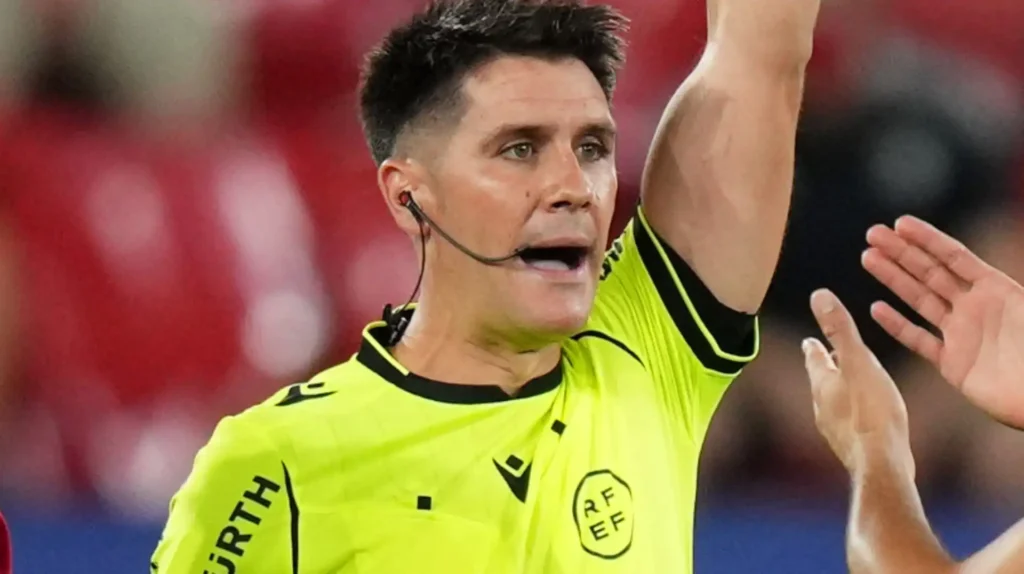
Barcelona beat Athletic Club 2-0 at the Spotify Camp Nou on Thursday night, but the most interesting Barcelona vs Athletic referee decisions came during the opening half-hour.
Raphinha opened the scoring in the 37th minute before Fermín López made it 2-0 late in the second half. Miguel Ángel Ortiz Arias was the referee, with Jorge Figueroa Vázquez on VAR.
There was no penalty, red card or major VAR intervention, but that does not mean the officials had an easy night.
Xavi Espart was involved in two incidents that deserve proper analysis. Athletic wanted him sent off after bringing down Iñaki Williams, while an earlier challenge on Aymeric Laporte may actually have been the more important refereeing mistake.
Xavi Espart on Laporte: the decision Ortiz Arias missed
The first controversial moment arrived after around ten minutes.
Espart lost control of the ball and tried to recover it, arriving late into a challenge on Aymeric Laporte around the ankle area.
The surprising part was not that Espart escaped a red card.
It was that Ortiz Arias did not even award a foul.
Laporte needed treatment after the challenge.
Spanish referee analysis after the match also questioned the decision, with the incident widely considered worthy of at least a yellow card.
The VAR Verdict: Yellow card missed 🟨❌
For us, this should have been a booking.
Espart arrives late, catches Laporte and the challenge has enough intensity to move beyond a simple careless foul.
Would we show a straight red?
No.
There is not enough clear evidence of excessive force or serious foul play for us to demand a dismissal.
But yellow is the correct disciplinary level.
This is important because of what happened only around 15 minutes later.
Verdict: Foul and yellow card should have been given.
Espart brings down Iñaki Williams: Athletic demand a red
The second incident arrived in the 26th minute.
Iñaki Williams attacked space after Barcelona failed to deal cleanly with the ball. Espart chased him and brought the Athletic forward down from behind just outside the penalty area.
Athletic’s bench immediately wanted a straight red card for denying an obvious goalscoring opportunity.
Ortiz Arias instead showed Espart a yellow.
VAR checked the situation but did not recommend a review.
The VAR Verdict: Yellow correct, not a straight red ✅
This is where the phrase “last man” causes confusion.
The Laws of the Game do not say:
Last defender = automatic red card.
For DOGSO, the referee has to consider several factors:
Distance to goal
Direction of the attack
Likelihood of controlling the ball
Position and number of other defenders
Gerard Martín was still in a position where he had a realistic possibility of becoming involved defensively.
That means Williams did not have an unquestionably obvious one-on-one opportunity.
The foul clearly stops a promising attack, so yellow is justified.
But the threshold for DOGSO is higher.
Former referee Iturralde González reached the same conclusion after the match: clear yellow, but not red because another Barcelona defender remained in a position to intervene.
Verdict: Correct yellow card. No DOGSO red.
But should Barcelona actually have gone down to ten?
This is where the discussion becomes much more interesting.
If Espart should have received a yellow for the earlier challenge on Laporte, the foul on Williams would then have been his second caution.
Barcelona could therefore have been reduced to ten players in the 27th minute.
That does not mean we can simply say:
“Espart definitely should have been sent off.”
Football does not work retrospectively like that.
If he had been booked after ten minutes, Espart might have defended differently afterwards. Hansi Flick might even have changed his position or made a substitution.
But from a pure refereeing perspective, there is a legitimate criticism:
Ortiz Arias missed a cautionable first offence, and Espart then committed another clear yellow-card offence.
That makes the first mistake much more significant.
The VAR Verdict: Athletic have a legitimate complaint ⚠️
Not because the Williams challenge was a straight red.
It was not.
Athletic’s stronger complaint should be about the challenge on Laporte.
If that first incident is correctly punished, the entire disciplinary context of the match changes.
Why VAR could not simply give Espart a second yellow
This is another important point.
VAR cannot go back to the Laporte incident and tell the referee:
“You should have booked Espart earlier, so now this is his second yellow.”
The video system does not work like that.
A missed normal yellow card is generally outside VAR’s intervention protocol.
VAR could intervene in the first incident only if it considered Espart’s challenge a possible direct red-card offence, such as serious foul play.
For us, it did not clearly reach that level.
Then, on the Williams incident, VAR could review whether the foul should have been a straight red for DOGSO.
It correctly determined that it should not.
So we can have an unusual situation where:
the referee may have made an important disciplinary mistake, but VAR was still correct not to intervene.
That distinction matters.
Not every refereeing error is a VAR error.
Anthony Gordon penalty appeal: was there enough contact?
Barcelona had their own complaint in the second half.
Anthony Gordon went down inside the Athletic penalty area following contact with a defender and wanted a penalty.
Ortiz Arias immediately allowed the game to continue.
VAR did not intervene.
Post-match referee analysis also supported the decision, describing the contact as normal football contact rather than a punishable offence.
The VAR Verdict: No penalty ✅
We agree.
This is exactly the type of incident that becomes more dramatic when watched repeatedly in slow motion.
There is contact.
But contact alone is not enough.
A defender is allowed to use his body legally and compete for position. For a penalty, the referee needs an actual offence: a trip, push, hold, charge or other illegal action.
Nothing in this incident clearly crosses that threshold.
Gordon goes down, but the defender’s action does not provide enough evidence for a penalty.
Verdict: Correct decision to play on. Correct VAR non-intervention.
Raphinha puts Barcelona ahead
The refereeing discussion did not decide the result.
Barcelona took the lead in the 37th minute through Raphinha and increasingly controlled the game.
Athletic still created moments of danger, with Oihan Sancet hitting the post in the second half, but Barcelona eventually secured the points when Fermín López scored in the 82nd minute.
The match finished Barcelona 2-0 Athletic Club.
There was no significant controversy surrounding either goal.
That is worth mentioning because referee-analysis sites should not manufacture incidents simply because a match contains VAR.
Both goals stood without a meaningful reason for intervention.
Ortiz Arias referee performance
This was not a bad performance overall, but the missed Espart challenge on Laporte prevents us from rating it particularly highly.
His strongest decision was arguably the one Athletic protested most loudly.
The foul on Iñaki Williams looked dramatic because Williams was heading towards goal, but Ortiz Arias correctly recognised that the DOGSO criteria were not fully satisfied.
Showing yellow rather than reacting to the bench and atmosphere with a red was the right decision.
The problem was what happened earlier.
The Laporte challenge deserved disciplinary action.
Once that yellow is missed, Espart remains on the pitch after committing what should probably have been two separate cautionable offences.
The VAR Verdict referee rating: 6.5/10
Espart on Laporte: 🟨❌ Yellow missed
Espart on Iñaki Williams: 🟨✅ Yellow correct
Athletic straight-red appeal: ✅ Correctly rejected
Gordon penalty appeal: ✅ No penalty
Major VAR mistake: ✅ None
It is an interesting example of why a referee can make an important mistake even when VAR technically does its job correctly.
An awkward week for Athletic and refereeing
There is also an unavoidable piece of context.
Athletic arrived at Camp Nou without Yuri Berchiche after his controversial red card against Sevilla.
The Spanish Referees’ Technical Committee publicly acknowledged that Yuri’s dismissal had been a “clear and manifest error”, but Athletic’s appeal against the one-match suspension was still rejected, meaning he had to miss the Barcelona game.
That made the Espart incident especially sensitive for Athletic.
Only days after losing Yuri to a red card that refereeing authorities themselves later recognised as incorrect, Athletic watched a Barcelona defender commit two significant challenges in the opening 27 minutes and remain on the field.
That does not mean Ortiz Arias should have shown Espart a straight red simply to create some kind of balance.
Referees cannot compensate one club for a previous mistake.
But it explains why Athletic’s reaction was so strong.
Final VAR Verdict
Barcelona deserved their 2-0 victory, and there is no strong case that a penalty, direct red card or VAR decision incorrectly determined the result.
But there was one meaningful refereeing mistake.
Xavi Espart should have been booked for the early challenge on Laporte.
His later foul on Iñaki Williams was correctly punished with yellow rather than a straight DOGSO red.
Taken separately, Ortiz Arias got the second decision right.
Taken together, however, the two incidents create a legitimate question about whether Barcelona should eventually have been playing with ten men.
The Anthony Gordon penalty appeal was much simpler.
There was contact, but not enough for an offence. Play on was the correct decision.
So our overall verdict is slightly unusual:
Athletic were wrong to demand a direct red for the Williams incident, but they were right to feel Espart had been fortunate to stay on the pitch.
And importantly, that was primarily an on-field refereeing issue.
Not a VAR failure.

0 Comments
Join the conversation with respect. Comments are moderated and must follow our community rules.
Want to join the discussion?
Please log in or create an account to comment and reply. This keeps the conversation cleaner and safer.