
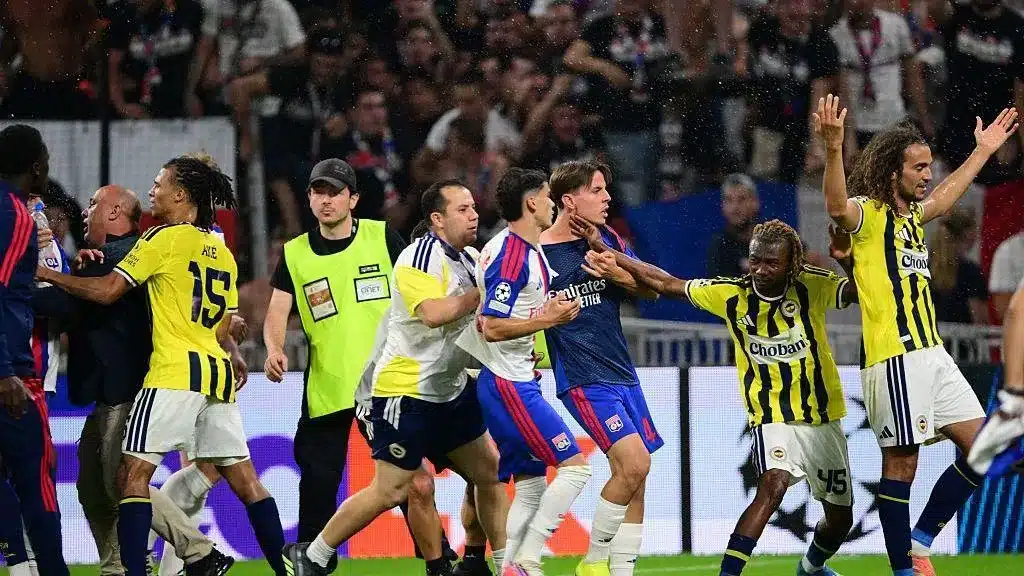
Fenerbahce should have been celebrating one of their biggest European nights in years. Instead, much of the discussion after their 2-1 victory over Lyon is now about Mattéo Guendouzi.
The Turkish side won 3-2 on aggregate and secured a place in the Champions League league phase, but the final whistle at Groupama Stadium triggered ugly scenes involving players, staff and security.
Guendouzi was at the centre of it.
The former Marseille midfielder repeatedly provoked Lyon supporters, celebrated Fenerbahce’s qualification directly in front of the home crowd, shouted “Allez l’OM” and made a gesture associated with Marseille rapper Jul. Players reacted, a confrontation began on the pitch and the situation later became even more serious near the tunnel.
There is an important distinction, however.
Guendouzi’s behaviour can be criticised and potentially punished by UEFA. But provoking somebody does not give players, coaches or supporters the right to physically attack him.
Those are separate disciplinary offences and UEFA should treat them separately.
It actually started before kickoff
The tension did not begin with the final whistle.
Guendouzi spent more than two seasons with Marseille and remains strongly associated with Lyon’s biggest French rival.
When Fenerbahce came out to warm up, Guendouzi was heavily booed by the Lyon supporters.
His response was immediate and unnecessary.
L’Équipe reported that Guendouzi responded to the crowd by showing his middle finger several times during the warm-up.
That is already significant from a disciplinary perspective.
A footballer being booed is normal. Even very aggressive verbal abuse from supporters does not give a player complete freedom to respond with offensive gestures.
UEFA’s 2026 Disciplinary Regulations specifically list provoking spectators, unsporting conduct and insulting people present at a match among offences that can result in a one-match suspension or another specified sanction.
So Guendouzi may already have exposed himself to UEFA action before the match even started.
What did Guendouzi do after the final whistle?
Fenerbahce had every reason to celebrate.
They had beaten Lyon 2-1 away from home after the first leg finished 1-1, qualifying 3-2 on aggregate. Vedat Muriqi and Archie Brown scored for Fenerbahce before Malick Fofana pulled one back for Lyon.
But Guendouzi did more than simply celebrate with his teammates.
He went towards the Lyon supporters and continued the Marseille references.
He performed the Jul hand gesture and was then captured shouting “Allez l’OM!”
Given the history between Lyon and Marseille, there was absolutely no ambiguity about the intention.
It was a provocation.
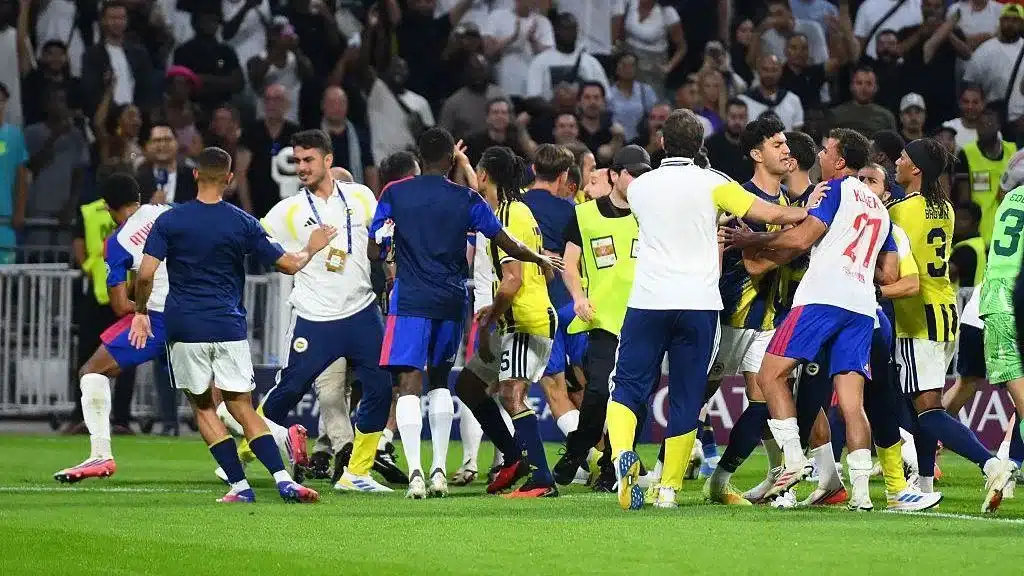
Lyon players confronted him, Fenerbahce players became involved and a mass confrontation developed.
The VAR Verdict: Guendouzi crossed the line
Celebrating qualification is completely legitimate.
Celebrating in front of your own supporters is legitimate.
Even showing emotion after being abused for 90 minutes is understandable.
But deliberately walking towards an eliminated opponent’s supporters and using their biggest rival to provoke them is different.
Our verdict: Guendouzi’s behaviour was unnecessary and clearly provocative.
UEFA has rules specifically designed for this situation.
That does not mean he deserves an enormous suspension. But based on the available footage and reports, there is a legitimate disciplinary case for provoking spectators and/or unsporting conduct.
Guendouzi says his family was insulted for 90 minutes
There is another side to the story.
After the match, Guendouzi explained why he reacted.
He said Lyon supporters had insulted his family, including his mother and children, throughout the night. He also complained that nobody from the refereeing team intervened to calm the situation.
That context matters.
Nobody should pretend that a player is a robot who hears nothing from the stands.
If supporters spend an entire match directing personal abuse towards a player’s family, frustration is understandable.
But there is a difference between explaining behaviour and justifying it.
Guendouzi could have celebrated with the Fenerbahce supporters and walked down the tunnel.
Instead, he deliberately answered the crowd.
From a UEFA disciplinary perspective, “they insulted me first” is unlikely to remove responsibility for an offensive gesture or deliberate provocation.
It could potentially be considered as context or mitigation. It does not make the action disappear.
Corentin Tolisso’s reaction was telling
Lyon captain Corentin Tolisso publicly criticised Guendouzi afterwards.
Tolisso acknowledged the emotional atmosphere but made the basic point that a player cannot react in that manner simply because supporters are provoking him.
That is probably the fairest interpretation.
Guendouzi was deliberately targeted because of his Marseille past.
But an experienced international player also knows exactly what shouting “Allez l’OM” in front of Lyon supporters after eliminating their club is going to do.
He was not trying to calm the situation.
He was trying to get a reaction.
And he got one.
But Lyon’s response went far beyond acceptable
This is where the incident becomes much more serious.
Reports and footage from the tunnel area show Lyon goalkeeping coach Antonio Ferreira moving aggressively towards Guendouzi as the Fenerbahce midfielder was trying to leave the pitch.
Fenerbahce players and staff then became involved and Ferreira was surrounded during the confrontation. L’Équipe identifies Ferreira as the Lyon staff member who rushed towards Guendouzi near the tunnel.
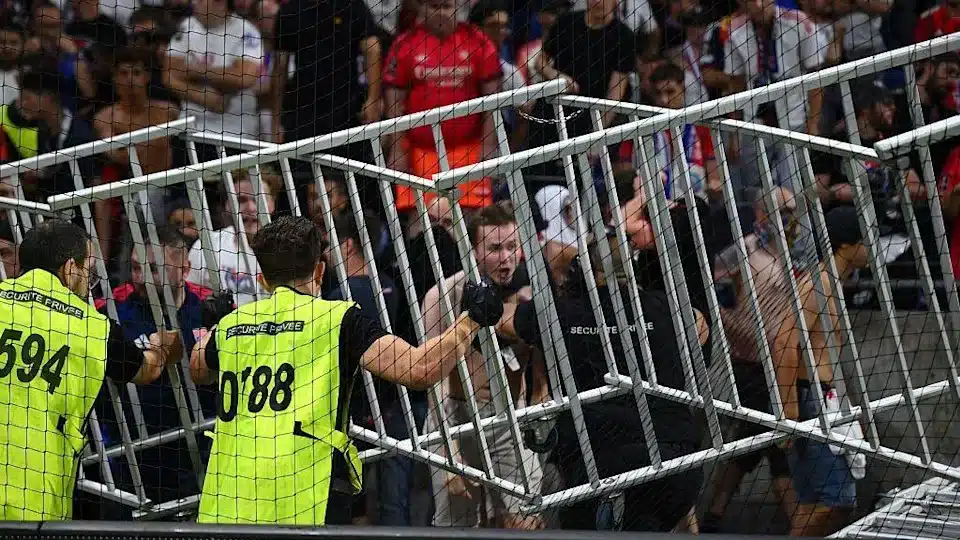
Other footage also reportedly shows a supporter entering the restricted area near the tunnel and attempting to get at Guendouzi, creating another security incident.
This cannot be excused by Guendouzi’s provocation.
The VAR Verdict: Physical retaliation is more serious
A middle finger can be punished.
Provoking spectators can be punished.
Unsporting behaviour can be punished.
But attempting to physically attack somebody moves the situation into a completely different disciplinary category.
UEFA’s current regulations provide for a three-match suspension or specified period for assaulting another player or another person present at the match. More serious cases can result in increased sanctions.
If UEFA determines from the footage and officials’ reports that a member of Lyon’s staff attempted or committed an assault, the potential consequences could therefore be considerably more serious than the punishment facing Guendouzi for provoking the crowd.
That is how it should be.
Provocation and violence cannot be treated as equivalent offences.
Lyon could also face a stadium-security case
The supporter involvement creates another problem for Lyon.
UEFA Article 16 makes host clubs responsible for order and security before, during and after UEFA matches.
The regulations specifically cover pitch invasions, crowd disturbances and other failures of order around the stadium.
If UEFA confirms that a Lyon supporter gained access to a restricted area and attempted to confront a Fenerbahce player, the club could face a separate disciplinary charge.
This part of the incident has nothing to do with whether Guendouzi was behaving badly.
Players must be able to reach the dressing room safely.
Once a supporter can physically approach an opposing player near the tunnel, there is a security issue.
What could UEFA do to Guendouzi?
As of Thursday morning, UEFA has not publicly announced a disciplinary decision or formal charge against Guendouzi for these incidents.
So any claim that he has already been suspended would be premature.
But the disciplinary regulations give us a good idea of what UEFA could examine.
Article 15 provides for a one-match suspension or specified period for:
Provoking spectators
Unsporting conduct
Insulting players or other people present at the match
The middle-finger gesture before kickoff and the post-match actions could potentially fall within those categories.
UEFA does not necessarily have to treat every gesture as an independent suspension, and aggravating or mitigating factors can influence the final sanction.
So we should not simply add one game for every action and predict a three or four-match ban.
But a UEFA investigation and at least some disciplinary action would not be surprising.
Could the referee punish Guendouzi after the final whistle?
Yes.
This is another misconception worth clearing up.
The referee’s disciplinary authority does not disappear the instant the final whistle is blown.
Maurizio Mariani remained responsible for misconduct occurring on the field and around the immediate post-match period while the match officials still had authority.
Guendouzi had actually been booked in the 90+4th minute for a foul on Tolisso, shortly before the final whistle.
But even if Mariani or his team did not personally see every post-match action, that does not prevent UEFA from acting retrospectively.
With dozens of players and staff involved in a mass confrontation, a referee cannot realistically identify everything occurring at the same time.
UEFA can use referee reports, delegate reports, security reports and video footage to investigate what happened afterwards.
That is exactly why a disciplinary system exists outside the 90 minutes.
What about the actual refereeing during the match?
Interestingly, the match itself contained significant VAR activity before the post-match chaos took over the headlines.
Lyon had two goals disallowed after VAR checks in the second half.
Loïs Openda’s 64th-minute goal was overturned for offside, and another Lyon goal involving Kaïl Boudache was disallowed at 71 minutes after a second review.
There was also a Fenerbahce penalty appeal for a possible Niakhaté handball early in the second half. Mariani allowed play to continue and VAR supported the on-field decision.
Despite Lyon’s frustration, there is currently no strong evidence that any of those decisions represents the major refereeing error of the night.
Ironically, Mariani and VAR were largely overshadowed not by a controversial penalty or red card, but by what happened after the football ended.
Who is responsible for the brawl?
It is tempting to choose one person and say:
“Guendouzi caused everything.”
The reality is more complicated.
Guendouzi unquestionably played a central role in escalating the atmosphere.
His middle-finger gestures were provocative.
His post-match celebration in front of the Lyon crowd was provocative.
The “Allez l’OM” shout was provocative.
He knew exactly what those actions meant in Lyon.
But every person remains responsible for his own response.
A Lyon player confronting him is responsible for that confrontation.
A staff member attempting to attack him is responsible for that action.
A supporter entering a restricted area is responsible for that security breach.
Fenerbahce players or staff who used unnecessary violence in the resulting melee would also be responsible for their own actions.
Provocation explains why a fight started. It does not legally or disciplinarily excuse the fight.
That distinction should be central to UEFA’s investigation.
Our disciplinary verdict
Mattéo Guendouzi: ⚠️ DISCIPLINARY ACTION JUSTIFIED
The gestures towards supporters and deliberate post-match provocation appear to fit UEFA’s rules on provoking spectators and unsporting conduct. A suspension would not surprise us.
Lyon staff involvement: 🟥 POTENTIALLY MORE SERIOUS
If the footage establishes attempted or actual physical assault, UEFA should treat that significantly more severely than verbal or gestural provocation.
Supporter/tunnel security: ❌ LYON HAVE QUESTIONS TO ANSWER
An opposing player should not be reachable by a supporter in a restricted stadium area, regardless of what that player has shouted towards the crowd.
Fenerbahce participants in the melee: 🔍 NEEDS VIDEO REVIEW
Anybody who struck or attempted to strike another person should be judged individually. Being on the “provoked” side does not provide immunity from discipline.
Final VAR Verdict
Guendouzi behaved irresponsibly.
That should be said clearly.
He was playing against the historic rival of his former club, was booed heavily, responded with offensive gestures before kickoff and then deliberately celebrated Fenerbahce’s qualification in a manner designed to anger the Lyon crowd.
He cannot reasonably claim that he was simply celebrating innocently.
But there is another point that matters even more:
being provocative does not make somebody fair game for physical violence.
If Lyon staff or supporters attempted to attack Guendouzi, UEFA should sanction those actions separately and more severely where the regulations require it.
Football disciplinary decisions should not work on the principle of “he started it.”
They should identify every action and judge every participant individually.
Guendouzi may have lit the match.
Anyone who then chose to turn the confrontation into physical violence still made their own decision.
Now UEFA has the footage.
The next question is how hard it decides to punish everyone involved.

0 Comments
Join the conversation with respect. Comments are moderated and must follow our community rules.
Want to join the discussion?
Please log in or create an account to comment and reply. This keeps the conversation cleaner and safer.