
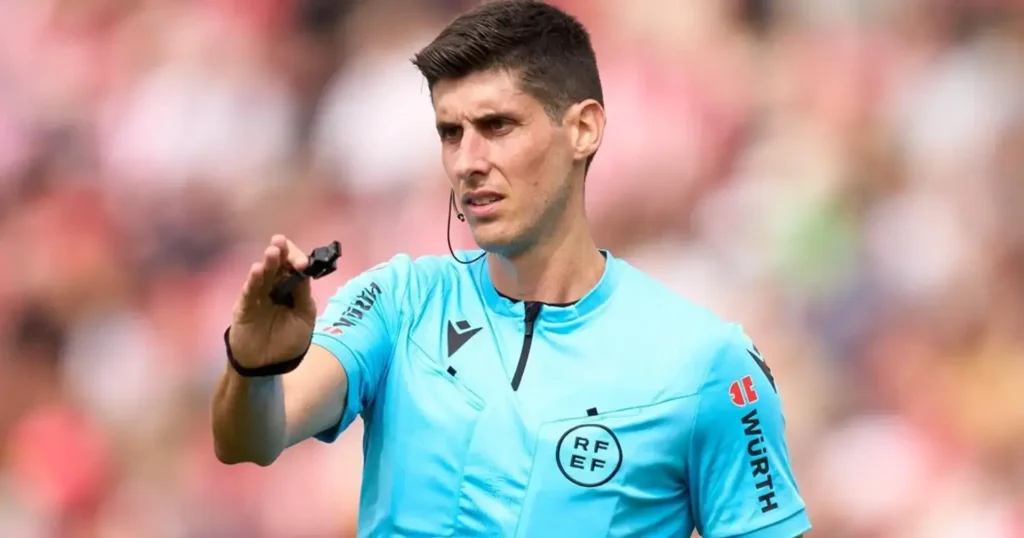
Real Madrid’s first home league game of the season ended with a convincing 4-1 victory over Real Sociedad, and for once the referee was not the biggest talking point at the Santiago Bernabéu.
Kylian Mbappé scored a hat-trick, Vinícius Junior added another and Luka Sučić briefly brought Real Sociedad level before half-time. Mateo Busquets Ferrer had several disciplinary situations to manage, particularly during a competitive first half, but there were no penalties, no red cards and no major VAR intervention.
After the controversy surrounding some of Real Madrid’s recent matches, that alone is worth highlighting.
Real Madrid 4-1 Real Sociedad: what happened?
Real Sociedad actually started well and created the first big opportunity, with Thibaut Courtois denying Mikel Oyarzabal after Takefusa Kubo’s pass.
Real Madrid gradually took control, and Mbappé opened the scoring in the 40th minute after Federico Valverde drove through midfield and released him into the area.
Sučić equalised four minutes later after Ochieng’s effort was blocked and the rebound fell kindly to the Croatian.
The second half was a different game.
Mbappé restored Madrid’s lead in the 60th minute after an excellent combination with Jude Bellingham. Vinícius made it 3-1 eight minutes later before returning the favour to Mbappé with the assist for his hat-trick goal in the 80th minute.
From that point, there was little doubt about the result.
Mateo Busquets Ferrer’s refereeing performance
We highlighted before the match that Busquets Ferrer had averaged more than five yellow cards per game in La Liga last season.
Wednesday’s match never reached that kind of disciplinary level.
He showed four yellow cards according to the available match data:
Álvaro Carreras – 10’
Yangel Herrera – 31’
Jon Aramburu – 45+2’
Ibrahima Konaté – 73’
The overall foul threshold was relatively consistent. Busquets allowed physical competition but stepped in when challenges became tactical or unnecessarily forceful.
There are, however, a couple of decisions worth discussing.
Carreras yellow card on Kubo: too harsh?
The first card arrived very early.
Álvaro Carreras challenged Takefusa Kubo low to the ground in the 10th minute and Busquets immediately produced yellow.
BeSoccer’s live report also described the booking as somewhat excessive.
The VAR Verdict: Foul yes, yellow slightly harsh ⚖️
For us, this is the most debatable disciplinary decision of the match.
There is enough for a foul. Carreras arrives late enough to interrupt Kubo’s progress.
But a yellow card requires something more: normally a reckless nature, a significant tactical consequence or another cautionable element.
From the available views and descriptions, this looked closer to a normal careless foul than an obvious reckless challenge.
It is not a serious mistake, but Busquets established a fairly strict disciplinary threshold within the opening ten minutes.
Interestingly, Mourinho replaced Carreras with Marc Cucurella at half-time. The booking almost certainly made the second half more difficult for a full-back facing Kubo.
Verdict: Foul correct. Yellow arguably harsh.
Yangel Herrera on Bellingham: obvious yellow
There was much less debate in the 31st minute.
Yangel Herrera grabbed Bellingham and continued holding him as the Madrid midfielder tried to escape.
Busquets showed yellow immediately. El País and BeSoccer both describe it as a sustained holding offence.
The VAR Verdict: Correct yellow ✅
This is a simple caution.
The challenge is not particularly violent, but it is clearly tactical. Herrera has been beaten and uses prolonged holding to stop Bellingham progressing.
These are exactly the fouls referees need to punish consistently.
Allowing tactical holding without cards encourages teams to use it repeatedly.
Verdict: Correct yellow card.
Aramburu catches Vinicius: yellow or red?
Vinícius was again involved in one of the more physical moments of a Real Madrid match.
Just before half-time, Jon Aramburu caught the Brazilian with his arm as Vinícius accelerated down the left.
Busquets stopped play and showed Aramburu a yellow card. Both El País and BeSoccer recorded the incident as an arm/hand contact while Vinícius was escaping down the wing.
The VAR Verdict: Yellow is correct ✅
There is no convincing case for a straight red here.
An arm contacting an opponent’s face or upper body does not automatically mean violent conduct.
The referee has to assess force, intention, point of contact and whether the action is part of a normal football movement.
Aramburu’s action is illegal and clearly stops Vinícius, but it does not appear to contain the brutality or excessive force required for violent conduct.
Yellow is proportionate.
This was also a better disciplinary response than some of the incidents involving Vinícius at Espanyol four days earlier.
Verdict: Correct yellow. No VAR red-card intervention necessary.
Sučić challenge on Bellingham: could there have been another card?
Early in the second half, Sučić arrived into a contested ball with Bellingham.
BeSoccer described the Croatian as having “risked the card,” but Busquets chose only to award the foul.
This is one of those incidents where match management matters.
Not every late challenge needs yellow. A referee should look at speed, force, point of contact and whether the player is genuinely competing for the ball.
There was an argument for a caution, but it was nowhere near a clear enough mistake to make it a major refereeing controversy.
Verdict: Borderline. No major error.
Konaté tactical foul: textbook yellow
Ibrahima Konaté received Madrid’s second yellow in the 73rd minute after bringing down Barrenetxea during a Real Sociedad counterattack.
There was little protest.
The foul clearly stopped a developing transition.
The VAR Verdict: Correct yellow ✅
This is exactly why the tactical context of a foul matters.
The physical challenge itself was not particularly severe.
But Barrenetxea was moving into space and Real Sociedad had an opportunity to counter.
Konaté knew what he was doing.
Verdict: Correct caution for stopping a promising attack.
No penalties and no VAR drama
Perhaps the most positive refereeing aspect of the match was what did not happen.
There were no long VAR delays.
No marginal handball turned into a five-minute review.
No soft penalty changed the direction of the match.
No red-card intervention became the main story.
VAR González Francés had a quiet night, and that is usually a good thing.
VAR should not be judged by how many times it sends a referee to the monitor.
If the major decisions on the field are correct, the best video refereeing performance can be one that supporters barely notice.
That was largely the case at the Bernabéu.
Was Vinicius treated differently after the Espanyol controversy?
This was an interesting subplot going into the game.
José Mourinho had publicly complained about the treatment Vinícius received against Espanyol, where he believed opponents were repeatedly targeting the Brazilian.
Busquets Ferrer could not allow those comments to influence his decisions.
And, to his credit, there was no obvious sign that they did.
Vinícius was allowed to compete physically. He did not receive a free kick every time there was contact.
But when Aramburu clearly crossed the threshold with his arm challenge, the referee produced the yellow.
That is exactly how the situation should be managed.
A referee does not need to “protect” a star player differently.
He needs to punish illegal challenges consistently.
Busquets Ferrer referee rating
The VAR Verdict referee rating: 7.5/10
This was a generally good night for Mateo Busquets Ferrer.
The early Carreras booking was perhaps too aggressive and there were one or two smaller foul decisions that could be debated, but nothing significant was clearly missed.
The important disciplinary decisions were mostly correct:
Carreras yellow: ⚖️ Harsh
Herrera yellow: ✅ Correct
Aramburu yellow on Vinicius: ✅ Correct
Sučić challenge on Bellingham: ⚖️ Borderline
Konaté tactical yellow: ✅ Correct
Major VAR errors: None ✅
Most importantly, the officials did not become the story.
Final VAR Verdict
Real Madrid were simply the better team in the second half.
Mbappé’s hat-trick, Bellingham’s influence between the lines and Vinícius’ goal and assist decided the match, not a penalty, red card or controversial VAR intervention.
That is an important distinction on a referee-analysis site.
We do not need to manufacture controversy after every game.
Busquets Ferrer had decisions to make and a few can be debated, particularly the early Carreras yellow, but there was no refereeing incident serious enough to explain the 4-1 scoreline.
Real Sociedad were still level at half-time.
Real Madrid then raised the tempo, scored three unanswered goals and took control.
For the officials, this was a relatively clean night.
And sometimes the best verdict on a referee is the simplest one:
the match was decided by the players.

0 Comments
Join the conversation with respect. Comments are moderated and must follow our community rules.
Want to join the discussion?
Please log in or create an account to comment and reply. This keeps the conversation cleaner and safer.