
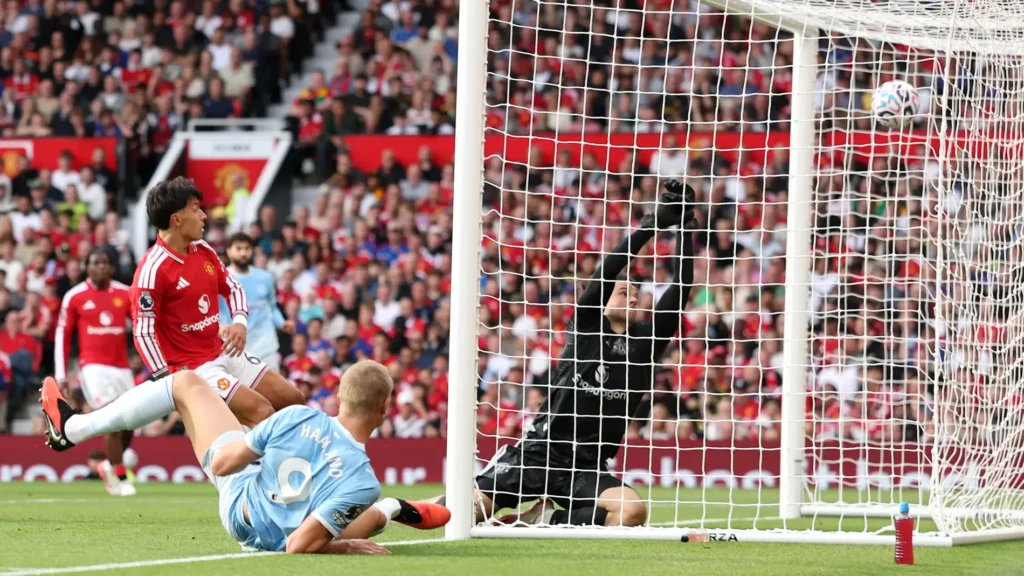
The Manchester United vs Manchester City VAR controversy now has an official conclusion from England’s refereeing body. Manchester City won 1-0 at Old Trafford through Erling Haaland’s 60th-minute goal, but Pro Ref later acknowledged that VAR made an “error of judgement” and should have sent referee Michael Oliver to the monitor because of Enzo Fernandez’s involvement from an offside position.
That was not the only major refereeing incident in a chaotic Manchester derby.
Phil Foden had already been sent off in the 23rd minute for kicking out at Bruno Fernandes. The red card was immediately checked and confirmed by VAR, although City’s frustration centred on Fernandes receiving no punishment for the action that preceded Foden’s retaliation.
So this was not simply a match with “bad VAR”.
The two major incidents were fundamentally different. Foden’s dismissal was a subjective disciplinary decision that VAR supported. Haaland’s goal involved both a factual offside calculation and a separate subjective question about whether Fernandez interfered with Lisandro Martinez.
The latter is where the officiating team went wrong.
Who were the referee and VAR?
Michael Oliver refereed the Manchester derby at Old Trafford.
Stuart Burt and Tim Wood were the assistant referees, Paul Tierney was fourth official, Matt Donohue operated as VAR and Blake Antrobus was Assistant VAR.
Manchester City eventually won 1-0 despite playing more than an hour with ten men, with Haaland scoring the only goal in the 60th minute.
23′: Phil Foden sent off after clash with Bruno Fernandes
The first major refereeing controversy arrived midway through the first half.
Fernandes challenged Foden and the City player went to ground. What happened afterwards was the important part.
Foden reacted while on the floor and kicked towards Fernandes’ body.
Oliver immediately produced a straight red card.
The Premier League Match Centre later published the officials’ reasoning. Oliver identified a kick-out into Fernandes’ body, while the VAR considered there to be a clear secondary movement and confirmed the red card for violent conduct.
That process is important.
VAR did not send Oliver to the monitor because Donohue agreed that the on-field red-card decision was clearly supportable.
What does Law 12 say?
Under IFAB Law 12, violent conduct occurs when a player uses or attempts to use excessive force or brutality against an opponent when not challenging for the ball.
Contact is not even essential if an attempted act itself reaches the violent-conduct threshold.
Foden was no longer making a normal football challenge. His action was a retaliation after the initial contact from Fernandes.
That removes much of the argument about whether he was “trying to win the ball”.
He was not.
The VAR Verdict: ✅ Foden red card was supportable and, in our view, correct
There has been significant criticism of the red card from former players, including Roy Keane and Micah Richards, but the Laws question is different from whether the reaction looked dramatic.
Foden deliberately kicked out at Fernandes after the initial challenge.
Oliver saw the action and interpreted it as violent conduct. VAR found no clear reason to overturn him.
Under Law 12, that is a defensible red card.
The fact Fernandes may have initiated the confrontation does not give Foden the right to retaliate.
But should Bruno Fernandes also have been punished?
This is where City’s complaints have more substance.
Replays showed Fernandes making additional contact with Foden immediately before the retaliation.
City manager Enzo Maresca argued afterwards that if Foden’s action was a red card, Fernandes should also have been dismissed. Sky Sports analysts also questioned why Fernandes escaped without any sanction.
However, two separate questions must be asked:
Did Fernandes commit an offence?
And:
Did Fernandes commit a direct-red-card offence that VAR was permitted to correct?
Those are not the same question.
The available footage descriptions support an argument that Fernandes’ action deserved at least disciplinary consideration. A caution for an unsporting or reckless act would have been entirely plausible.
But VAR cannot normally intervene simply to issue an ordinary yellow card.
For Donohue to send Oliver to the monitor over Fernandes, the footage needed to show a probable direct red-card offence, such as violent conduct.
The threshold for that is substantially higher.
The VAR Verdict: ⚠️ Fernandes fortunate to escape punishment, but no confirmed VAR error
Our assessment is that Oliver should have considered sanctioning Fernandes for the initial action.
A yellow card would have been supportable.
Calling it a definite missed red card, however, is harder to justify from the available evidence. Foden’s retaliatory movement was more obvious and was interpreted as violent conduct by Oliver in real time.
If Fernandes’ act only merited yellow, VAR had no authority to intervene solely to produce that caution.
This distinction matters.
Possible on-field referee mistake: Fernandes escaping without a card.
Not necessarily a VAR mistake: VAR cannot fix every missed yellow card.
60′: Haaland goal initially disallowed for offside
The decisive controversy came on the hour.
Josko Gvardiol delivered the ball across United’s penalty area. Enzo Fernandez attacked the cross centrally, while Haaland arrived behind him and finished at the far post.
The assistant’s original decision was offside and the goal was disallowed.
VAR then checked Haaland’s position.
Semi-automated offside information showed that Patrick Dorgu was playing Haaland onside.
On that factual question, VAR was correct.
Haaland himself was not offside.
But that was only half of the incident.
Fernandez was in an offside position.
And Fernandez clearly attempted to reach the same cross before it travelled through to Haaland.
VAR decided Fernandez had not touched the ball and recommended that the goal be awarded.
The Premier League Match Centre initially explained the decision on that basis.
That explanation was incomplete.
Why Enzo Fernandez did not need to touch the ball
This is the key Law 11 point.
A player in an offside position does not have to touch the ball to commit an offside offence.
IFAB Law 11 says an offside-positioned player can be penalised for interfering with an opponent by:
clearly attempting to play a nearby ball when that action impacts an opponent, or making an obvious action which clearly affects an opponent’s ability to play the ball.
That is exactly why simply establishing that Fernandez did not touch the cross was insufficient.
The officials also needed to determine what his movement did to Lisandro Martinez.
Martinez moved with Fernandez as the City midfielder attacked the cross.
Haaland was then free behind them.
The relevant question was therefore not:
Did Fernandez touch the ball?
It was:
Did Fernandez’s attempt to play the ball clearly impact Martinez’s ability to defend the cross or Haaland?
That is a subjective offside judgement.
And subjective offside interference normally requires the referee to look at the incident himself when VAR believes the original decision may be wrong.
Pro Ref officially admits VAR made an error
A few hours after full-time, Pro Ref issued its clarification.
The refereeing body confirmed that Haaland was factually onside but said that because Fernandez did not touch the ball, the question of his possible offside offence was subjective.
Crucially, Pro Ref acknowledged that VAR failed to recognise the likely impact of Fernandez’s position and should have recommended an on-field review.
Pro Ref also contacted Manchester United directly to acknowledge what it described as an error of judgement and confirmed that the incident would be reviewed.
That is an important official admission.
It means the error was not the semi-automated offside calculation.
The technology correctly established that Haaland was onside.
The error came afterwards, when the VAR team failed to properly assess Fernandez’s interference with Martinez.
The VAR Verdict: ❌ VAR error
Matt Donohue should have recommended an on-field review.
Michael Oliver should have been shown the sequence and asked to judge whether Fernandez’s attempt to play the cross affected Martinez.
That did not happen.
Instead, VAR effectively treated “Fernandez did not touch the ball” as sufficient justification to award the goal.
Under Law 11, it was not.
Should Haaland’s goal actually have been disallowed?
Our answer is yes.
This goes one step beyond saying Oliver should have been sent to the monitor.
Fernandez was clearly attempting to play a ball that was close to him, and Martinez’s defensive movement was influenced by that action.
IFAB specifically recognises this as a potential offside offence even when the attacker does not touch the ball.
Fernandez attacked the cross.
Martinez reacted to Fernandez.
Haaland benefited behind them.
That creates the direct connection Law 11 requires between the offside-positioned player’s action and the defender’s ability to play the situation.
The VAR Verdict: ❌ Goal should have been disallowed for offside interference
Haaland’s own position was legal.
Fernandez’s was not.
The correct final restart should have been an indirect free kick to Manchester United for Fernandez’s offside offence.
Why an on-field review was required
The VAR process is worth explaining because this was a mixture of factual and subjective offside.
Haaland’s position relative to Dorgu was factual.
That could be resolved by technology and a VAR-only review.
Fernandez’s interference with Martinez was subjective.
IFAB’s VAR Protocol specifically states that subjective decisions such as interference at offside are appropriate for an on-field review.
The correct process should therefore have been:
Step 1: establish whether Haaland was onside.
He was.
Step 2: establish whether Fernandez was in an offside position.
He was.
Step 3: because Fernandez attempted to play the cross, assess whether his action impacted Martinez.
That is subjective.
Step 4: VAR recommends an on-field review.
Step 5: Oliver watches the sequence and decides whether Fernandez committed an offside offence.
The process stopped before Steps 4 and 5.
That is why Pro Ref has acknowledged the error.
Was Michael Oliver or VAR responsible for the Haaland mistake?
Primarily, VAR.
This distinction is important.
The on-field team had originally disallowed the goal.
VAR then correctly established that Haaland himself was onside and recommended overturning the original no-goal decision.
Oliver did not go to the monitor because Donohue did not identify Fernandez’s involvement as requiring a subjective review.
Pro Ref’s statement specifically says the VAR should have recommended an on-field review.
So it would be misleading to describe this simply as “Michael Oliver wrongly awarded the goal.”
The central procedural error belonged to the video team.
The VAR Verdict: ❌ Matt Donohue VAR error, not primarily an Oliver error
Oliver could only make the subjective judgement after being presented with the relevant review.
He never received that opportunity.
The original offside decision was wrong and right at the same time
This is one of the most interesting technical aspects of the incident.
The original flag appears to have targeted Haaland.
On that specific factual judgement, the assistant was wrong because Dorgu kept him onside.
Yet the overall no-goal outcome should still have survived because another City player committed an offside offence.
That means:
Haaland offside? No.
Fernandez in an offside position? Yes.
Fernandez touched the ball? No.
Can Fernandez still commit offside without touching it? Yes.
Did his action likely affect Martinez? Yes, according to Pro Ref’s concern and our reading of Law 11.
Should Oliver have reviewed it? Yes.
Should the goal ultimately have stood? Our verdict: no.
This is precisely why offside analysis cannot stop at drawing a line through the eventual goalscorer.
Manchester United’s reaction
United manager Michael Carrick strongly criticised the decision after the match.
His concern centred on how a video system with several officials and multiple replay angles could still reach the wrong interpretation.
Lisandro Martinez was even more directly involved.
The defender explained that he moved towards Fernandez because the City midfielder was directly in front of him, which in turn left Haaland free behind.
Pro Ref’s subsequent admission supported United’s central complaint: Fernandez’s impact on Martinez should have been properly assessed.
Did the VAR error decide the match?
In the literal scoring sense, yes.
Haaland’s 60th-minute goal was the only goal of Manchester City’s 1-0 victory.
If it had been disallowed, the match was still 0-0 at that moment.
But it would be wrong to claim Manchester United therefore “should have won”.
Football does not work that way.
There were still around 30 minutes plus stoppage time remaining, and subsequent tactical decisions would have been different had the score remained level.
What can be said accurately is:
Manchester City’s winning goal should not have been awarded under The VAR Verdict’s assessment, and Pro Ref has officially acknowledged that the VAR process was wrong.
The final result itself cannot be retrospectively rewritten.
Michael Oliver’s overall referee performance
Oliver’s afternoon is more nuanced than the final controversy suggests.
He made the biggest disciplinary call himself when he immediately sent Foden off.
VAR backed that red card, and our Law 12 assessment supports it.
There is a legitimate question over Fernandes escaping without punishment for his role in the confrontation, but that is primarily a disciplinary-management issue rather than evidence that Foden’s red was incorrect.
The decisive goal controversy was different.
Oliver’s on-field team originally had a no-goal decision.
It was the subsequent VAR process that changed the outcome without giving Oliver the opportunity to judge Fernandez’s interference.
For that reason, it would be unfair to place the full weight of the match-deciding error on the referee.
The VAR Verdict referee rating: 6.5/10
Michael Oliver: 6.5/10
Correct and decisive handling of the Foden retaliation, but Fernandes was fortunate to avoid a sanction and overall disciplinary consistency can be questioned.
The Haaland goal materially affects the officiating assessment, but the principal failure came from the VAR room.
VAR rating: 3/10
Matt Donohue: 3/10
The factual part of the offside review was correct.
The decisive subjective part was missed.
Once Fernandez’s offside position and attempt to play the ball were established, Donohue needed to consider his impact on Martinez. Pro Ref has now confirmed that an on-field review should have been recommended.
That was the match’s major officiating failure.
Major decisions summary
| Incident | On-field decision | VAR action | The VAR Verdict |
|---|---|---|---|
| Fernandes challenge/action on Foden, 23′ | No card | No intervention | ⚠️ Fernandes fortunate to escape sanction |
| Foden retaliation, 23′ | Straight red | Red confirmed | ✅ Correct/supportable |
| Haaland position, 60′ | Offside/no goal | Haaland found onside | ✅ Factual VAR correction |
| Fernandez interference, 60′ | Not separately judged | No OFR recommended | ❌ VAR error |
| Haaland goal, 60′ | Initially disallowed, then awarded | VAR recommended goal | ❌ Goal should not have stood |
Quick answers
Was Phil Foden’s red card correct?
Yes, in The VAR Verdict’s assessment. Foden kicked out at Bruno Fernandes when he was no longer making a normal challenge for the ball. Oliver treated it as violent conduct and VAR confirmed the decision.
Should Bruno Fernandes have been sent off too?
There is a reasonable argument that Fernandes deserved punishment for his action immediately before Foden’s retaliation.
However, we do not have enough evidence to call it a definite direct-red-card offence. A yellow card was supportable, but VAR cannot intervene merely to issue an ordinary caution.
Was Erling Haaland offside?
No. Semi-automated offside analysis established that Patrick Dorgu kept Haaland onside.
Why should the goal still have been disallowed?
Because Enzo Fernandez was in an offside position and attempted to play the cross in a way that affected Lisandro Martinez.
A player does not have to touch the ball to commit an offside offence.
Did VAR make a mistake?
Yes. Officially.
Pro Ref has acknowledged an error of judgement and said VAR should have recommended an on-field review for Fernandez’s possible interference.
Who was the VAR?
Matt Donohue was VAR, with Blake Antrobus as Assistant VAR.
Final VAR Verdict
The Manchester derby produced two major controversies, but they should not be treated as the same type of refereeing problem.
✅ Phil Foden’s red card was supportable and, in our assessment, correct.
Foden retaliated against Fernandes with a deliberate kick-out away from a genuine challenge for the ball. VAR was entitled to confirm Oliver’s violent-conduct decision.
⚠️ Bruno Fernandes was fortunate to escape punishment.
His action before Foden’s retaliation deserved closer disciplinary consideration. A yellow card was supportable, although there is not enough evidence to call VAR’s lack of a direct-red intervention a confirmed mistake.
❌ The Haaland goal was the major VAR failure.
Haaland himself was onside.
But that did not end the offside analysis.
Fernandez was offside, clearly attempted to play the cross and affected the way Martinez defended the situation. Law 11 specifically allows an offside offence to be given in exactly that type of circumstance without the attacker touching the ball.
VAR correctly solved the factual question and then failed on the subjective one.
Pro Ref has now acknowledged that Donohue should have recommended an on-field review and has contacted Manchester United over the error.
The VAR Verdict: Manchester City’s winning goal should not have stood. The decisive mistake was a VAR failure to properly assess Enzo Fernandez’s offside interference, not a failure of the semi-automated offside technology.
That distinction is the central refereeing story of the 199th Manchester derby.

0 Comments
Join the conversation with respect. Comments are moderated and must follow our community rules.
Want to join the discussion?
Please log in or create an account to comment and reply. This keeps the conversation cleaner and safer.