
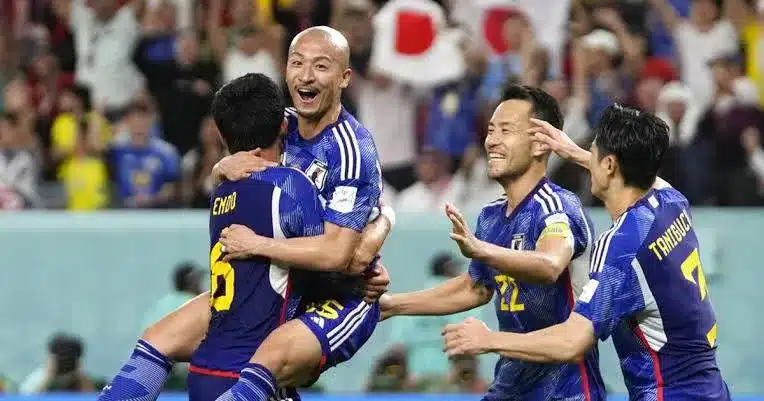
Japan’s 2-1 victory over Venezuela produced one of the most extraordinary VAR sequences of the international break.
Deep into second-half stoppage time, Venezuela thought they had been awarded a potentially match-winning penalty. Seconds later, the decision was gone.
VAR took referee Timothy Danaskos back to an incident at the opposite end of the pitch, where Takefusa Kubo had gone down inside Venezuela’s penalty area before the counter-attack began.
After an on-field review, Danaskos cancelled Venezuela’s penalty and awarded one to Japan instead. Ayase Ueda converted it in the 96th minute to complete Japan’s 2-1 comeback.
The Venezuela players were furious. But can VAR really do that? Can a referee award a penalty to one team, review something that happened earlier at the other end of the field, cancel the original penalty and then give a spot kick to the opposition?
Yes. Although the sequence looked bizarre, the VAR Protocol provides a clear mechanism that can make exactly this type of decision possible.
What happened in Japan vs Venezuela?
The match was level at 1-1 entering stoppage time. Venezuela had taken the lead immediately after half-time through Kevin Kelsy before substitute Ayase Ueda equalised for Japan in the 49th minute.
Then came the extraordinary final sequence. Takefusa Kubo entered Venezuela’s penalty area and went down after a challenge involving Yangel Herrera. Danaskos did not award Japan a penalty, and play continued.
Venezuela immediately moved forward on the counter-attack. At the opposite end, Jesús Ramírez entered the Japanese penalty area and went down following a challenge from Junnosuke Suzuki. This time Danaskos blew his whistle and awarded a penalty to Venezuela.
At that moment, it appeared Venezuela had been given the opportunity to win the match. But before the penalty could be taken, VAR intervened.
VAR went back to the earlier Kubo incident
The video officials had identified a potential foul on Kubo during the phase immediately before Venezuela’s counter-attack. Danaskos was advised to conduct an on-field review.
The referee went to the monitor and watched the earlier challenge. The replay showed Herrera making contact with Kubo’s foot inside Venezuela’s penalty area.
Danaskos changed his decision. The Venezuela penalty was cancelled. Instead, Japan were awarded a penalty for the earlier offence against Kubo. Ueda stepped forward and converted the spot kick to make it 2-1.
It was a remarkable reversal. But the referee was not simply comparing two independent penalty incidents and deciding which one he preferred. The order in which the incidents occurred is what made the decision possible.
How can VAR cancel one penalty and give another?
This is where the VAR Protocol becomes essential. Whenever a goal, penalty or certain other match-changing incidents are reviewed, VAR can examine the attacking phase of play immediately leading to that decision. That can include the moment when the attacking team gained possession.
Venezuela’s penalty did not appear from an isolated situation. The attack began immediately after Japan’s penalty appeal involving Kubo.
If Venezuela committed a penalty offence against Kubo before gaining possession and launching the counter-attack, play should technically have stopped at that earlier moment. Japan should have received a penalty. Everything that followed happened only because that offence was initially missed.
That includes Venezuela travelling to the opposite end and eventually winning what appeared to be their own penalty. Once VAR established that the earlier incident should have resulted in a Japan penalty, the later Venezuela penalty could no longer determine the restart.
The first offence came first.
Why had play been allowed to continue?
Danaskos did not initially believe the Kubo incident required a penalty. That is normal VAR procedure: referees are instructed to continue making decisions as though VAR does not exist, while VAR checks potential match-changing incidents in the background.
In this case, play continued before the VAR process could be completed. Venezuela transitioned quickly and created an attack of their own. Once Danaskos awarded Venezuela a penalty, play was finally stopped, giving the VAR team the opportunity to fully examine the sequence before the restart.
Crucially, Venezuela had not yet taken their penalty. The match had not restarted, which meant the referee could still review what had happened during the relevant phase. Had Venezuela already taken the penalty and play restarted, the situation would have been fundamentally different.
Was the foul on Kubo really a penalty?
This remains the subjective part of the incident. Video showed Kubo receiving contact from Herrera as the Japanese attacker moved through the Venezuelan penalty area. The key issue was contact around Kubo’s foot.
Under Law 12, a defender who carelessly trips or challenges an opponent inside their own penalty area commits an offence punishable by a penalty. Danaskos initially allowed play to continue. After viewing the footage at the monitor, however, he concluded the contact was sufficient to constitute a foul.
That means VAR must have considered the original no-penalty decision a clear and obvious error, or considered that a serious incident had been missed.
The on-field review was important because this was not simply a factual question, such as whether contact occurred inside or outside the penalty area. The referee needed to judge the nature and consequence of the challenge.
Once Danaskos decided Herrera had fouled Kubo, the correct restart became a Japan penalty.
What about the foul at the other end?
This is where the situation can appear unfair to Venezuela. Ramírez had gone down in the Japanese penalty area and Danaskos had already pointed to the spot. But the referee was effectively forced to go backwards chronologically.
If Kubo was fouled first, the game should have stopped at that moment. Venezuela should never legally have been allowed to complete the counter-attack that ended with their penalty. Therefore, the later penalty decision becomes irrelevant to the restart.
Imagine the referee had immediately blown his whistle when Kubo was challenged. Japan would have received a penalty and Venezuela’s counter-attack would never have happened. VAR simply restored the match to that earlier point.
That is why it is slightly misleading to describe the incident as “VAR changed Venezuela’s penalty into a Japan penalty”. Technically, VAR identified an earlier offence that should have stopped play before Venezuela ever reached Japan’s penalty area.
Could both challenges still be fouls?
Potentially, yes. Cancelling Venezuela’s penalty because of the earlier offence does not necessarily mean Suzuki’s challenge on Ramírez suddenly became a clean tackle. The later incident simply no longer determines the restart.
There is also an important distinction involving disciplinary sanctions. Under the VAR Protocol, certain disciplinary action occurring after the reviewed incident can still remain even when the original decision is changed. There are exceptions, particularly for cautions connected specifically to stopping a promising attack or denying an obvious goalscoring opportunity when the underlying phase is subsequently cancelled.
This illustrates why VAR decisions can become much more complicated than simply choosing between “penalty” and “no penalty”. The officials have to reconstruct the legal sequence of events.
Why Venezuela were furious
Venezuela’s reaction was immediate. Their players believed they had earned a penalty that could have given them the victory. Instead, after several minutes of VAR involvement, they found themselves defending a penalty at the other end.
Ueda scored. Japan led 2-1. Venezuela’s players protested heavily around the referee, and the frustration continued after the final whistle.
From an emotional perspective, the reaction is understandable. The team had gone from potentially taking a match-winning penalty to conceding one. But the unusual appearance of a decision does not automatically make it incorrect. The question is whether the VAR Protocol allowed officials to review the previous incident. In this case, it did.
Was VAR allowed to go that far back?
This is probably the biggest question supporters had after watching the incident. VAR cannot simply search through several minutes of football looking for something wrong. There are limits.
For penalty decisions, however, the review can include the attacking phase of play that directly led to the incident. That can include examining how the attacking team obtained possession.
Here, the sequence was continuous:
- Japan attacked.
- Kubo went down in Venezuela’s penalty area.
- Venezuela gained the ball.
- Venezuela immediately counter-attacked.
- Ramírez entered Japan’s area.
- Japan were penalised.
There was no unrelated restart separating those events. That continuous transition is what allowed VAR to examine the earlier Kubo challenge.
Had Venezuela’s penalty arrived after an unrelated throw-in, goal kick, free kick or another completed restart, VAR could not simply travel backwards through the match to award Japan an earlier penalty. That distinction is critical.
Was VAR correct to intervene?
There are really two separate questions.
Was VAR legally permitted to review the Kubo incident? Yes. Because the incident occurred immediately before Venezuela gained possession and launched the attack that resulted in their penalty, it formed part of the relevant sequence.
Was the challenge on Kubo actually enough for a penalty? That is the subjective refereeing question. Danaskos concluded after watching the replay that Herrera had committed a punishable offence. If the footage clearly shows Herrera stepping on or illegally catching Kubo’s foot and causing him to go down, then the penalty has a strong Law 12 basis.
What VAR cannot do is intervene merely because the video referee personally prefers a different interpretation of marginal contact. The original no-penalty decision still needs to reach the required intervention threshold.
The VAR Verdict: PROCEDURE CORRECT, FOUL DECISION SUPPORTABLE.
The extraordinary part of the incident was not a failure of the system. It was an unusual example of the system following the chronological order of two connected penalty incidents.
Why this incident is an excellent VAR lesson
Japan vs Venezuela demonstrates something that is often misunderstood about video refereeing. VAR does not always review only the final incident visible on screen. For goals and penalties, officials sometimes need to look backwards through the attacking phase to determine whether an earlier offence changes everything that followed.
Normally this happens with an attacking foul before a goal, an offside before a penalty, a handball before an attack develops, or a foul during the turnover that created the attacking opportunity.
Japan vs Venezuela produced an extreme version. The missed incident occurred inside one penalty area. The subsequent attack ended with a penalty decision inside the other penalty area.
That geographical distance made the reversal look extraordinary. Legally, however, distance across the pitch is less important than whether the actions formed one continuous reviewable sequence.
What would have happened without VAR?
Without video review, Venezuela would have taken the penalty. The earlier Kubo incident had already been missed by the referee. There would have been no mechanism to return to it.
That demonstrates both the power and controversy of VAR. Video technology allowed the officials to identify an earlier incident that potentially changed the entire sequence. But because the correction came only after Venezuela believed they had won a penalty, the eventual decision naturally felt far more dramatic than an immediate whistle would have.
Had Danaskos awarded Japan the original penalty in real time, almost nobody would have discussed the later Venezuela challenge because it would never have happened.
Ueda completes Japan’s comeback
Once the review was complete, Ayase Ueda had the responsibility of taking the penalty. The striker had already equalised shortly after half-time following Kevin Kelsy’s opener for Venezuela.
Ueda converted the stoppage-time penalty to make it Japan 2-1 Venezuela. What ordinarily would have been remembered primarily as a late match-winning goal instead became one of the most unusual VAR stories of the international window.
The VAR Verdict
The sequence looked almost impossible: Venezuela penalty, VAR review, Venezuela penalty cancelled, Japan penalty, Japan score.
But the VAR Protocol explains why it could happen. The decisive factor is chronology. If Herrera fouled Kubo inside the Venezuela penalty area before Venezuela gained possession and launched the counter-attack, play should have stopped there.
Once Danaskos confirmed that offence after an on-field review, Japan’s penalty became the correct restart. The later Venezuela attack could no longer produce the restart because legally the earlier offence took priority.
That does not mean every part of the decision is beyond debate. Whether the contact on Kubo was sufficiently clear to justify overturning the original no-penalty decision is still a legitimate refereeing discussion. But VAR going back to review the incident itself was permitted.
This was not VAR randomly cancelling one penalty and giving another. It was an exceptionally rare situation in which an earlier missed penalty offence occurred immediately before the opposing team counter-attacked and won a penalty of their own.
And that is precisely why Japan vs Venezuela may become one of the clearest real-world examples of how far the VAR attacking-phase review can reach.
The VAR Verdict: VAR procedure correctly applied. Japan’s penalty is supportable if the replay clearly establishes Herrera’s foul on Kubo.
Law references: IFAB Laws of the Game 2026/27, Law 12 and VAR Protocol
Reviewed: September 29, 2026

0 Comments
Join the conversation with respect. Comments are moderated and must follow our community rules.
Want to join the discussion?
Please log in or create an account to comment and reply. This keeps the conversation cleaner and safer.