
Monday’s UEFA Nations League matches produced plenty of goals, but the most interesting night for refereeing analysis came away from the headline victories of France and Italy.
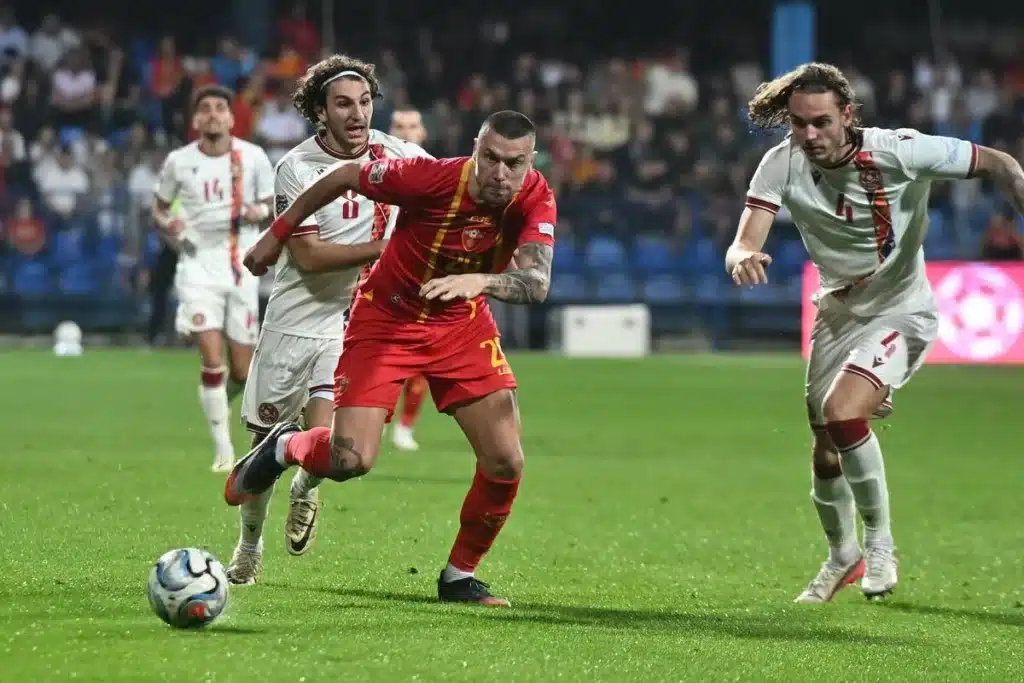
Three matches in particular gave VAR plenty to examine. Northern Ireland were awarded a late penalty against Georgia after an on-field review, while the same game also produced two other penalty claims treated differently. Bosnia and Herzegovina beat Poland 1-0 after VAR identified a late handball inside the Polish penalty area. In Podgorica, Montenegro midfielder Stefan Lončar’s yellow card was upgraded to a direct red after VAR intervened.
None of those situations can be assessed simply by asking whether there was contact. The more important questions are whether the original decisions were clearly wrong, whether the VAR intervention threshold was met, and whether the final sanctions were consistent with the 2026/27 Laws of the Game.
Here is The VAR Verdict’s analysis of Monday’s biggest incidents.
Northern Ireland vs Georgia: Three penalty situations, three different outcomes
Northern Ireland’s 0-0 draw with Georgia was easily the most complicated refereeing match of the night. Austrian referee Sebastian Gishamer had three significant penalty-area situations to manage: Northern Ireland’s first-half appeal, the penalty awarded in the 84th minute following a VAR review, and Georgia’s appeal in virtually the final action of the game.
That sequence makes this match particularly useful for understanding how VAR thresholds work.
Should Northern Ireland have had a first-half penalty?
The first controversial moment involved Tom Atcheson and Saba Sazonov. Atcheson moved into the Georgia penalty area and went down during a physical challenge with the defender. Instead of awarding Northern Ireland a penalty, Gishamer penalised Atcheson. The incident was checked by VAR, but the original decision remained.
That does not necessarily mean VAR agreed that the referee had made the perfect call. This is one of the most misunderstood parts of video refereeing. VAR does not ask, “What decision would I personally make?” It asks whether the referee’s original decision represents a clear and obvious error.
A physical duel can contain holding, pushing and contact from both players. If the pictures do not clearly establish that Sazonov committed the decisive offence, VAR should normally stay with the on-field judgement.
Northern Ireland may reasonably have felt the decision was harsh, particularly because Atcheson appeared convinced he had been fouled. But a debatable penalty appeal is not automatically a VAR intervention.
The VAR Verdict: NO INTERVENTION SUPPORTABLE
There was enough ambiguity around the contact for VAR to leave the original decision alone. Without clear evidence that the defender committed the decisive illegal action, this falls into the category of a subjective on-field judgement.
Northern Ireland’s late penalty: why VAR intervened
The situation in the 84th minute was different. Northern Ireland created chaos from a corner. Ruairi McConville rose for a header, with the ball eventually striking the crossbar. During the challenge, Georgia substitute Nodar Lominadze caught McConville high, while Sazonov was also involved physically.
Initially, play continued. VAR then recommended that Gishamer review the incident at the monitor. After watching the replay, the referee awarded Northern Ireland a penalty. Isaac Price took the kick, but Giorgi Mamardashvili saved it. The miss does not affect whether the decision was correct.
The key difference from the first-half incident is the nature of the contact. When a defender raises a boot into the head or face area of an opponent while challenging for the ball, the referee has to consider Law 12. Playing the ball does not automatically make a challenge legal. A player must still challenge in a way that does not carelessly, recklessly or dangerously make illegal contact with the opponent.
If McConville was clearly caught in the face while legitimately attempting to head the ball, the penalty has a strong basis.
Was VAR right to send Gishamer to the monitor?
Yes, assuming the replay clearly demonstrated contact that the referee had missed. This is precisely the type of situation VAR was designed for.
Gishamer had effectively made a no-penalty decision by allowing play to continue. If the video then showed a clear boot-to-face contact that constituted a careless or reckless challenge, the original decision was no longer simply debatable. It became a potentially clear missed offence.
That distinction matters. VAR should not intervene because a challenge looks slightly worse in slow motion. It should intervene because replay evidence clearly reveals something important that the referee either did not see or did not appreciate correctly in real time.
The VAR Verdict: CORRECT VAR INTERVENTION, PENALTY SUPPORTABLE
The late Northern Ireland penalty has a much stronger VAR basis than their first-half appeal. Mamardashvili’s save changed the outcome, but not the quality of the decision.
Did Georgia deserve a penalty in stoppage time?
Then came the final twist. Georgia launched one last attack and appealed for a penalty after Callum Marshall and Saba Sazonov collided inside the Northern Ireland area. No penalty was awarded. There was no on-field review.
After Northern Ireland had received a penalty through VAR only minutes earlier, it was inevitable that Georgia would demand the same treatment. But consistency does not mean every incident must produce identical outcomes.
The question remains whether Marshall committed a punishable foul. Football permits shoulder-to-shoulder contact and normal physical competition. A collision alone does not create a penalty. VAR must identify an actual offence: a trip, push, hold, charge or other illegal action.
If the footage did not clearly establish that Marshall committed such an offence, the correct VAR outcome was to complete the check and leave the original decision unchanged.
Preliminary verdict: NO CLEAR EVIDENCE OF A MISSED PENALTY
The incident was worth checking, but the existence of contact does not automatically mean Georgia were denied a penalty. That remains an important distinction after a match containing several physical penalty-area incidents.
Bosnia and Herzegovina vs Poland: VAR decides the match
The decisive moment in Bosnia and Herzegovina’s 1-0 win over Poland arrived very late. For most of the night, French referee Jérémie Pignard had resisted awarding a penalty despite several situations being checked.
Then VAR identified a possible handball by Jan Bednarek. Pignard went to the monitor. After reviewing the incident, he pointed to the penalty spot and cautioned the Poland defender. Ivan Bašić converted in the 84th minute, scoring the only goal of the match.
This was the clearest example on Monday of VAR directly changing the result of a Nations League game.
Why was Bednarek’s handball punished?
Handball remains one of football’s most misunderstood rules. The basic principle is simple: not every contact between the ball and a player’s hand or arm is an offence.
A defender can be penalised when they deliberately move the arm towards the ball, or when the arm position makes the body unnaturally bigger and cannot reasonably be justified by the player’s movement.
That second category is particularly important. Referees must consider where the arm is, why it is there and whether the player has assumed the risk of blocking the ball with an extended arm.
If Bednarek’s arm was clearly away from his body and blocking the path of the ball in a position not naturally explained by his movement, then awarding the penalty was consistent with Law 12.
The referee had not identified the offence initially. VAR did. That is exactly why an on-field review was required for such a subjective handball judgement.
The VAR Verdict: PENALTY SUPPORTABLE
The crucial issue is not whether the contact was intentional in the everyday sense. Modern handball decisions can be offences because of the defender’s arm position even when there was no deliberate attempt to handle the ball.
Why did Bednarek also receive a yellow card?
This part requires more care. A handball offence does not automatically mean a yellow card. The disciplinary sanction depends on what the handball prevented and whether it was deliberate.
Under the current Laws, a non-deliberate handball caused by an unnaturally positioned arm does not automatically require a caution merely because it stopped a promising attack. However, when the handball denies a goal or an obvious goalscoring opportunity inside the defender’s own penalty area without being deliberate, the penalty can be accompanied by a yellow card.
The exact reason for Bednarek’s caution therefore matters. If the officials determined that his handball prevented a goal or an obvious goalscoring opportunity, the caution has a clear legal basis. If it merely stopped an ordinary attacking situation, a yellow card would require a different justification.
The VAR Verdict: PENALTY STRONGER THAN THE DISCIPLINARY QUESTION
The handball decision is easier to support confidently than the card without access to the officials’ explanation of the sanction.
An earlier Bosnia penalty check ended with no penalty
Interestingly, this was not the first time VAR examined a potential Bosnia penalty. Around the 77th minute, another penalty situation was checked. This time, the conclusion was no penalty.
That is useful context. VAR did not simply spend the final stages searching for a reason to award Bosnia a spot kick. One incident failed to meet the threshold. The later Bednarek handball did.
This is exactly how VAR should work. Similar incidents do not have to produce identical decisions when the factual circumstances are different.
Bosnia also had a goal ruled out
Earlier in the second half, Bosnia briefly thought they had broken the deadlock. A goal involving Haris Tabaković was checked and disallowed for offside.
Unlike handball or physical contact, offside is largely a factual VAR decision. If the relevant attacker is in an offside position and becomes involved in active play, the goal cannot stand. There is far less interpretive flexibility than in a handball review.
For Bosnia, the important moment came later. The VAR intervention on Bednarek ultimately decided the match.
Montenegro vs Armenia: Yellow upgraded to red after VAR
The biggest disciplinary decision of the evening came in Podgorica. Montenegro midfielder Stefan Lončar challenged Narek Hovhannisyan in the 84th minute. Referee Manfredas Lukjancukas initially showed Lončar a yellow card.
VAR then reviewed the challenge. After the review process, the yellow was upgraded and Lončar was shown a direct red card for serious foul play. Montenegro therefore finished the 0-0 draw with ten players.
This type of VAR intervention raises an important question: if the referee has already seen the challenge and decided it is yellow, when should VAR intervene and turn it into red?
The difference between reckless and serious foul play
Law 12 gives referees a disciplinary scale. A careless challenge results in a foul but no card. A reckless challenge shows disregard for the danger or consequences to the opponent and requires a yellow card. A challenge that endangers the safety of an opponent or uses excessive force becomes serious foul play and requires a red card.
The difference is therefore not simply whether the tackle looked bad. Referees consider several factors:
- the speed of the challenge
- its intensity
- whether the player is in control
- the point of contact
- the use of studs
- whether one or both feet are involved
- the risk created for the opponent
VAR should intervene only when the replay shows that the initial yellow clearly underestimates the seriousness of the challenge.
Was VAR allowed to upgrade Lončar’s yellow?
Absolutely. A potential direct red card for serious foul play is one of VAR’s core reviewable categories. The fact that Lukjancukas initially showed yellow does not prevent intervention.
VAR can effectively tell the referee: “You have seen the foul, but the replay indicates this should be considered a direct-red offence.” The final decision remains with the referee. Once the challenge is classified as serious foul play, the original yellow is cancelled and replaced by a direct red card.
The VAR Verdict: CORRECT PROCESS
Without relying on slow motion alone, the officials determined the challenge crossed the line from reckless into serious foul play. The procedure itself was completely correct.
For VAR to intervene after an on-field yellow, the replay must provide sufficiently clear evidence that the challenge endangered the opponent’s safety or involved excessive force. That is a far better use of VAR than attempting to re-referee ordinary yellow-card fouls.
Why slow motion can be dangerous in red-card reviews
Lončar’s incident also highlights one of the biggest problems when supporters assess tackles from replay footage. Slow motion exaggerates contact. A challenge can look dramatically worse when reduced to individual frames.
Referees should therefore use slow motion primarily to establish factual elements such as where contact occurred. Normal-speed footage is crucial for judging intensity. That is where the referee can assess how quickly the player arrived, how much force was involved and whether the opponent’s safety was endangered.
A good serious-foul-play review combines both. Freeze frames alone should never decide a red card.
France and Italy win without major VAR controversy
The biggest teams on Monday’s schedule actually produced relatively little refereeing controversy. France came from behind to beat Belgium 4-1, while Italy defeated Türkiye 3-1. Neither match produced a major VAR decision comparable to those in Belfast, Zenica or Podgorica.
That is worth acknowledging. A referee-analysis website should not try to create controversy simply because a high-profile team is involved.
When the major goals are legal, the disciplinary threshold is consistent and VAR stays largely invisible, that is usually a positive sign for the officiating team.
The VAR Verdict: Monday was about intervention thresholds
The most interesting theme from Monday’s Nations League matches was not whether VAR was busy. It was when VAR chose to intervene.
Northern Ireland’s first-half penalty appeal against Georgia was checked but left alone because there was not enough evidence that the on-field decision was clearly wrong. Their later penalty was different. A high challenge on McConville gave VAR stronger evidence of a missed offence and Gishamer changed his decision after reviewing the footage.
Georgia’s late penalty appeal then remained a no-penalty call because contact alone was not enough to establish a clear foul.
In Bosnia, the first penalty review produced nothing. The second identified Bednarek’s handball and directly produced the winning goal. And in Montenegro, VAR correctly stepped in when Lončar’s challenge was considered serious enough to move from yellow-card territory into serious foul play.
That is the standard VAR should aim for. Do not intervene because another decision is possible. Intervene because the original decision is clearly wrong.
Monday was not free from debate. The Northern Ireland–Georgia match in particular contained enough subjective contact to generate arguments on both sides. But the larger picture was relatively encouraging.
VAR was used to distinguish between marginal incidents and potentially clear mistakes rather than automatically overturning every close call. The most convincing interventions were the Northern Ireland penalty, the Bednarek handball and the Lončar red-card upgrade.
And all three provide good examples of what video refereeing is supposed to do when the on-field officials miss decisive details.
The VAR Verdict: A busy but generally defensible night for VAR, with the strongest interventions coming in Belfast, Zenica and Podgorica.
Law references: IFAB Laws of the Game 2026/27 — Law 12 and VAR Protocol
Reviewed: October 6, 2026

0 Comments
Join the conversation with respect. Comments are moderated and must follow our community rules.
Want to join the discussion?
Please log in or create an account to comment and reply. This keeps the conversation cleaner and safer.