
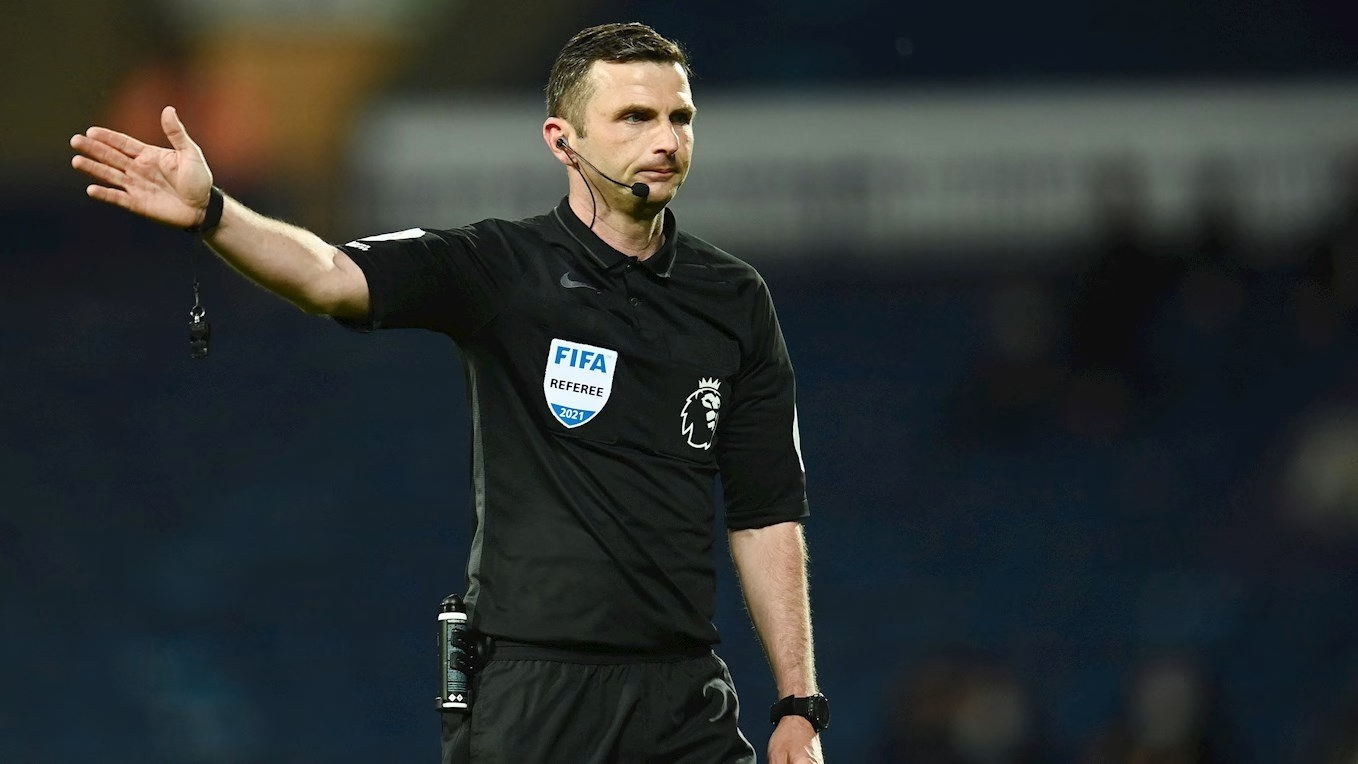
The latest Michael Oliver Champions League referee appointment will see the English official return to UEFA duty for a decisive qualifying match between Slovan Bratislava and Mjällby on Tuesday, August 11.
UEFA has confirmed Oliver as referee for the Champions League third qualifying round second leg in Bratislava, with an entirely English officiating team supporting him both on the pitch and in the VAR room.
Slovan Bratislava enter the second leg with a narrow advantage after beating Mjällby 2–1 in Sweden on August 4. That leaves the tie very much alive and puts Oliver and his team in charge of a match with significant Champions League consequences.
For Oliver, it is also another high-profile international appointment shortly after his work at the 2026 World Cup.
Michael Oliver Champions League referee team confirmed
UEFA’s official match information lists the complete officiating team:
| Role | Official | Country |
|---|---|---|
| Referee | Michael Oliver | England |
| Assistant referee | Wade Smith | England |
| Assistant referee | Blake Antrobus | England |
| Fourth official | Farai Hallam | England |
| VAR | Michael Salisbury | England |
| Assistant VAR | Darren England | England |
Every member of the refereeing team is English.
That makes the appointment particularly interesting from an English refereeing perspective.
It is not only Oliver being trusted by UEFA. Wade Smith and Blake Antrobus will work on the touchlines, Farai Hallam has been given fourth-official duties, while Michael Salisbury and Darren England form the video team.
For Hallam in particular, involvement alongside one of England’s most established international referees offers another notable UEFA assignment as he continues his development.
Slovan Bratislava vs Mjällby is far from decided
This is not a routine appointment in a tie that has already been settled.
Slovan Bratislava won the first leg 2–1 away to Mjällby, meaning only one goal separates the clubs going into Tuesday’s return.
UEFA lists the second leg for August 11, with the winners advancing to the Champions League play-off round. The losing side will transfer to the Europa League play-off round.
That creates genuine pressure.
A penalty decision, red card, offside intervention or disputed goal could have a direct impact on which club remains within reach of the Champions League league phase.
For the match officials, the challenge is therefore not simply managing 90 minutes.
It is managing 90 minutes where every major decision may carry enormous sporting and financial consequences for both clubs.
Why UEFA’s Michael Oliver appointment stands out
Oliver does not need an introduction to Champions League football.
UEFA used him repeatedly during the 2025/26 competition, including matches such as Real Madrid against Bayern Munich in the quarter-finals. He also handled earlier league-phase and knockout fixtures during that campaign.
His latest appointment comes shortly after another significant assignment at the World Cup.
In July, FIFA selected Oliver to referee the Belgium vs Spain World Cup quarter-final in Los Angeles, working with English assistants Stuart Burt and James Mainwaring.
UEFA turning to him again so early in the new European campaign demonstrates that Oliver remains firmly involved at the highest international level.
There is also an important wider context for English refereeing.
Anthony Taylor retired from elite refereeing in July after a career spanning more than two decades.
That leaves Oliver as an especially prominent English presence on major UEFA and FIFA appointments.
A completely English VAR operation
The video appointments deserve attention as well.
Michael Salisbury will operate as VAR, while Darren England has been appointed assistant VAR. UEFA lists both as English officials.
That means communication between Oliver and the video room will take place within a team familiar with the same domestic refereeing environment.
That familiarity can be valuable.
VAR performance depends heavily on communication.
The video official must quickly establish:
- What decision the referee made on the field.
- What the referee saw.
- Whether available footage provides evidence of a clear and obvious error.
- Whether an on-field review is necessary.
The objective should not be for Salisbury to re-referee the match from the VAR room.
His job is to intervene only when the protocol permits it.
That distinction will be particularly relevant in a close knockout tie.
Michael Salisbury’s VAR role could be crucial
A Champions League qualifier with only one goal separating the teams creates several situations where VAR could become decisive.
Penalty-area challenges are the obvious example.
If Oliver waves away a penalty appeal, Salisbury must determine whether the decision is supportable or whether replay demonstrates a clear error.
The same principle applies to possible direct red cards.
For factual situations such as offside before a goal, the process is more straightforward. Subjective fouls and handballs require much greater discipline from the video officials.
The best VAR performance is not necessarily the one with the most interventions.
Sometimes the correct decision is to complete the check and allow Oliver’s original judgement to stand.
That is particularly important as European refereeing authorities continue to stress the principle that VAR should correct clear mistakes rather than constantly re-referee subjective incidents.
Wade Smith and Blake Antrobus complete the on-field trio
Oliver will be assisted by Wade Smith and Blake Antrobus.
Their responsibilities will extend well beyond traditional throw-in and goal-kick decisions.
Assistant referees remain central to offside judgement, incidents outside Oliver’s immediate field of vision and communication throughout the match.
Even with video technology available, the assistants’ live judgement remains important.
VAR is a safety net for reviewable situations, not a replacement for the on-field team.
An especially important element will be delayed offside flags.
When an attacking situation is close, assistants are often required to allow the phase to finish before raising the flag so that a potentially valid goal is not destroyed by a premature decision.
That demands concentration and excellent communication between the referee and assistant.
Farai Hallam gets another important assignment
Another interesting name on UEFA’s list is Farai Hallam, who will serve as fourth official.
The fourth official’s role can sometimes be underestimated.
In a decisive European qualifier, Hallam will be involved in managing the technical areas, substitutions and communication between the benches and refereeing team.
If tension increases, particularly late in the match, technical-area management can become one of the more difficult parts of the officiating operation.
Working with Oliver in a Champions League qualification match also places Hallam inside an experienced international refereeing environment.
For English refereeing, that makes the appointment more interesting than Oliver’s name alone.
UEFA has selected officials at different stages of their elite careers within one national team.
Oliver returns quickly after the World Cup
The timing is noteworthy.
Only last month, Oliver was representing England at the World Cup.
His appointment for Belgium against Spain in the quarter-finals demonstrated the level of trust he continued to receive from FIFA deep into the competition.
Now UEFA has immediately brought him back into European club competition.
There is a considerable difference between a World Cup quarter-final and a Champions League third qualifying round match in terms of global attention.
But from a referee-management perspective, qualification matches can be particularly demanding.
For the clubs involved, there is no sense that this is a minor fixture.
The Champions League can define an entire season.
That pressure can produce:
- increased dissent;
- tactical fouling;
- time-wasting;
- confrontation;
- penalty-area appeals;
- pressure on match officials late in the game.
Oliver’s experience will therefore be important.
What should we watch from Michael Oliver?
Oliver’s performance should not be judged only by whether there is a major controversial decision.
Several smaller aspects will tell us how successfully he manages the game.
Foul threshold
Consistency will be important from the opening minutes.
If Oliver allows physical challenges early, he must apply that threshold to both teams throughout the match.
Tactical fouls
With Slovan protecting a one-goal aggregate advantage and Mjällby needing to attack, counter-attacking situations could become important.
Stopping promising attacks may require yellow cards even when the foul itself is relatively minor.
Dissent
Players understand the stakes.
That does not change the referee’s responsibility to control dissent and prevent repeated protests from becoming normalised.
Time-wasting
If Slovan remain ahead on aggregate late in the game, restart management could become a major issue.
Officials will need to distinguish normal game management from deliberate delay.
Penalty-area contact
This is where both Oliver and Salisbury will face their biggest potential test.
The existence of contact alone does not automatically make an incident a foul. VAR should also avoid using slow motion to manufacture certainty around subjective contact that remains reasonably debatable.
Why an all-English team can help communication
UEFA does not require every appointment to consist entirely of officials from one country, but national teams are common because established working relationships can help communication.
This appointment takes that idea all the way into the video room.
Oliver, his two assistants, the fourth official, VAR and assistant VAR are all from England.
There should therefore be no language barrier within the refereeing operation.
More importantly, the officials should be familiar with similar terminology and communication patterns.
That can matter during a high-pressure VAR check.
A good VAR conversation should be concise.
The referee needs to understand exactly what the video official has identified rather than being overwhelmed with unnecessary information.
If an on-field review becomes necessary, Salisbury’s communication with Oliver will be particularly important.
The VAR should identify the potential error.
Oliver should then be given the relevant replay evidence and remain responsible for the final subjective decision.
Slovan have a one-goal advantage
The first leg gives the second match a particularly interesting shape.
Slovan Bratislava’s 2–1 victory in Sweden means Mjällby need to overturn a one-goal deficit.
There is therefore no comfortable aggregate margin.
An early Mjällby goal could completely reset the contest.
A Slovan goal could force the Swedish side to become significantly more aggressive.
Those changing tactical circumstances also affect the referee.
As matches become more stretched, officials have to cover greater distances and make decisions during faster transitions.
That is often when tactical fouls, DOGSO situations and late challenges become more likely.
What happens to the winner?
UEFA confirms that the winners of the third qualifying-round ties move into the Champions League play-off round. Teams defeated in the champions path transfer to the Europa League play-off round.
So neither club’s European campaign necessarily ends on Tuesday.
But Champions League progression remains the major prize.
That is why UEFA’s choice of referee matters.
This is the final qualifying stage before the play-offs, and the tie remains separated by only one goal.
Michael Oliver remains a major UEFA referee
Looking at Oliver’s recent appointments gives the clearest indication of his standing.
During last season’s Champions League, UEFA trusted him with Real Madrid vs Bayern Munich in the quarter-finals as well as numerous other matches across the competition.
FIFA then appointed him to a World Cup quarter-final in July.
Now he returns for Slovan Bratislava against Mjällby.
The scale of the fixture is smaller than those previous two appointments, but that should not be interpreted as a demotion.
Elite referees routinely work matches across different stages of European competition, particularly at the start of a new season.
What matters more is that UEFA has immediately placed Oliver back into an important knockout tie.
Could Oliver be one of England’s main European referees in 2026/27?
The early evidence points in that direction.
Taylor’s retirement removes one of England’s most experienced UEFA referees from the active pool. England Football confirmed Taylor’s retirement on July 21.
Oliver, meanwhile, has moved directly from a World Cup quarter-final to another UEFA appointment.
That does not guarantee which matches UEFA will assign him later in the season.
Appointments depend on performance, availability, nationality conflicts and competition circumstances.
But Oliver begins 2026/27 with considerable recent international experience behind him.
That makes every early-season UEFA appointment worth monitoring.
Michael Oliver Champions League referee: key facts
Match: Slovan Bratislava vs Mjällby
Competition: UEFA Champions League third qualifying round
Leg: Second leg
Date: August 11, 2026
First-leg result: Mjällby 1–2 Slovan Bratislava
Referee: Michael Oliver
Assistants: Wade Smith and Blake Antrobus
Fourth official: Farai Hallam
VAR: Michael Salisbury
AVAR: Darren England
Entire officiating team: England
The VAR Verdict
The latest Michael Oliver Champions League referee appointment is more significant than an ordinary early-season assignment.
UEFA has chosen one of England’s most experienced international referees for a genuinely competitive second leg with only one goal separating the teams.
It has also surrounded Oliver with a completely English team.
Wade Smith and Blake Antrobus will assist him on the pitch. Farai Hallam takes the fourth-official role. Michael Salisbury and Darren England will control VAR.
Our verdict: this is a sensible appointment for a potentially difficult tie.
Oliver arrives directly from a summer in which FIFA trusted him with a World Cup quarter-final. UEFA used him in major Champions League matches last season, including a quarter-final, and has now immediately returned him to European duty.
The most interesting element may be the VAR operation.
With only a 2–1 aggregate advantage, one subjective intervention could transform the tie.
Salisbury’s job should therefore be to protect Oliver from a clear and obvious error without replacing the referee’s judgement on every debatable incident.
If the English team can maintain that distinction, the best outcome will be a match in which their appointment receives far less attention after full-time than it did before kick-off.

0 Comments
Join the conversation with respect. Comments are moderated and must follow our community rules.
Want to join the discussion?
Please log in or create an account to comment and reply. This keeps the conversation cleaner and safer.