
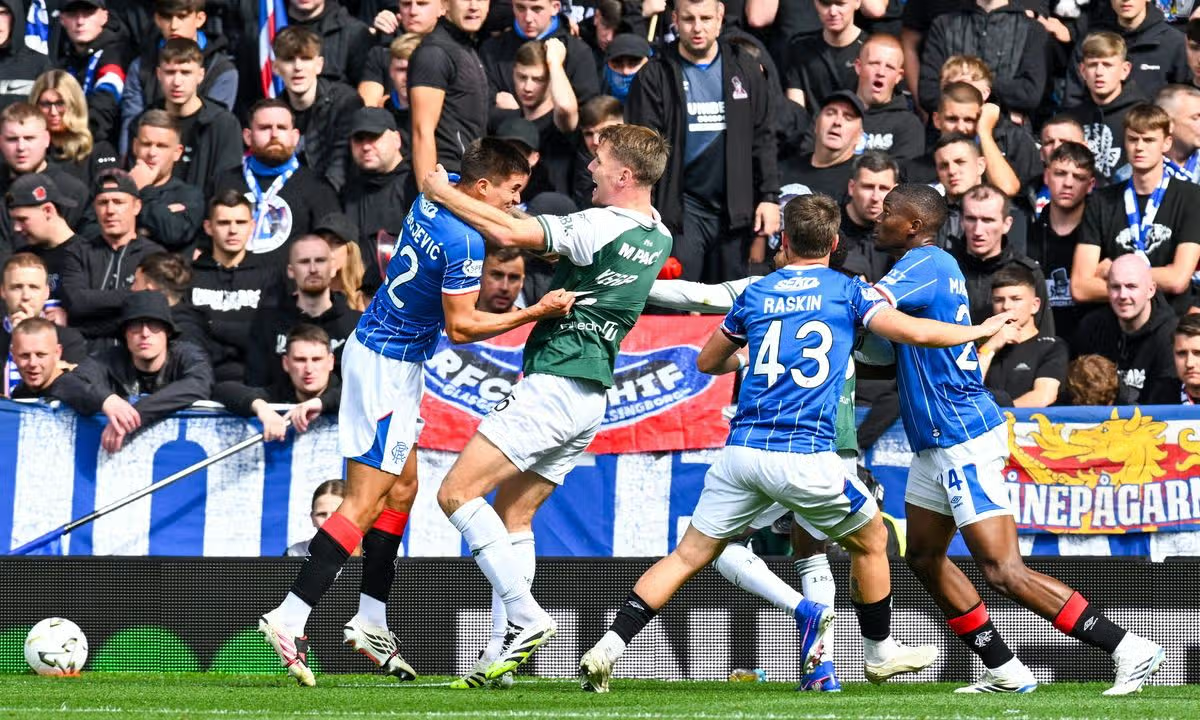
The Rangers Hibernian VAR penalty has become one of the first major refereeing controversies of the new Scottish Premiership season after Don Robertson changed his original decision following a pitch-side review at Ibrox.
Hibernian were awarded an early penalty when Rangers defender Vanja Dragojevic was judged to have held Jason Kerr during a corner. Robertson initially allowed play to continue, but VAR Matthew MacDermid recommended an on-field review. After watching the incident again, Robertson pointed to the spot and Josh Campbell converted to give Hibs the lead.
Rangers manager Derek McInnes strongly disagreed.
After watching the incident back, McInnes said he did not believe it was a penalty and questioned why Robertson had been sent to the monitor in the first place.
That second question is actually the most interesting part of the controversy.
It is possible to believe there was some holding while still questioning whether Robertson’s original no-penalty decision was clearly and obviously wrong.
That is the real VAR debate.
What happened in Rangers vs Hibernian?
The incident occurred early in Sunday’s Premiership match at Ibrox.
During a Hibernian corner, Dragojevic and Kerr became involved in a physical confrontation inside the Rangers penalty area. Robertson did not initially award anything and play continued.
VAR MacDermid then checked the incident and recommended that Robertson review it at the referee review area. Sky Sports’ match timeline records that Robertson was called to the screen to examine the grapple between the two players before awarding Hibernian a penalty.
Campbell converted the spot kick to put Hibs ahead.
Rangers eventually equalised through a Miguel Chaiwa own goal in the 85th minute, but substitute Callum Wright scored a stoppage-time winner as Hibernian left Ibrox with a 2–1 victory.
The match officials were Don Robertson as referee, Matthew MacDermid on VAR, Colin Steven as fourth official and Gary Hilland as assistant VAR.
Rangers Hibernian VAR penalty: what does Law 12 say?
Holding an opponent is a direct-free-kick offence under Law 12.
Inside a defender’s own penalty area, that means a penalty can be awarded when the ball is in play.
IFAB also gives referees specific guidance about holding at corners and free kicks. Officials are encouraged to intervene early, particularly inside the penalty area. If holding continues once the ball is in play, the referee should award the appropriate direct free kick or penalty and can caution the offender.
So there is nothing unusual about awarding a penalty for holding at a corner.
The difficult question is how much holding is enough.
Football allows physical contact. Players regularly use their arms to establish position during corners. Two opponents may also be holding each other at the same time.
The referee must therefore decide when ordinary physical competition crosses the line into an offence that restricts an opponent’s movement.
That is inherently subjective.
Did Dragojevic clearly hold Jason Kerr?
The available footage and reporting show contact between Dragojevic and Kerr, but the debate centres on whether Dragojevic alone committed a punishable holding offence or whether the two players were engaged in mutual grappling.
Former FIFA referee Keith Hackett questioned exactly that point.
Hackett said that when viewing the incident, it was difficult to determine who was actually doing the holding because both players appeared to have contact with each other. He concluded that the decision could potentially have gone either way.
That is significant for VAR.
A penalty does not have to be obviously wrong just because another interpretation is possible.
If Robertson had awarded the penalty immediately, the key question for VAR would have been whether that decision was clearly incorrect.
But Robertson originally allowed play to continue.
Therefore MacDermid needed to decide whether the no-penalty decision was clearly and obviously wrong.
That is a much higher threshold than simply saying:
“Looking at the replay, I would personally award a penalty.”
The biggest question: should VAR have intervened?
This is where The VAR Verdict has concerns.
The official VAR protocol states that a video assistant referee can intervene in penalty/no-penalty situations where there has been a clear and obvious error or a serious missed incident.
The protocol is not supposed to create a completely new refereeing decision every time replay shows contact.
VAR should first respect Robertson’s original judgement.
The correct process is essentially:
What did the referee decide?
Robertson: no penalty.
Does the replay clearly demonstrate that this decision cannot reasonably stand?
Only if the answer is yes should an on-field review normally be recommended.
That distinction is extremely important.
If the footage shows Dragojevic clearly wrapping both arms around Kerr, preventing him from moving and pulling him away from the ball with no significant reciprocal holding, intervention is understandable.
But if both players are holding, leaning into one another or fighting for position, then the situation becomes far more subjective.
And when an incident remains subjective, the original decision should receive greater protection from VAR.
Why McInnes questioned the monitor recommendation
McInnes did not simply argue that the final decision was incorrect.
He questioned the intervention itself.
After the match, the Rangers manager said he had watched the incident again and did not believe it was a penalty. He also said he did not think Robertson should have been sent to the screen. Sky Sports reported McInnes describing the penalty as very soft.
That distinction matters.
Once a referee is sent to the monitor, there is enormous psychological weight behind the recommendation.
The VAR has effectively told the referee:
“I believe you may have made a clear and obvious error.”
The referee is still entitled to reject that recommendation, but in practice most on-field reviews result in the original decision being changed.
That is why the threshold for sending the referee to the monitor must remain high.
Was it enough for a penalty under the Laws?
There are really two separate questions.
Question one: could a penalty legally be awarded?
Yes.
If Robertson concluded that Dragojevic held Kerr after the corner was taken and that the holding materially restricted his movement, Law 12 supports a penalty. IFAB specifically tells referees to penalise holding during corners once the ball is in play.
Question two: was the original no-penalty decision clearly wrong?
That is much less certain.
When an experienced former FIFA referee looks at the same footage and concludes that both players appear to be holding each other, it becomes harder to describe the initial no-call as an unmistakable error.
That does not automatically make the final penalty wrong.
It potentially makes the VAR intervention threshold the controversial part.
Mutual holding changes the analysis
This is a recurring problem at corners.
Suppose a defender has one arm around an attacker, but the attacker is simultaneously holding the defender’s shirt.
Who is committing the offence?
Sometimes one action is clearly dominant. The defender may completely restrict the attacker while the attacker’s contact is merely an attempt to free himself.
In other situations, both players are equally responsible.
VAR has to consider the complete interaction rather than isolate one movement in slow motion.
That means looking at:
Who initiates the contact?
Who is actually restricting whom?
Does Kerr attempt to move toward the ball?
Does Dragojevic prevent that movement?
Is Kerr also holding Dragojevic?
Does the holding continue after the ball is in play?
Would Kerr realistically have been able to challenge for the ball without the contact?
Those questions require judgement.
That is exactly why using VAR for grappling incidents can become dangerous if the threshold is too low.
Almost every corner contains contact that can look illegal when isolated in slow motion.
Slow motion can make holding look worse
Unlike an offside line or whether the ball crossed the goal line, holding is not purely factual.
Replay can establish where an arm was positioned, but the referee still has to evaluate the consequence.
A freeze-frame showing an arm around another player tells us only part of the story.
The full-speed sequence shows:
how long the holding lasted, whether both players were moving together, whether the attacker was genuinely prevented from challenging and whether the physical contact was normal for that situation.
VAR should therefore avoid turning a normal set-piece battle into a penalty simply because slow motion produces an unattractive image.
The question is not:
Was there contact?
It is:
Was there a clear holding offence?
Does the yellow card matter?
Reports indicate Dragojevic was also cautioned after the review.
IFAB’s guidance specifically says that when holding occurs after the ball is in play, referees can award the penalty and caution the offending player.
So the combination of penalty and yellow card is not itself unusual.
The controversy remains whether Dragojevic’s action was sufficiently one-sided and significant to justify the foul in the first place.
Would the penalty have survived VAR if Robertson gave it immediately?
This is perhaps the best way to understand the controversy.
Imagine Robertson had blown immediately and awarded Hibernian a penalty.
Would VAR have told him:
“No, this is clearly not a penalty”?
Probably not, based on the available evidence.
There was visible physical contact and at least a credible argument that Dragojevic restricted Kerr.
That means the penalty itself was supportable.
But now reverse the situation.
Robertson initially decides that the contact does not justify a penalty.
Should VAR then tell him that his judgement was clearly wrong?
That is harder to justify.
This is one of the strange realities of the clear-and-obvious standard: in highly subjective incidents, both penalty and no-penalty decisions can sometimes be supportable.
VAR is not supposed to choose which one it prefers.
UEFA’s recent VAR message is relevant
This incident also arrives during a wider debate about the future of VAR.
IFAB continues to define VAR around clear and obvious errors, while European refereeing authorities have been stressing that video officials should avoid unnecessarily re-refereeing subjective decisions.
The Rangers-Hibernian incident is a perfect example of why that principle matters.
If VAR intervenes every time there is visible holding at a corner, video officials could theoretically recommend penalties several times in the same match.
The threshold therefore cannot simply be:
“There was holding.”
It needs to be:
“The referee clearly missed a holding offence that materially prevented an opponent from competing.”
That is a considerably higher standard.
The result should not change the referee analysis
Rangers ultimately lost 2–1, but the penalty should be analysed separately from the result.
McInnes’s side had plenty of time to respond and Sky Sports recorded Rangers producing 25 shots during the match. Hibernian nevertheless scored the decisive goal through Wright in stoppage time.
It would therefore be wrong to say the penalty alone caused Rangers to lose.
Similarly, Rangers’ poor result should not be used to dismiss legitimate questions about the VAR decision.
Referee analysis has to remain independent from team performance.
A team can play badly and still suffer from an incorrect decision.
A team can also play well and lose despite completely correct officiating.
The VAR Verdict
The Rangers Hibernian VAR penalty is not a straightforward refereeing mistake.
There is a credible argument for awarding a penalty because Dragojevic has physical contact with Kerr during the corner, and IFAB explicitly instructs referees to deal firmly with holding inside the penalty area.
But that does not automatically mean VAR should have intervened.
The available footage has generated reasonable disagreement over whether the contact was one-sided holding or mutual grappling. Former FIFA referee Keith Hackett also concluded that both players appeared to be holding and that the judgement could have gone either way.
Our verdict: the penalty itself is supportable, but the VAR intervention is much more debatable.
Robertson initially saw no offence. For MacDermid to send him to the monitor, the video evidence should have demonstrated a clear and obvious mistake rather than simply offering another reasonable interpretation.
If the referee had awarded the penalty live, we would not expect VAR to overturn it.
But because Robertson originally allowed play to continue, we are not convinced the footage establishes the level of obvious error normally required to reverse his judgement.
Penalty decision: Supportable
Original no-penalty decision: Also arguably supportable
VAR intervention: Debatable
Clear and obvious threshold: Questionable
Overall VAR Verdict: We would have preferred the original on-field decision to stand unless VAR had a clearer angle demonstrating significant, one-sided holding.
That distinction is important.
VAR should correct clear mistakes.
It should not decide every subjective argument on the referee’s behalf.
At the time of writing, the sources reviewed did not contain a published Scottish FA technical verdict on the incident. If the SFA later includes the decision in its official VAR review, that explanation—and especially any referee/VAR audio—would provide valuable evidence about exactly what MacDermid identified before recommending the review.

0 Comments
Join the conversation with respect. Comments are moderated and must follow our community rules.
Want to join the discussion?
Please log in or create an account to comment and reply. This keeps the conversation cleaner and safer.