
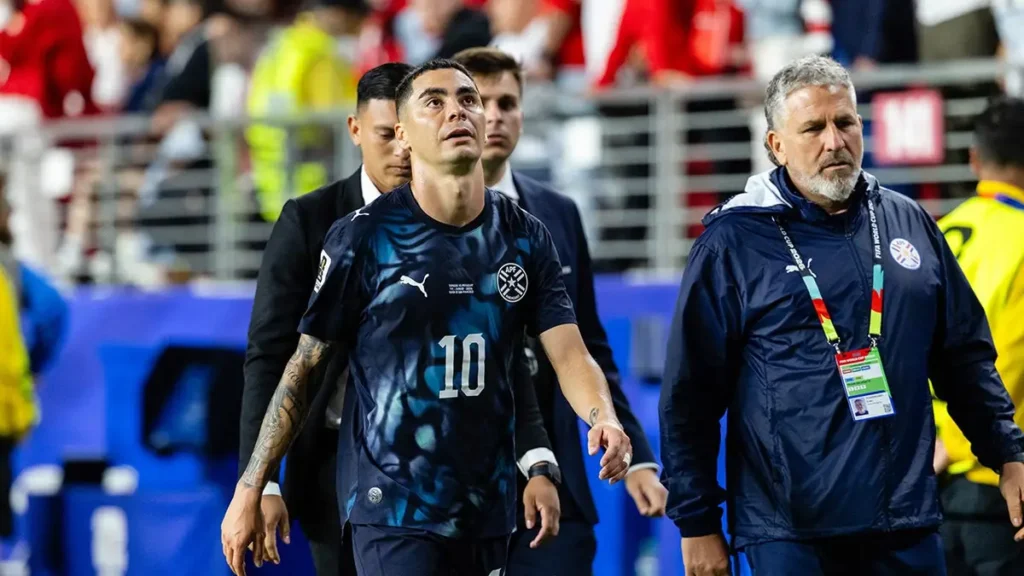
Miguel Almiron red card: a World Cup decision that instantly became bigger than the match
Miguel Almiron red card debates are usually about reckless tackles, late challenges or denying an obvious goal-scoring opportunity. This one was different. Paraguay’s midfielder was sent off against Türkiye for covering his mouth during a confrontation a decision that immediately became one of the most talked-about refereeing moments of the World Cup.
The incident came in first-half stoppage time of Paraguay’s Group D match against Türkiye. Paraguay were already leading 1-0 when Almirón became involved in an exchange with Mert Müldür. During that confrontation, Almirón covered his mouth while speaking. Referee Iván Barton was then sent to the monitor, and after VAR involvement, the red card was shown.
It was a dramatic moment not because the referee lost control, but because the game had entered new territory. FIFA and IFAB had introduced a rule aimed at preventing players from concealing potentially discriminatory or abusive comments in confrontational situations. Almirón became the first high-profile example of that rule being applied at the World Cup.
The important point is this: there is no public evidence of exactly what Almirón said. That matters. The red card was not publicly justified by proven discriminatory language. It was given because the visible action — covering the mouth during a confrontation with an opponent — fell under the new disciplinary framework.
Quick Verdict
Decision: Harsh in optics, but supportable in law.
If the referee and VAR judged that Almirón covered his mouth during a confrontation with an opponent, the red card fits the new FIFA/IFAB instruction. It feels severe because there was no violent challenge, no injury risk, and no public confirmation of what was said. But under the competition’s disciplinary approach, the act itself is enough to open the door to a red card.
So this is not a classic “clear mistake” by the referee. It is a controversial application of a strict new rule.
What happened in Paraguay vs Türkiye?
Paraguay had made a dream start. Matías Galarza scored inside the opening minutes, giving them a 1-0 lead and putting Türkiye under immediate pressure.
Then, just before half-time, the game changed. Almirón and Müldür were involved in a confrontation. The key action was Almirón putting his hand over his mouth while speaking to the Turkish defender.
That detail is what triggered the disciplinary issue.
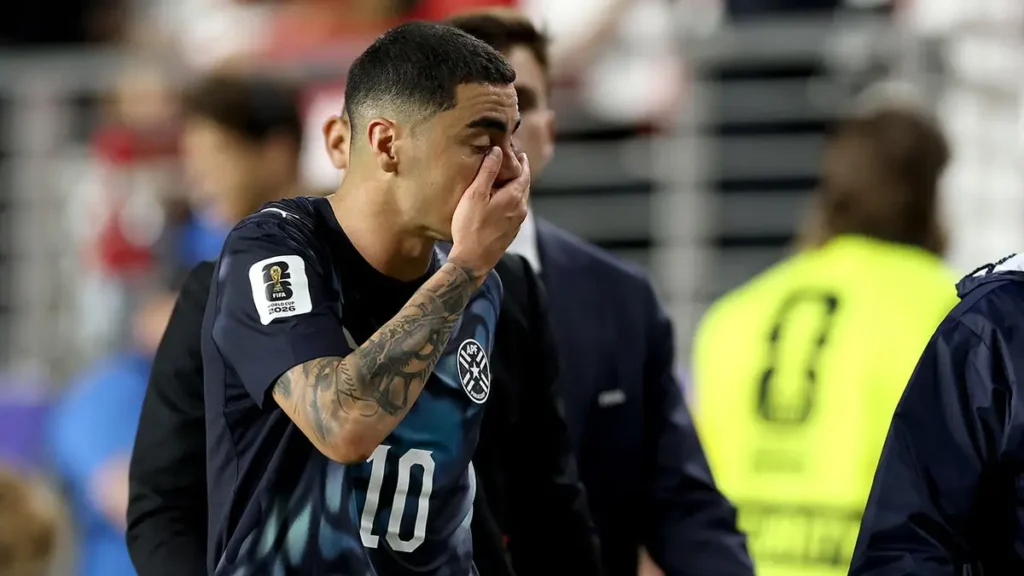
After VAR became involved, Barton reviewed the incident and showed Almirón a straight red card. Paraguay had to play the entire second half with ten men while protecting a narrow lead.
From a match-management perspective, this was a huge decision. It did not just punish one player; it changed the tactical shape of the game. Paraguay were forced deeper, Türkiye had the man advantage, and the rest of the match became a survival exercise.
Paraguay still held on to win 1-0, which made the decision even more dramatic. If Türkiye had equalised or won, this red card would probably have become an even bigger political and refereeing storm.
Why was Miguel Almirón sent off?
Almirón was sent off because he covered his mouth during a confrontation with an opponent.
That is the key wording.
The new FIFA/IFAB measure is designed to stop players from hiding comments in heated exchanges, especially where there is concern about discriminatory or abusive language. For years, players have covered their mouths to prevent cameras from capturing what they are saying. In normal tactical conversations, that has usually been accepted as part of the modern game.
This new rule draws a line between ordinary communication and confrontation.
If a player is speaking to a teammate, giving instructions, or having a normal football conversation, covering the mouth is not automatically the issue. But if the situation is confrontational and the player is addressing an opponent, the action can be punished much more severely.
That is why Almirón’s dismissal was different from most red cards. The referee was not judging force, studs, speed, danger, or denial of a goal-scoring opportunity. He was judging conduct.
Miguel Almiron red card and the IFAB law context
The law context is simple, but the football reality is uncomfortable.
IFAB’s approved measure allows a player to be sanctioned with a red card when he covers his mouth in a confrontational situation with an opponent. FIFA chose to implement that measure at the World Cup.
That means the referee does not need to prove publicly what was said before showing the red card. The focus is on the visible behaviour: mouth covered, confrontation, opponent involved.
This is why many fans found the decision strange. Football audiences are used to red cards being attached to visible danger: a dangerous tackle, violent conduct, serious foul play, DOGSO, or abusive conduct that everyone can see or hear.
Here, the offence was partly about prevention. The rule is designed to remove the possibility of a player hiding unacceptable language from cameras, officials, and opponents.
That makes the decision easier to defend in law than it is to sell emotionally.
Why VAR could intervene
VAR could intervene because this was a potential straight red-card offence.
Under VAR protocol, video officials can recommend an on-field review when there may have been a clear and obvious error or a serious missed incident connected to a red-card offence. This was not a normal yellow-card management issue. It was treated as conduct that could result in a direct dismissal.
That matters.
If this had only been a possible caution, VAR would not normally be expected to get involved. But once the competition rules classify this type of conduct as potentially red-card worthy, VAR can support the referee by checking whether the key facts are visible on video.
The video question was not: “Can we prove what Almirón said?”
The practical VAR question was closer to: “Did he cover his mouth during a confrontation with an opponent?”
If the answer was yes, Barton had a basis to show red.
Why the decision feels harsh
This is where the controversy is understandable.
A red card is football’s strongest in-match punishment. It removes a player, changes the balance of the game, affects suspensions, and can alter a team’s tournament path. For many supporters, that feels disproportionate when there is no visible violent act.
There is also an evidence problem in the public debate. Viewers can see the gesture, but they cannot know the words. That creates a gap between the punishment and what people feel they can verify with their own eyes.
That is why this decision looked harsh.
But “harsh” and “wrong” are not the same thing. A decision can be severe, unpopular and still defensible under the law being applied.
In Almirón’s case, the harshness comes from the nature of the rule, not necessarily from Barton’s interpretation of it.
Was Iván Barton correct?
Based on the publicly available information, Barton’s decision was supportable.
If the officials identified the incident as a confrontational exchange with Müldür and confirmed that Almirón covered his mouth while speaking, then the red card aligns with FIFA’s new disciplinary instruction.
The more difficult question is whether the rule itself is too blunt.
Referees are now being asked to punish an action that can look minor but is linked to serious concerns around discriminatory abuse. That puts officials in a difficult position. If they ignore it, they risk failing to enforce a rule introduced for an important reason. If they apply it, the decision can look excessive to millions of viewers.
Barton chose enforcement.
From a refereeing perspective, that is understandable. At a World Cup, especially with a new rule, officials are usually expected to apply FIFA’s instructions strictly. The first major case always becomes the test case.
Was VAR right to support the red card?
Yes, if the video clearly showed the required action.
VAR’s role was not to create a new offence. VAR’s role was to help the referee identify whether a red-card offence had occurred under the competition rules.
There are two important limits here.
First, VAR cannot read lips if the mouth is covered. Second, VAR does not need to establish publicly what was said if the offence being applied is the act of covering the mouth during confrontation.
That is why this decision can feel unsatisfying. The audience wants the full explanation: what was said, why it mattered, whether it was abusive. But the law does not necessarily require that full public explanation before the red card is supported.
So VAR’s involvement was correct in protocol terms. The bigger debate is about the threshold of the rule itself.
Impact on the match
The impact was massive.
Paraguay were leading 1-0 when Almirón was dismissed. Instead of entering the second half with control and a lead, they had to defend that advantage with ten players.
Türkiye pushed forward, Paraguay dropped deeper, and the match became a test of resistance. Every defensive clearance, every duel, every stoppage mattered more because the red card changed the rhythm of the game.
Paraguay’s ability to survive made the story even bigger. They did not just overcome a normal setback; they overcame a red card that many fans were still trying to understand while the game was happening.
For Türkiye, the decision gave them the platform to rescue their World Cup hopes. They could not take it. That made the red card both a refereeing controversy and a decisive chapter in the group.
The bigger issue: clarity for players and fans
The biggest lesson from the Almirón red card is not only about Paraguay or Türkiye. It is about communication.
If FIFA wants this rule enforced strongly, players need absolute clarity. They must know that covering the mouth during any heated exchange with an opponent is not a small risk. It can end their match.
Fans also need clarity. A red card for a mouth-covering gesture will always look strange without context. The more unusual the offence, the more important the explanation becomes.
This is where FIFA and IFAB have work to do. The principle behind the rule is understandable: football should not allow players to hide abusive or discriminatory comments. But the enforcement must be explained clearly, consistently and quickly, or every incident will create confusion.
Final verdict
Miguel Almirón’s red card was one of the most unusual and controversial decisions of the World Cup so far.
It was not a red card for violence. It was not a red card for a dangerous tackle. It was a red card for conduct under a new FIFA/IFAB measure designed to stop players hiding comments during confrontations.
That makes the decision feel harsh. But based on the available evidence, it was not clearly wrong.
The fairest verdict is this: correct or at least strongly supportable in law, harsh in football optics, and a major reminder that players must now treat mouth-covering in confrontations as a genuine red-card risk.

0 Comments
Join the conversation with respect. Comments are moderated and must follow our community rules.
Want to join the discussion?
Please log in or create an account to comment and reply. This keeps the conversation cleaner and safer.