
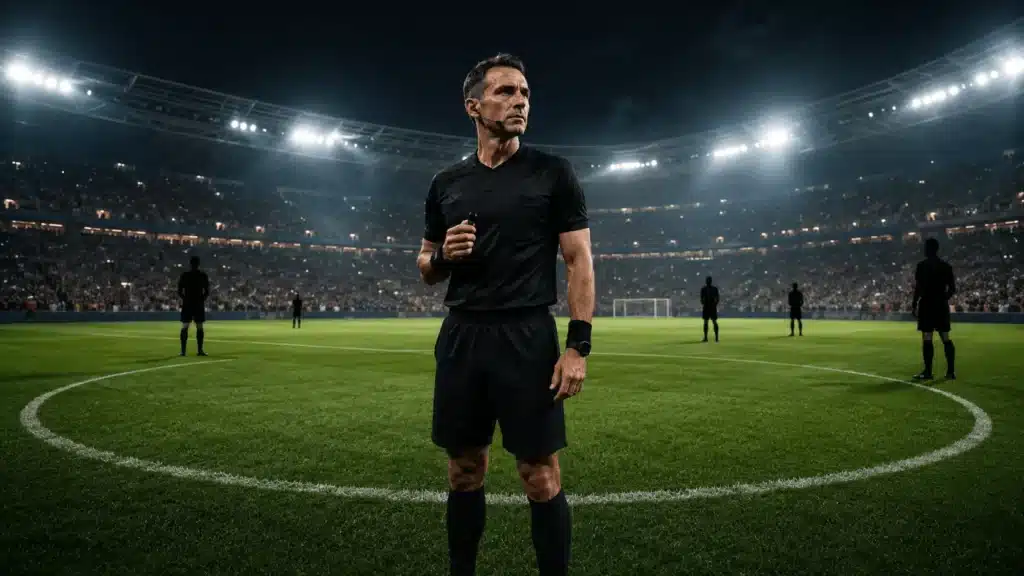
At a World Cup, referee appointments tell their own story. Some officials are trusted early with high-profile fixtures. Others are held back, used as fourth officials, or kept in reserve until the tournament takes shape.
After the latest completed group-stage fixtures, there is now a clear pattern: several names from FIFA’s official World Cup referee list have still not taken charge of a match as the main referee.
That does not automatically mean they have been “dropped” or judged poorly. In tournament refereeing, appointments are shaped by geography, language, confederation balance, team neutrality, performance reports, travel logistics, and the profile of the match. But it is still significant when a referee remains unused in the middle while others have already received a second appointment.
As of the latest completed appointments checked by The VAR Verdict, 11 FIFA-listed referees have not yet served as the main referee at the World Cup.
They are:
| Referee | Country | Status so far |
|---|---|---|
| Khalid Al-Turais | Saudi Arabia | Used as fourth official, not yet main referee |
| Yusuke Araki | Japan | Used as fourth official, not yet main referee |
| Omar Abdulkadir Artan | Somalia | Special case; no match appointment so far |
| Juan Calderón | Costa Rica | Used as fourth official, not yet main referee |
| Katia García | Mexico | Used as fourth official, not yet main referee |
| Campbell-Kirk Kawana-Waugh | New Zealand | Used as fourth official, not yet main referee |
| Oshane Nation | Jamaica | Used as fourth official, not yet main referee |
| Kevin Ortega | Peru | Used as fourth official, not yet main referee |
| Andrés Rojas | Colombia | Used as fourth official, not yet main referee |
| Sandro Schärer | Switzerland | Used as fourth official, not yet main referee |
| Abongile Tom | South Africa | Used as fourth official, not yet main referee |
The key phrase is main referee. Several of these officials have not been absent from the tournament operation; they have appeared in supporting on-field roles. FIFA’s World Cup referee list includes 52 referees. That number is large because the 2026 tournament has expanded to 48 teams and 104 matches. But the early group-stage pattern has not been one referee per match. Some officials have already handled two matches. Wilton Sampaio, Pierre Atcho, Jalal Jayed, Maurizio Mariani, Slavko Vinčić and Said Martínez are among the referees who have already been trusted again. Meanwhile, the 11 names listed above are still waiting for their first appointment as the referee in the middle.That contrast is what makes the situation interesting. FIFA is not simply rotating the list evenly. It is making performance-based and match-specific appointments.
Why Some World Cup Referees Are Still Waiting
There are several possible reasons.
1. FIFA may be protecting neutrality
World Cup appointments must avoid obvious conflicts. Confederation, nationality, regional sensitivity and team history can all affect who is suitable for a match.
A referee may be available but simply not fit the match pool FIFA needs on a specific day.
2. Fourth official work can be part of the pathway
Several referees still waiting for a centre match have already been used as fourth officials. That often keeps them active inside the tournament, familiar with match operations, and visible to assessors.
It can also be a sign that FIFA still trusts them, even if it has not yet given them the whistle.
3. Performance reviews matter
Every referee performance is assessed. Control, disciplinary consistency, foul detection, fitness, communication, teamwork, VAR cooperation and game management all feed into future appointments.
If FIFA feels a referee has delivered strongly, a second match can come quickly. If FIFA wants more certainty, it may delay a first centre appointment.
4. Some officials may be held for specific match profiles
A referee who speaks a certain language, has experience with a certain playing style, or is trusted in emotionally charged matches may be saved for a later group-stage or knockout assignment.
That is why an unused referee is not automatically a rejected referee.
The Special Case: Omar Abdulkadir Artan
Omar Abdulkadir Artan is the most complicated name on the list.
He was included in FIFA’s official referee list, but reports around the tournament have described his situation as different from the other unused officials. Unlike referees who have been used as fourth officials, Artan has not appeared in the normal appointment rotation so far.
For The VAR Verdict, the correct approach is to separate him from the wider appointment debate. His lack of a centre match should not be read in the same way as a referee who is present, working as fourth official, and waiting for a possible appointment.
What This Means for the Tournament
This matters because referee rotation affects credibility.
A 52 referee list suggests depth. But if the same referees are used repeatedly while others wait, fans and analysts naturally ask whether FIFA is narrowing its trusted pool earlier than expected.
That is not necessarily wrong. In a World Cup, the best-performing referees should get the biggest matches. But transparency is limited. FIFA does not publish detailed assessor reports, so outside analysis has to be careful.
The fairest reading is this:
FIFA appears to be prioritising reliability over equal rotation.
That is normal at elite tournament level. It also means the next set of appointments will tell us a lot about who is genuinely in FIFA’s plans for the knockout stage.
World Cup Referees Not Used Yet as Main Referee
Here is the clean list again:
- Khalid Al-Turais — Saudi Arabia
- Yusuke Araki — Japan
- Omar Abdulkadir Artan — Somalia
- Juan Calderón — Costa Rica
- Katia García — Mexico
- Campbell-Kirk Kawana-Waugh — New Zealand
- Oshane Nation — Jamaica
- Kevin Ortega — Peru
- Andrés Rojas — Colombia
- Sandro Schärer — Switzerland
- Abongile Tom — South Africa
Final Verdict
The fact that 11 World Cup referees have not yet taken charge of a match is notable, but it is not automatically controversial.
Most of them have still been involved as fourth officials, which means FIFA is using them inside the tournament structure. The more important question is whether they receive a centre appointment before the group stage ends.
If they do, the rotation will look normal. If they do not, it will suggest FIFA’s trusted centre-referee group is already smaller than the official 52-man list suggests.
For now, the verdict is balanced: no scandal, no VAR issue, but a clear appointment trend worth watching closely.

0 Comments
Join the conversation with respect. Comments are moderated and must follow our community rules.
Want to join the discussion?
Please log in or create an account to comment and reply. This keeps the conversation cleaner and safer.