
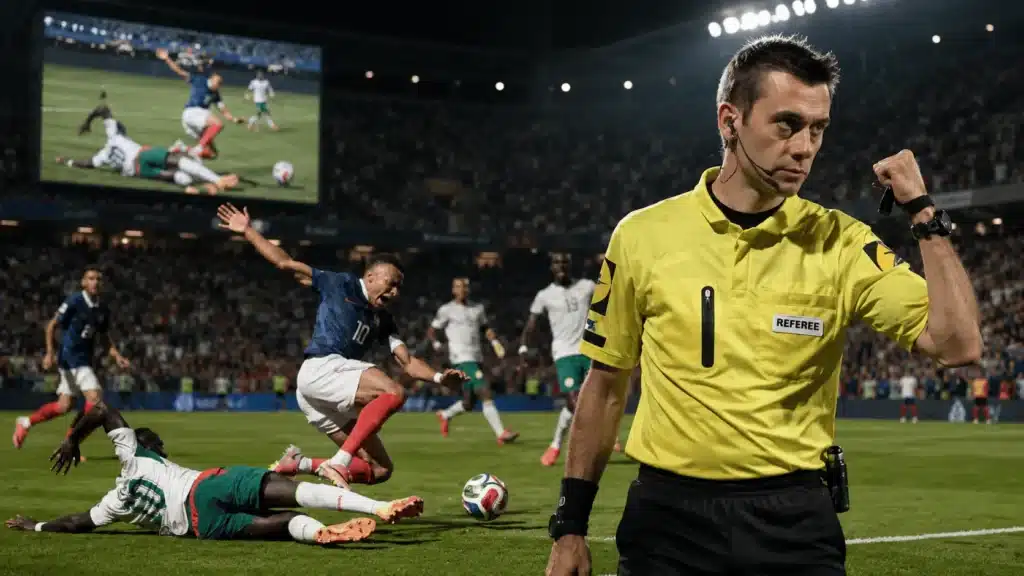
The World Cup 2026 referee decisions debate has moved quickly from background noise to one of the defining themes of the group stage. We have already seen a major no-penalty controversy involving Kylian Mbappé, a formal complaint from Algeria over Argentina’s win, several correct VAR interventions, and a landmark appearance for women officials on the men’s World Cup stage.
That does not mean the tournament is being badly officiated. It means the level of scrutiny is huge, the VAR protocol is wider than before, and every major decision is now judged not only by the Laws of the Game, but by how clearly officials explain and sell the decision.
As of today, Saturday, June 20, 2026, this is World Cup group-stage Matchday 10. Today’s referee watch includes high-profile assignments for Felix Zwayer, Alejandro Hernández Hernández, Ivan Barton, Michael Oliver and others, with several games carrying qualification pressure.
Quick Verdict
The VAR Verdict audit so far:
- Clear or strongly supportable major errors: 2
- Correct major VAR interventions: at least 3
- Technical/transparency issues, not necessarily decision errors: 1
- Best referee performance so far: Clément Turpin — 8.5/10
- Women officials: Historic, credible, and generally positive, though not free from normal match scrutiny
The key point is this: FIFA has not published a public official “wrong decisions” table. So the number above is not an official FIFA statistic. It is The VAR Verdict’s editorial audit based on publicly reported incidents, available footage, VAR protocol logic and IFAB law context.
Today’s World Cup Matchday: Which Games Are on the Referee Watch?
Today’s World Cup schedule gives us another strong set of officiating storylines. The most important matches for referee analysis are:
USA vs Australia
Referee: Felix Zwayer
VAR: Bastian Dankert
This is a major assignment for the German team. USA matches naturally bring a large audience, and with group-stage qualification pressure rising, game management will matter as much as isolated decisions. Zwayer’s challenge is to keep physical duels under control without turning the match into a stop-start card exercise.
Scotland vs Morocco
Referee: Ilgiz Tantashev
VAR: Armando Villarreal
This is the type of match where disciplinary consistency can become decisive. Scotland’s direct style and Morocco’s transition threat could create several tactical fouls and penalty-area duels. The referee needs a strong early line.
Brazil vs Haiti
Referee: Alejandro Hernández Hernández
VAR: Carlos Del Cerro Grande
Brazil matches always bring close attention to penalty-area contact. The key for Hernández Hernández will be separating normal football contact from reckless challenges, especially if Haiti are forced to defend deep for long spells.
Türkiye vs Paraguay
Referee: Ivan Barton
VAR: Khamis Al Marri
This is one of the more interesting appointments of the day. Barton is often firm and expressive, which can help in emotionally charged matches. Türkiye and Paraguay both have players who will compete aggressively in duels, so the first 20 minutes may define the referee’s control.
Netherlands vs Sweden
Referee: Michael Oliver
VAR: Jarred Gillett
This is the headline appointment from an officiating perspective. Oliver is one of UEFA’s most experienced referees, and this match should give him a platform to show calm control, accurate foul selection and strong communication. Expect VAR to stay quiet unless something clearly match-changing happens.
Germany vs Ivory Coast
Referee: Juan Gabriel Benítez
VAR: Antonio García
This one could be a test of game tempo. Germany are likely to dominate possession, while Ivory Coast may create danger in transition. That combination can create holding offences, tactical fouls, and possible DOGSO-style situations if defensive lines are exposed.
How Many Wrong Referee Decisions Have There Been So Far?
The honest answer: there is no official public FIFA number for wrong decisions so far.
The VAR Verdict’s current audit places the number at two major decisions that are either wrong or strongly questionable.
That number should be used carefully. It does not mean every disputed decision is an error. It means two incidents currently stand above the rest as match-changing situations where the available evidence points toward either a clear mistake or a failure to use VAR at the expected standard.
1. France vs Senegal: Mbappé No-Penalty Decision
This is the cleanest candidate for a major wrong decision so far.
Kylian Mbappé went down in the Senegal penalty area after a challenge from Sadio Mané. The referee, Alireza Faghani, initially did not award a penalty and instead appeared to judge the contact as not enough or as initiated by the attacker. VAR checked the incident and sent the referee to the monitor.
That part is important. When VAR recommends an on-field review, it usually means the video official believes the original decision may be clearly and obviously wrong.
After review, Faghani stayed with no penalty.
The VAR Verdict view
This looks like a wrong no-penalty decision.
If the defender does not play the ball and makes contact that trips or clearly impedes the attacker inside the penalty area, Law 12 points toward a direct free kick offence. Inside the penalty area, that becomes a penalty kick.
The referee’s explanation that the attacker initiated the contact is the possible route to support the decision. But from the widely reported description and available replays, that explanation is difficult to defend. Mbappé’s movement appears consistent with an attacker carrying the ball through the box, not manufacturing contact without being challenged.
Decision rating
Incorrect — penalty should have been awarded.
This is not just a “soft penalty” debate. The key issue is that VAR did intervene, the referee saw the footage again, and still came back with a decision that many observers found hard to reconcile with the contact and ball position.
2. Argentina vs Algeria: Messi-Mandi Incident and Algeria’s Complaint
The second major case is Argentina vs Algeria, where Algeria filed a formal complaint over the refereeing after their 3-0 defeat. The main incident involved Lionel Messi and Aïssa Mandi, with Algeria arguing that Messi should have been punished more severely for contact on Mandi.
There was also reported concern over a later incident involving Alexis Mac Allister and Ibrahim Maza.
The VAR Verdict view
This one is more complicated than France vs Senegal because the publicly available evidence and angles matter heavily.
If a player makes high, forceful contact with an opponent’s calf with no realistic footballing justification, then the discussion moves quickly toward serious foul play or violent conduct, depending on whether it happened as a challenge for the ball. Under Law 12, excessive force or brutality can mean a red card.
But the exact classification depends on:
- point of contact
- force
- speed
- whether the ball was playable
- whether the action was a football challenge or an off-ball act
- whether the referee had a clear view
- what the VAR saw from all angles
Decision rating
Strongly questionable — at minimum, it appears worthy of a serious VAR check.
Based on the reports, this is not a routine foul debate. It is a potential red-card incident. If the action clearly endangered the opponent or involved excessive force, VAR should recommend an on-field review. If the evidence was less clear, VAR may have stayed out. That is why this remains slightly below the France-Senegal penalty incident in certainty.
Not Every Controversy Is a Wrong Decision
This is where football analysis needs discipline. A controversy is not automatically an error.
So far, several VAR moments have been uncomfortable, but not necessarily wrong.
Switzerland vs Qatar: Transparency Problem, Not Proven Decision Error
The Switzerland vs Qatar penalty incident raised questions because viewers did not receive the expected semi-automated offside visualisation. That caused confusion and damaged trust in the process.
But a technology or broadcast transparency issue is not automatically a wrong decision.
If the VAR team completed the offside check and judged the attacker onside, the decision can still be correct even if the public explanation was poor. The problem is not necessarily the law application. The problem is communication.
The lesson is simple: at a World Cup, VAR cannot only be accurate. It must be seen to be accurate.
USA vs Paraguay: Correct Use of VAR for Mistaken Identity
One of the best VAR moments so far came in USA vs Paraguay, where a yellow card decision was corrected after review. The original caution was transferred after VAR identified that the wrong player had been punished and that simulation was involved.
This is exactly the type of correction VAR should make.
It was not about re-refereeing every contact. It was about preventing a clear disciplinary injustice. Under the expanded VAR framework, mistaken identity is reviewable, and this was a strong example of the system working as intended.
Canada vs Qatar: Correct Red-Card Upgrade
Canada vs Qatar also gave us a strong example of VAR doing its job. A serious tackle was reviewed and the sanction was upgraded to a red card.
This is the kind of intervention that protects player safety and supports Law 12. When a challenge uses excessive force or endangers the safety of an opponent, the referee has to move from yellow-card territory to red-card territory.
The important thing is that VAR did not intervene for a minor subjective disagreement. It intervened because the possible offence was match-changing and related to a direct red card.
Why VAR Could or Could Not Intervene
VAR is still misunderstood by many fans. It is not there to correct every bad throw-in, every missed shirt pull, or every debatable foul in midfield.
VAR can intervene only in specific match-changing situations:
- goal or no goal
- penalty or no penalty
- direct red card
- mistaken identity
- expanded 2026 protocol areas, including certain second-yellow and set-piece-related situations when they directly affect major outcomes
The phrase that matters is clear and obvious error or serious missed incident.
That means the original decision still has weight. VAR should not intervene just because another referee might prefer a different call. It should intervene when the on-field decision cannot be supported by the footage.
That is why the Mbappé incident is so significant. VAR did intervene and sent the referee to the monitor. The issue is not that VAR ignored it. The issue is that the final decision remained no penalty after review.
Law Context: What IFAB Law 12 Says in Practice
Law 12 is the centre of almost every major controversy so far.
For penalty incidents, the core question is whether a defender commits a direct free kick offence inside the penalty area. That can include tripping, charging, pushing, holding, kicking or attempting to kick an opponent.
For red-card incidents, the referee must judge whether the player used excessive force or endangered the safety of an opponent. If yes, it is serious foul play when challenging for the ball. If it happens away from a football challenge, it can become violent conduct.
This distinction matters.
A bad tackle while trying to win the ball is usually judged as careless, reckless or serious foul play. An off-ball stamp, strike or deliberate act of brutality is more likely to be violent conduct.
That is why the Messi-Mandi incident requires careful wording. Without every angle, it is not responsible to say with total certainty that it must be violent conduct. But if the contact was as forceful and avoidable as reported, it should at least sit firmly inside VAR review territory.
Best Referee So Far: Clément Turpin — 8.5/10
The VAR Verdict’s best referee of the tournament so far is Clément Turpin, rated 8.5/10 for England vs Croatia.
This rating is not an official FIFA rating. It is our editorial assessment based on control, decision accuracy, body language, foul selection, disciplinary balance and VAR cooperation.
Turpin handled one of the most intense early group-stage games with authority. England vs Croatia was fast, emotional and full of pressure. It had goals, set pieces, penalty drama and high-profile players who naturally test the referee’s presence.
What stood out was Turpin’s calm. He did not chase the game. He did not overreact to every contact. He allowed football to breathe where possible, but still gave himself enough control to manage flashpoints.
Turpin rating breakdown
- Match control: 9/10
- Foul detection: 8/10
- Disciplinary management: 8/10
- VAR cooperation: 8.5/10
- Communication and authority: 9/10
Overall: 8.5/10
The best refereeing performances are often the ones that do not dominate the match afterwards. Turpin’s display was close to that standard.
Women Officials at World Cup 2026: Historic, Serious and Deserving of Normal Analysis
The women officials at this World Cup have already made history, but they should not be treated only as a symbolic story. They are match officials. Their performances should be analysed by the same standards as everyone else.
Tori Penso’s appointment for Czech Republic vs South Africa was a landmark moment, especially with Brooke Mayo and Kathryn Nesbitt as part of the officiating team. Katia García, Sandra Ramírez and Tatiana Guzmán have also been part of the tournament’s wider officiating picture.
The key takeaway so far: their presence has been credible, composed and important for the tournament.
That does not mean every decision will be universally accepted. No referee gets that luxury. Penso’s match included a late penalty situation that created debate, which is normal at this level. The right question is not whether women officials should be judged differently. They should not. The question is whether they can manage World Cup football under pressure.
So far, the answer is yes.
Tori Penso rating
7.5/10
A calm and historic performance, with solid overall control. The late penalty debate prevents a higher rating, but the match did not look too big for the officiating team. That matters.
Referee Trends So Far
Three patterns are already clear in this World Cup.
1. VAR is more active, but not always clearer
The expanded protocol gives VAR more room to correct major errors, but it also creates more expectation. Fans now assume everything can be checked. That is not true, and FIFA needs clear stadium explanations to reduce confusion.
2. Player safety is being taken seriously
The red-card upgrades and heavy scrutiny on dangerous contact show that officials are expected to protect players. That is a good trend, but it must be consistent. If one dangerous challenge is punished and another is ignored, the tournament loses credibility quickly.
3. Communication is now part of decision quality
A correct decision explained badly can still create controversy. A wrong decision explained confidently is even worse. At this level, referees need accuracy, but they also need clarity.
Current Wrong Decision Table
| Match | Incident | The VAR Verdict Assessment | Error Level |
|---|---|---|---|
| France vs Senegal | Mbappé penalty appeal | Penalty should have been awarded | Major error |
| Argentina vs Algeria | Messi-Mandi contact | Strongly questionable; should likely have triggered deeper review | Probable/possible major error |
| Switzerland vs Qatar | Offside visualisation issue | Transparency problem, not proven wrong call | Not counted as error |
| USA vs Paraguay | Mistaken identity correction | Correct VAR intervention | Correct |
| Canada vs Qatar | Red-card upgrade | Correct VAR intervention | Correct |
What This Means for FIFA
FIFA does not have a crisis yet. But it does have pressure.
The overall refereeing level has not collapsed. There have been several strong performances and several correct VAR interventions. But the big mistakes are loud because they involve superstar players, possible red cards, penalty decisions and World Cup group-stage consequences.
The most damaging incident remains France vs Senegal because the referee had the chance to correct the decision at the monitor and did not. That is harder to explain than a missed call in real time.
Argentina vs Algeria is different. It now sits in the territory of formal complaint, disciplinary review and public trust. FIFA does not need to agree with Algeria publicly, but it does need consistency in how dangerous contact is judged.
Final Verdict
The World Cup 2026 officiating picture is mixed, not disastrous.
VAR has corrected several important situations. Referees have generally managed games with authority. Women officials have added quality and history, not tokenism. Clément Turpin has produced the strongest performance so far.
But two major incidents are now shaping the referee narrative of the tournament: the Mbappé no-penalty decision against Senegal and Algeria’s complaint over Argentina. One looks like a clear mistake. The other needs careful review, but it cannot be dismissed as ordinary football contact without proper explanation.
The VAR Verdict’s position is firm: the tournament is not being ruined by referees, but the margin for error is gone. At a 48-team World Cup, with expanded VAR powers and global scrutiny on every camera angle, good officiating is no longer just about making the decision. It is about making the decision, explaining it, and applying the same standard tomorrow.

0 Comments
Join the conversation with respect. Comments are moderated and must follow our community rules.
Want to join the discussion?
Please log in or create an account to comment and reply. This keeps the conversation cleaner and safer.