
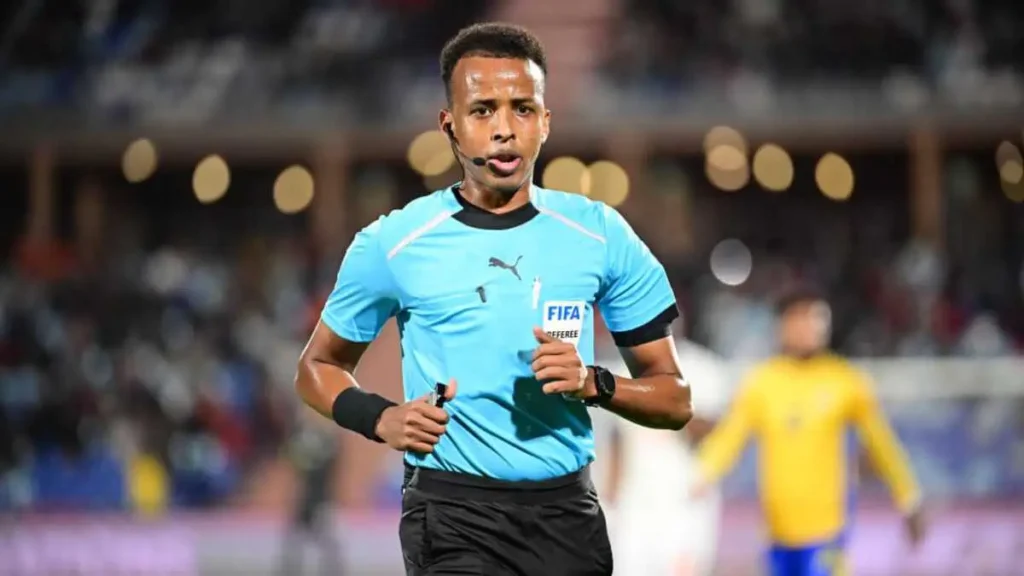
The Omar Artan UEFA Super Cup appointment is about to return one of the most unusual refereeing stories of 2026 to the international spotlight.
Somali referee Omar Abdulkadir Artan will take charge of Paris Saint-Germain against Aston Villa in the UEFA Super Cup on Wednesday, August 12 at Stadion Salzburg in Austria. UEFA has confirmed the 34-year-old as referee for the match between the Champions League winners and Europa League holders.
The appointment would already be significant on sporting merit. Artan was named CAF Men’s Referee of the Year for 2025, has been FIFA-listed since 2018 and recently handled the second leg of the 2025/26 CAF Champions League final.
But there is a much bigger story behind his selection.
Only two months ago, Artan was preparing to become the first Somali referee to officiate at a FIFA World Cup. Instead, he was denied entry to the United States after arriving in Miami and was forced to miss the tournament entirely. FIFA confirmed at the time that U.S. authorities would not change his status and that he therefore could not train or officiate at the World Cup.
UEFA has now handed him one of European football’s biggest one-off referee appointments.
That makes PSG against Aston Villa much more than another final for Artan.
Omar Artan UEFA Super Cup appointment confirmed
UEFA announced the appointment after discussions with the Confederation of African Football.
Artan will referee the 2026 UEFA Super Cup at Stadion Salzburg, with kick-off scheduled for 21:00 CEST on Wednesday, August 12. Paris Saint-Germain qualify as Champions League winners, while Aston Villa enter as Europa League champions.
UEFA’s official match page lists the complete referee team:
| Role | Official | Country |
|---|---|---|
| Referee | Omar Abdulkadir Artan | Somalia |
| Assistant referee | Liban Abdoulrazack Ahmed | Djibouti |
| Assistant referee | Stephen Eleazar Onyango Yiembe | Kenya |
| Fourth official | Rade Obrenovič | Slovenia |
| VAR | Marco Di Bello | Italy |
| Assistant VAR | Guillermo Cuadra Fernández | Spain |
The multinational team is notable in itself. UEFA has combined an African on-field trio with European officials in the fourth-official and video roles.
Who is Omar Artan?
Artan has developed into one of Africa’s leading match officials.
FIFA’s current referee database lists him as an international referee for Somalia since 2018, while UEFA and CAF both highlighted his rapid rise when confirming the Super Cup appointment.
His recent achievements include:
- CAF Men’s Referee of the Year 2025
- FIFA international referee since 2018
- Appointment to the 2026 World Cup referee list
- Second leg of the 2025/26 CAF Champions League final
- Selection for the 2026 UEFA Super Cup
UEFA president Aleksander Čeferin described Artan as an excellent young but already experienced official who had proved himself at the highest level of African club football.
CAF president Patrice Motsepe similarly described the appointment as recognition of Artan’s international standing and a significant moment for African referees.
Why did Omar Artan miss the 2026 World Cup?
This is what makes the appointment particularly unusual.
Artan had been selected by FIFA for the 2026 World Cup and was set to become the first referee from Somalia to officiate at the tournament.
However, when he arrived at Miami International Airport in June, U.S. authorities refused him entry.
Reuters reported that U.S. Customs and Border Protection said a Somali national arriving from Istanbul had been found inadmissible following additional vetting. Authorities did not publicly provide detailed reasons for the decision.
FIFA subsequently confirmed that Artan would not be able to participate in the World Cup.
FIFA said immigration and visa decisions belonged to the host government and that it had been informed Artan’s status would not be changed.
Reports said Artan had held a valid visa, but that did not guarantee admission at the U.S. border.
The decision ended what should have been a historic World Cup appearance.
Somalia reacted strongly to the decision
The situation generated considerable criticism.
Somali officials argued that Artan deserved support from the international football community and questioned how a referee selected on sporting merit for the world’s biggest tournament could be prevented from participating.
When Artan returned to Mogadishu, he received a public welcome from supporters and officials.
The controversy also became part of the wider debate about access to the 2026 World Cup for officials, supporters and other participants from countries affected by U.S. immigration restrictions.
Importantly, there has been no suggestion that Artan was removed from FIFA’s referee list for sporting or disciplinary reasons.
He missed the tournament because he could not enter the host country.
That distinction is crucial.
UEFA responded only days later
UEFA announced Artan’s Super Cup appointment on June 11, just days after his World Cup participation collapsed.
The governing body made clear that the decision followed discussions with CAF and formed part of a broader cooperation agreement between the two confederations, including cooperation on refereeing.
UEFA also connected the appointment to values including unity, equality and non-discrimination.
Čeferin said that football should connect people and that UEFA wanted to demonstrate its respect for Artan and his officiating ability.
That wording made the symbolism difficult to ignore.
UEFA was not simply selecting an African referee for an important match. It was selecting an official whose World Cup opportunity had disappeared because he was denied entry into the host country.
Was the appointment based on merit or symbolism?
The answer can reasonably be both.
There is an obvious symbolic element.
UEFA openly referred to Artan’s inability to participate in the World Cup when announcing him for the Super Cup, and its statement highlighted equality and non-discrimination.
But treating the appointment only as a political gesture would undersell Artan’s refereeing record.
He was already:
- A FIFA international referee
- CAF’s reigning Men’s Referee of the Year
- Selected by FIFA for the World Cup
- Trusted with a CAF Champions League final
Those achievements existed before the U.S. entry controversy.
FIFA itself had already judged him capable of working at the World Cup.
The stronger interpretation is therefore that UEFA used a major appointment to recognise an official who had already earned elite status but lost his World Cup opportunity for reasons unrelated to his refereeing performance.
Is it unusual for UEFA to appoint a non-European referee?
Yes, although it is not without precedent for confederations to cooperate and exchange officials.
The Super Cup regulations state that UEFA’s Referees Committee appoints the referee team and that the officials must appear on FIFA’s international list.
Artan satisfies that eligibility requirement.
His selection has been made under the cooperation framework between UEFA and CAF, which specifically includes refereeing development.
That makes the match an interesting example of cross-confederation referee cooperation.
It also gives a leading African referee exposure to a high-level European final between two major clubs.
PSG vs Aston Villa creates a serious refereeing test
Artan will not be travelling to Salzburg for a ceremonial appearance.
The UEFA Super Cup is a major competitive fixture.
Paris Saint-Germain are the reigning Champions League holders, while Aston Villa arrive after winning the Europa League. PSG are also defending the Super Cup after winning the 2025 edition against Tottenham on penalties. Aston Villa’s only previous Super Cup appearance ended in victory over Barcelona in 1982.
A match involving clubs of this profile creates significant pressure.
Possible refereeing challenges include:
- Managing high-speed transitions
- Tactical fouls
- Penalty-area contact
- Dissent
- Delaying restarts
- Serious foul play
- Handball decisions
- VAR intervention thresholds
The match will also be watched far beyond Somalia and Africa because of the story surrounding the referee.
Marco Di Bello will lead VAR
Italy’s Marco Di Bello has been appointed as VAR, supported by Spain’s Guillermo Cuadra Fernández.
That creates another interesting element.
Artan will referee the game with African assistant referees but work with an experienced European VAR team.
The cooperation between Artan and Di Bello will be critical during subjective decisions.
Under the VAR protocol, the video official should not simply decide whether he personally would have made a different call.
The central question remains whether Artan’s original decision contains a clear and obvious error.
That will matter particularly for:
- Penalty/no-penalty decisions
- Direct red-card incidents
- Fouls during the attacking phase before a goal
- Possible handball offences
UEFA has recently stressed that VAR should avoid unnecessary microscopic re-refereeing. The Super Cup will provide an important early test of that approach.
The match could define Artan internationally
Artan is already highly respected in African football.
The UEFA Super Cup gives him a different kind of exposure.
A composed performance in PSG against Aston Villa could significantly raise his international profile and strengthen the argument for more cooperation between continental refereeing programmes.
For many European supporters, this will be their first time watching Artan closely.
That creates both opportunity and pressure.
Referees generally prefer not to become the story. In Artan’s case, however, his presence is already one of the biggest narratives around the match.
The objective now is to make the refereeing itself as unremarkable as possible.
A strong final should be remembered for the football rather than a controversial penalty, red card or VAR intervention.
Why this appointment matters for African referees
The significance extends beyond one individual.
African referees regularly work at World Cups and FIFA competitions, but appointments to UEFA’s major club finals are understandably rare because UEFA normally selects officials from its own referee structure.
Artan’s appointment creates an opportunity for an African official to demonstrate his ability in one of Europe’s most visible club matches.
It could also strengthen referee exchanges between CAF and UEFA.
That matters because elite officials improve not only through domestic appointments but through exposure to different:
- Playing styles
- Tactical systems
- Refereeing cultures
- VAR operations
- Languages
- Match environments
UEFA and CAF have specifically identified refereeing as one of the areas covered by their cooperation agreement.
If Artan performs strongly, similar exchanges could become easier to justify.
It also raises questions for FIFA
UEFA’s appointment inevitably puts Artan’s World Cup absence back under scrutiny.
FIFA selected him because it believed he was capable of refereeing on the biggest international stage.
He was then prevented from participating because of circumstances outside the normal sporting-selection process.
Two months later, UEFA is placing him in charge of a match involving the champions of its two biggest club competitions.
That contrast is striking.
It does not necessarily mean FIFA handled the situation incorrectly. FIFA cannot simply override the immigration decisions of a sovereign host country.
But the case highlights an important issue for future major tournaments.
When FIFA awards a World Cup to a host country, can it guarantee reasonable access for all properly accredited:
- Players
- Coaches
- Referees
- Federation staff
- Journalists
- Supporters?
Artan’s experience showed that sporting selection alone may not always guarantee participation.
That is a serious question for future tournament planning.
Why the timing makes this article important now
UEFA announced Artan’s appointment in June, but the story becomes much more searchable in the days immediately before the match.
The Super Cup is now only days away.
Searches are likely to shift from the original announcement toward questions such as:
Who is the referee for PSG vs Aston Villa?
Who is Omar Artan?
Why did Omar Artan miss the World Cup?
Where is Omar Artan from?
Who is the UEFA Super Cup referee?
That is why updating the story now is valuable.
Rather than treating it as an old June announcement, the article can serve as a complete referee guide before the final.
Omar Artan UEFA Super Cup: key facts
Full name: Omar Abdulkadir Artan
Country: Somalia
Age: 34
FIFA-listed since: 2018
Major award: CAF Men’s Referee of the Year 2025
Match: Paris Saint-Germain vs Aston Villa
Competition: UEFA Super Cup
Date: August 12, 2026
Venue: Stadion Salzburg, Austria
Kick-off: 21:00 CEST
VAR: Marco Di Bello
Assistant VAR: Guillermo Cuadra Fernández
Frequently Asked Questions
Who is refereeing PSG vs Aston Villa?
Omar Abdulkadir Artan of Somalia will referee Paris Saint-Germain against Aston Villa in the 2026 UEFA Super Cup.
When is the 2026 UEFA Super Cup?
The match takes place on Wednesday, August 12, 2026, at Stadion Salzburg in Austria, kicking off at 21:00 CEST.
Why did Omar Artan miss the World Cup?
Artan had been selected as a World Cup referee but was denied entry to the United States in June. FIFA subsequently confirmed that he could not participate in the tournament.
Is Omar Artan a FIFA referee?
Yes. FIFA lists Artan as an international referee from Somalia since 2018.
Has Omar Artan refereed a major final?
Yes. UEFA and CAF note that he officiated the second leg of the 2025/26 CAF Champions League final.
Who is the VAR for the UEFA Super Cup?
Italian referee Marco Di Bello will serve as VAR, with Spain’s Guillermo Cuadra Fernández as assistant VAR.
The VAR Verdict
The Omar Artan UEFA Super Cup appointment is both deserved and symbolically powerful.
Artan did not lose his World Cup opportunity because FIFA considered his refereeing inadequate. He had already been selected for the tournament and was preparing to become Somalia’s first World Cup referee.
Circumstances outside the football field prevented that from happening.
UEFA has now given him another major international platform.
The appointment should not be reduced to sympathy. Artan’s CAF Referee of the Year award, FIFA status and Champions League final experience demonstrate that he has earned recognition on sporting merit.
At the same time, UEFA clearly understood the wider meaning of its decision.
Our verdict: appointing Artan was a strong decision. It recognises an elite African referee, strengthens UEFA-CAF cooperation and ensures that a lost World Cup opportunity does not define his career.
Now comes the most important part.
On August 12, Artan must turn an extraordinary off-field story into an ordinary elite refereeing performance.
If PSG against Aston Villa finishes with supporters discussing the football rather than the referee, that may be the strongest possible conclusion to his remarkable summer.

0 Comments
Join the conversation with respect. Comments are moderated and must follow our community rules.
Want to join the discussion?
Please log in or create an account to comment and reply. This keeps the conversation cleaner and safer.