
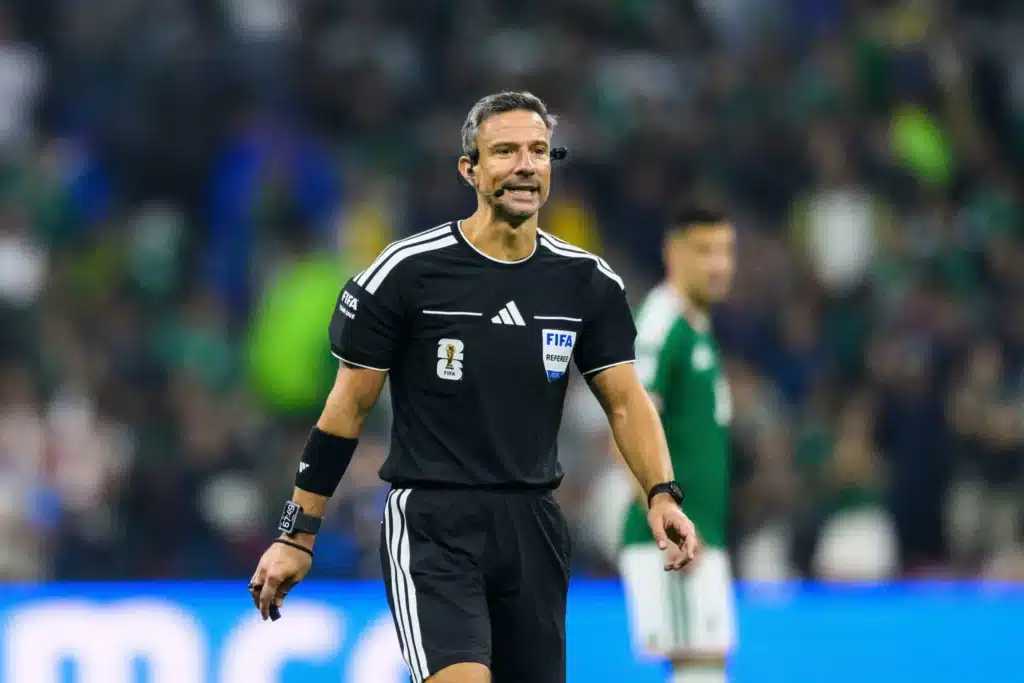
Who were the best referees at the 2026 World Cup?
FIFA selected 52 referees, 88 assistant referees and 30 video match officials for the expanded tournament in Canada, Mexico and the United States. Some officials handled only group-stage fixtures, while others were trusted with the pressure of knockout matches, semi-finals and the final between Spain and Argentina.
Appointments alone, however, do not provide a complete picture. Receiving a quarter-final or final is a major sign of FIFA’s confidence, but it does not automatically mean that the referee produced the best performance of the tournament.
The VAR Verdict has assessed the leading officials through decision accuracy, match control, disciplinary consistency, communication, positioning, VAR cooperation and the difficulty of their appointments. This is an independent editorial ranking and not an official FIFA classification.
How We Calculated the 2026 World Cup Referee Ratings
Each referee was assessed using five main criteria:
- Key decision accuracy: 35%
- Match control and player management: 25%
- Disciplinary consistency: 20%
- VAR cooperation and intervention threshold: 10%
- Difficulty and importance of appointments: 10%
A referee could therefore rank highly without receiving the final, while an official trusted with a late-stage match could lose points for a major error or weak disciplinary management.
Final 2026 World Cup Referee Rankings
| Rank | Referee | Country | Matches | Best Appointment | Rating |
|---|---|---|---|---|---|
| 1 | Alireza Faghani | Australia | 3 | Mexico vs England | 9.3/10 |
| 2 | Wilton Sampaio | Brazil | 3 | Netherlands vs Morocco | 9.1/10 |
| 3 | Slavko Vinčić | Slovenia | 4 | Spain vs Argentina, Final | 9.0/10 |
| 4 | Facundo Tello | Argentina | 3 | France vs Morocco | 8.9/10 |
| 5 | Clément Turpin | France | 4 | Norway vs England | 8.8/10 |
| 6 | Michael Oliver | England | 4 | Spain vs Belgium | 8.7/10 |
| 7 | Iván Barton | El Salvador | 4 | France vs Spain | 8.5/10 |
| 8 | Adham Makhadmeh | Jordan | 4 | United States vs Belgium | 8.4/10 |
| 9 | Jesús Valenzuela | Venezuela | 4 | France vs England | 8.3/10 |
| 10 | Espen Eskås | Norway | 2 | Portugal vs Croatia | 8.2/10 |
1. Alireza Faghani, Australia
Rating: 9.3/10
Matches refereed
- France vs Senegal, group stage
- Colombia vs Portugal, group stage
- Mexico vs England, Round of 16
Faghani’s three appointments placed him in very different refereeing environments. France against Senegal required physical awareness, Colombia against Portugal demanded strong player management, and Mexico against England became one of the most challenging knockout matches of the tournament.
His Round of 16 performance was the decisive factor in this ranking. Faghani correctly handled the match’s major penalty and red-card situations while maintaining authority during a contest that repeatedly threatened to become confrontational. Although two on-field reviews were required, the final outcomes were correct and his overall management remained exceptional.
Specialist analysis described his handling of Mexico against England as one of the most impressive refereeing performances in recent World Cup history. His ability to recognise players’ intentions, respond immediately to threats against his authority and communicate without losing composure separated him from the rest of the field.
Faghani did not simply punish offences. He understood when the match needed a warning, when it needed a card and when an immediate intervention was required to prevent escalation. That tactical intelligence is one of the clearest signs of an elite international referee.
Best performance: Mexico vs England
Main strength: Authority and understanding of player behaviour
Area for improvement: Earlier recognition of incidents that later required VAR intervention
The VAR Verdict: Faghani produced the tournament’s strongest individual refereeing performance. The final appointment went elsewhere, but no official combined decision-making, personality and control more effectively.
2. Wilton Sampaio, Brazil
Rating: 9.1/10
Matches refereed
- Mexico vs South Africa, group stage
- Norway vs Senegal, group stage
- Netherlands vs Morocco, Round of 32
Sampaio began with the opening match between Mexico and South Africa, returned for Norway against Senegal and then received the demanding Round of 32 meeting between the Netherlands and Morocco.
His third performance was one of the tournament’s most sophisticated displays of game management. Netherlands versus Morocco was physical, emotional and tactically difficult, yet Sampaio controlled it with only one yellow card.
That low card count did not result from passivity. The Brazilian distinguished between careless offences, deliberate attempts to disrupt play and challenges that genuinely required disciplinary action. He used his personality and presence to prevent problems before they developed.
A specialist review described the performance as a masterclass in applying FIFA’s preferred refereeing philosophy, highlighting how Sampaio solved an extremely challenging game without losing control.
The only factor keeping him below Faghani is the difference in the pressure and complexity of their best matches. Sampaio was outstanding, but Faghani faced a broader range of decisive incidents in Mexico against England.
Best performance: Netherlands vs Morocco
Main strength: Preventive refereeing and foul selection
Area for improvement: Few weaknesses were visible, although he was not tested in the final rounds
The VAR Verdict: Sampaio showed that match control is not measured by the number of cards. His Round of 32 performance was one of the finest tactical refereeing displays of the tournament.
3. Slavko Vinčić, Slovenia
Rating: 9.0/10
Matches refereed
- Brazil vs Morocco, group stage
- Jordan vs Algeria, group stage
- Mexico vs Ecuador, Round of 32
- Spain vs Argentina, World Cup Final
Vinčić was the only referee in our top three to handle four matches, culminating in FIFA appointing him to the final between Spain and Argentina. His earlier fixtures included Brazil against Morocco, Jordan against Algeria and Mexico against Ecuador.
His tournament was built on calmness, positioning and emotional stability. Vinčić rarely appeared rushed, even when players surrounded him or challenged his decisions. He allowed physical football without creating an uncontrolled match and generally maintained a clear disciplinary line.
The final demonstrated both his strengths and the reason he does not lead this ranking. His cautions for Lisandro Martínez and Leandro Paredes were correct, while Enzo Fernández’s dismissal for a second cautionable offence was also justified. The importance of the occasion did not prevent him from taking the required disciplinary action.
However, Alexis Mac Allister was fortunate to avoid an early yellow card for a reckless challenge on Dani Olmo. The decision to disallow Spain’s goal also remained highly debatable, with the contact in the attacking phase appearing insufficient to justify cancelling the goal.
Vinčić still completed the most prestigious appointment of his career without losing control of the players. FIFA’s decision also made him the first Slovenian referee to take charge of a men’s World Cup final.
Best appointment: Spain vs Argentina
Best overall performance: Mexico vs Ecuador
Main strength: Calm authority in high-pressure situations
Area for improvement: Earlier disciplinary intervention and consistency on marginal attacking fouls
The VAR Verdict: Reaching the final confirms FIFA’s trust, but the tournament’s best referee must be judged on performance rather than appointment alone. Vinčić was excellent overall, although the final contained enough debate to place him third.
4. Facundo Tello, Argentina
Rating: 8.9/10
Matches refereed
- Canada vs Bosnia and Herzegovina, group stage
- South Africa vs South Korea, Round of 32
- France vs Morocco, quarter-final
Tello progressed through three increasingly important appointments. After beginning with Canada against Bosnia and Herzegovina, he handled South Africa’s knockout meeting with South Korea before receiving the quarter-final between France and Morocco.
The quarter-final represented his most important test. France and Morocco brought speed, tactical fouling, emotional pressure and a physical battle around both penalty areas. Tello remained composed and did not allow the nationality debate surrounding the appointment to influence his approach.
His foul recognition was reliable, his movement kept him close to transitions and his disciplinary management was measured. He avoided unnecessary interventions but responded when the match required a stronger signal.
Tello’s greatest quality was consistency. There was no dramatic change in his threshold between the opening minutes and the closing stages, which helped players understand what would and would not be accepted.
Best performance: France vs Morocco
Main strength: Consistent foul threshold and physical positioning
Area for improvement: Could communicate decisions more clearly during crowded confrontations
The VAR Verdict: Tello delivered one of the best quarter-final performances and strengthened his reputation as one of South America’s leading referees.
5. Clément Turpin, France
Rating: 8.8/10
Matches refereed
- England vs Croatia, group stage
- Paraguay vs Australia, group stage
- Colombia vs Ghana, Round of 32
- Norway vs England, quarter-final
Turpin was trusted with four matches and consistently received fixtures featuring major teams or contrasting playing styles. His tournament ended with the quarter-final between Norway and England.
The French referee’s technical movement remained among the best at the tournament. He kept an effective viewing angle during fast transitions, stayed out of passing lanes and rarely became disconnected from the next phase of play.
His quarter-final performance was controlled and mature. Turpin understood that Norway against England did not need constant intervention. He allowed fair physical contact while recognising tactical fouls that threatened promising attacks.
VAR cooperation was also effective. Turpin did not appear dependent on the video team, but he accepted assistance when the protocol required it. That balance is important because a referee should not ignore VAR, yet should not officiate every major incident with the expectation that technology will rescue the decision.
Best performance: Norway vs England
Main strength: Positioning and technical consistency
Area for improvement: At times his calm style can appear too distant during emotional confrontations
The VAR Verdict: Turpin did not produce the tournament’s most dramatic refereeing performance, but he delivered four high-level displays with very few weaknesses.
6. Michael Oliver, England
Rating: 8.7/10
Matches refereed
- Netherlands vs Sweden, group stage
- Norway vs France, group stage
- Canada vs Morocco, Round of 16
- Spain vs Belgium, quarter-final
Oliver’s appointments became progressively more difficult, beginning with two European-style group matches before the intense Round of 16 tie between Canada and Morocco and the quarter-final between Spain and Belgium.
Canada against Morocco was his most complicated match from a control perspective. Oliver began too passively and allowed several early offences to pass without the disciplinary response they required. When a confrontation developed, however, he adjusted his approach, sanctioned players from both sides and restored control.
That ability to recognise that the original management plan is not working is important. Referees who refuse to adapt can lose a match completely. Oliver changed his threshold, became stricter and finished the contest with authority. Specialist analysis consequently assessed it as a good performance despite the difficult opening.
He followed that assignment with a confident quarter-final between Spain and Belgium. His advantage application, sprinting ability and familiarity with high-tempo European football were clear throughout.
Best performance: Spain vs Belgium
Most difficult match: Canada vs Morocco
Main strength: Adaptability and advantage application
Area for improvement: Earlier identification of persistent and provocative offenders
The VAR Verdict: Oliver showed why he remains one of UEFA’s most trusted referees. His tournament was not flawless, but he solved difficult situations and improved as matches developed.
7. Iván Barton, El Salvador
Rating: 8.5/10
Matches refereed
- Türkiye vs Paraguay, group stage
- Japan vs Sweden, group stage
- Switzerland vs Colombia, Round of 16
- France vs Spain, semi-final
Barton was one of only a small number of referees trusted with a semi-final. Before France against Spain, he handled two group-stage matches and the Round of 16 meeting between Switzerland and Colombia.
His strongest quality was his calm presence. Barton rarely reacted emotionally to player protests and generally communicated with short, clear explanations. He also showed confidence when rejecting several penalty appeals in Switzerland against Colombia.
Two late penalty-area incidents in that match were supportable either way, but neither reached the level of a clear and obvious error. Barton maintained his original decisions and completed a good overall performance.
The France versus Spain semi-final increased the difficulty considerably. Barton managed the general temperature well, although one potential red-card incident created debate and prevented his performance from reaching the very highest rating.
Best appointment: France vs Spain
Best technical performance: Switzerland vs Colombia
Main strength: Composure and confidence on penalty-area decisions
Area for improvement: Stronger disciplinary action against borderline serious challenges
The VAR Verdict: Barton’s semi-final appointment was deserved. He was one of the tournament’s most reliable referees, although one or two disciplinary moments kept him below the top six.
8. Adham Makhadmeh, Jordan
Rating: 8.4/10
Matches refereed
- Spain vs Cape Verde, group stage
- New Zealand vs Belgium, group stage
- England vs DR Congo, Round of 32
- United States vs Belgium, Round of 16
Makhadmeh’s World Cup represented a major success for Asian refereeing. He handled four matches as the referee and was later selected as fourth official for the final between Spain and Argentina.
His most impressive characteristic was leadership. Makhadmeh communicated directly, maintained a visible presence and did not appear intimidated by high-profile players or teams.
In England against DR Congo, he correctly rejected Harry Kane’s penalty appeal after recognising that the forward moved into the goalkeeper’s path while attempting to create contact. His technical performance contained a few smaller inconsistencies, but his reading of the major incident was strong.
He then handled the United States against Belgium convincingly. Early verbal warnings established his authority, while his management style prevented a high-pressure elimination match from becoming unnecessarily confrontational.
Best performance: United States vs Belgium
Main strength: Leadership and communication
Area for improvement: Greater technical consistency on ordinary fouls and delayed cautions
The VAR Verdict: Makhadmeh was one of the tournament’s biggest positive stories. His four appointments and final role reflected an excellent World Cup.
9. Jesús Valenzuela, Venezuela
Rating: 8.3/10
Matches refereed
- Australia vs Türkiye, group stage
- Bosnia and Herzegovina vs Qatar, Round of 32
- Ivory Coast vs Norway, Round of 32
- France vs England, third-place match
Valenzuela’s path ended with the third-place match between France and England, a significant appointment that confirmed he remained part of FIFA’s plans until the final weekend.
His strongest performance came in Ivory Coast against Norway. Valenzuela refused to reward soft contact, maintained a clear foul threshold and used disciplinary sanctions only when they were tactically necessary.
His card selection was particularly strong. Rather than simply punishing the most visually dramatic challenge, he considered the nature of the offence, the player’s intention and the effect on match control. Specialist analysis praised his understanding of what the players were trying to achieve in several important incidents.
The third-place playoff was more open and less controlled than a standard knockout match, but Valenzuela remained composed in a game with numerous goals and transitions.
Best performance: Ivory Coast vs Norway
Main strength: Foul selection and tactical use of cards
Area for improvement: More proactive prevention of group confrontations
The VAR Verdict: Valenzuela delivered a quietly impressive tournament and deserved his appointment on the final weekend.
10. Espen Eskås, Norway
Rating: 8.2/10
Matches refereed
- Uruguay vs Cape Verde, group stage
- Portugal vs Croatia, Round of 32
Eskås had fewer referee appointments than anyone else in the top ten, but the quality of his performance against Portugal and Croatia earns him a place in the ranking.
The Norwegian was given one of the biggest Round of 32 fixtures despite entering the tournament with less senior international experience than several established UEFA referees. He responded with a high-level performance.
His use of cards was accurate, his response to player crowding was firm and his cooperation with VAR was excellent. Two on-field reviews were required, but both followed appropriate interventions and were handled without unnecessary delay or confusion.
The limited number of matches prevents Eskås from ranking higher. His best performance was strong enough to compete with several officials above him, but the tournament did not provide a larger sample against different match styles.
Best performance: Portugal vs Croatia
Main strength: VAR cooperation and disciplinary confidence
Area for improvement: Limited tournament sample rather than a clear technical weakness
The VAR Verdict: Eskås justified a difficult knockout appointment and left the World Cup with his international reputation significantly improved.
Referees Who Narrowly Missed the Top 10
Anthony Taylor
Taylor produced a strong Round of 16 performance in Portugal against Spain and was extremely close to inclusion. His careful treatment of borderline incidents and late disciplinary intervention were effective.
François Letexier
Letexier had been among the leading candidates after the group stage, but Argentina against Egypt damaged his final rating. Although the major decisions were defensible under current instructions, his disciplinary threshold was too high and he gradually lost control of player behaviour. The specialist assessment gave that performance a grade of five.
Ismail Elfath
Elfath received the England versus Argentina semi-final, showing the confidence FIFA placed in him. However, his management of the match did not reach the level required to enter this top ten, particularly in relation to disciplinary consistency and control. His earlier Round of 16 performance in Brazil against Norway had been solid rather than outstanding.
Szymon Marciniak
Marciniak remains one of the world’s leading referees, but this ranking is based only on performances at the 2026 tournament. With no centre-referee appointment in the knockout rounds, the sample was not strong enough to place him above officials who succeeded in more demanding elimination matches.
Danny Makkelie
Makkelie was dependable but did not produce a standout performance comparable to Faghani, Sampaio or the referees selected for the latter knockout stages.
What Defined the Best World Cup Referees?
The tournament showed that the best refereeing performances were not necessarily those with the fewest fouls or cards. The leading officials understood the character of each match and adjusted before control was lost.
Faghani succeeded through authority and immediate intervention. Sampaio controlled an intense match through prevention and selective discipline. Vinčić used calmness and consistency to reach the final. Turpin and Oliver relied on movement, experience and technical accuracy.
The most important difference between the leading referees and those who struggled was tactical flexibility. A referee must enter with a plan, but must also recognise when the players are no longer responding to it.
Who Was the Best Referee at the 2026 World Cup?
Alireza Faghani was The VAR Verdict’s best referee at the 2026 World Cup.
His performance in Mexico against England was the tournament’s most complete combination of decision accuracy, authority, player management and emotional control. Wilton Sampaio finished a close second following his outstanding handling of the Netherlands against Morocco.
Slavko Vinčić ranks third. Receiving the final was the tournament’s most prestigious refereeing achievement, but our rankings assess the quality of every performance rather than using the appointment as an automatic first-place award.

0 Comments
Join the conversation with respect. Comments are moderated and must follow our community rules.
Want to join the discussion?
Please log in or create an account to comment and reply. This keeps the conversation cleaner and safer.