
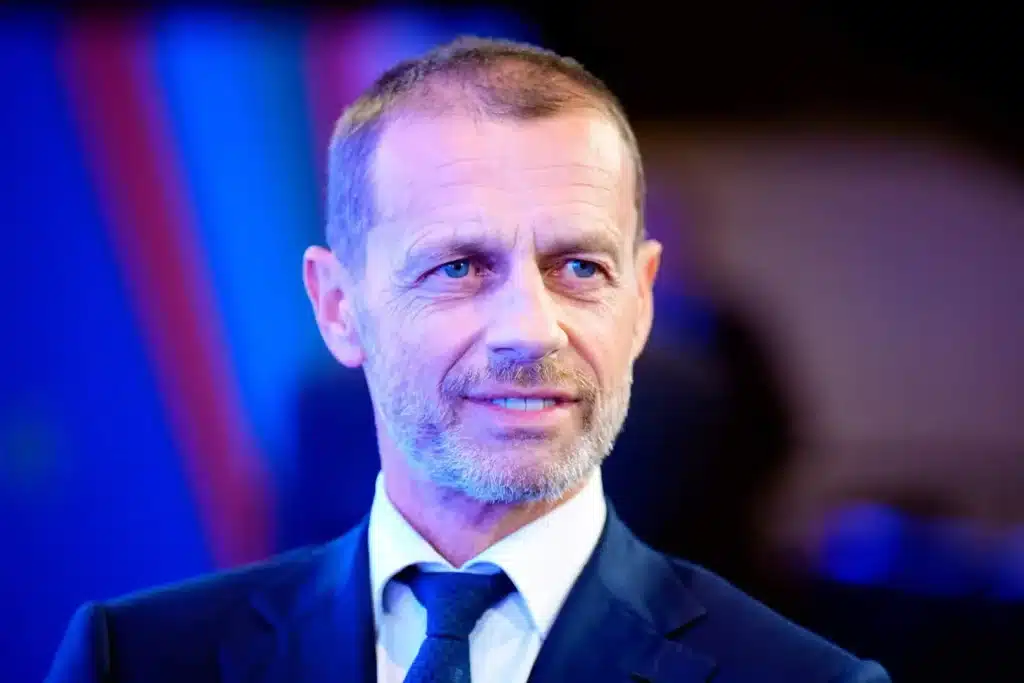
UEFA President Aleksander Čeferin refused to attend the 2026 FIFA World Cup final after a series of serious disagreements with FIFA over disciplinary procedures, refereeing logistics and the organisation of matches.
Čeferin’s absence was not treated as an ordinary scheduling decision. As UEFA president and a FIFA vice-president, he would normally have been expected to attend the most important match in international football. His decision to stay away therefore represented a visible public sign of the widening division between football’s two most powerful governing bodies.
According to Reuters, the dispute was not caused by one isolated incident. The suspension of United States forward Folarin Balogun was a central issue, but concerns over Somali referee Omar Abdulkadir Artan, matches involving Iran, mandatory hydration breaks and the extended half-time interval in the final also contributed to Čeferin’s decision.
Spain ultimately defeated Argentina 1-0 after extra time to become world champions. However, while the players competed for the trophy on the pitch, a much larger political and institutional disagreement was developing away from it.
Why did Aleksander Čeferin boycott the World Cup final?
The most immediate explanation was UEFA’s growing frustration with FIFA’s decision-making during the tournament.
The controversy reached its highest point when FIFA suspended the implementation of the automatic one-match ban attached to Folarin Balogun’s red card against Bosnia and Herzegovina. The decision allowed the United States forward to play against Belgium in the Round of 16.
UEFA publicly condemned the move and reportedly considered it a threat to the integrity and credibility of the competition. The disagreement became much bigger than a debate over whether Balogun deserved to be sent off. It became a debate over whether FIFA applied its disciplinary rules predictably and equally.
Čeferin’s absence from the final was also connected to the treatment of Omar Abdulkadir Artan. The Somali referee had been selected for the World Cup but was unable to participate after being denied entry into the United States, despite reportedly possessing a valid visa. UEFA later appointed him to referee the UEFA Super Cup between Paris Saint-Germain and Aston Villa.
That appointment appeared to carry a message. UEFA was not simply giving Artan another important match. It was demonstrating that the official remained trusted at the highest European level despite being unable to work at the World Cup.
The Folarin Balogun suspension explained
Balogun was sent off during the United States’ knockout match against Bosnia and Herzegovina.
No foul was initially awarded. However, the VAR reviewed the incident and identified contact on the back of the defender’s ankle. The referee was advised to conduct an on-field review and then issued a straight red card for serious foul play.
The decision immediately divided opinion.
Many observers believed the dismissal was excessively severe because the contact appeared accidental and Balogun was attempting to play the ball. Others argued that intention was not the deciding factor because serious foul play is assessed through the nature and danger of the challenge.
That distinction is essential.
Why accidental contact can still result in a red card
A player does not need to intend to injure an opponent for a challenge to qualify as serious foul play.
Referees assess elements such as:
- The point of contact
- The force used
- Whether studs were exposed
- The speed of the challenge
- Whether the opponent’s safety was endangered
- Whether the player had control of the movement
- The possibility and severity of injury
Therefore, saying that Balogun “did not mean it” does not automatically prove that the red card was wrong.
A player can make a genuine attempt to play the ball and still commit serious foul play if the challenge is made with excessive force or endangers an opponent’s safety.
However, the fact that contact occurs above or around the ankle does not automatically make every incident a red card either. The referee must assess the complete action, including force, intensity and the player’s level of control.
The Balogun incident was controversial because the contact looked unpleasant in slow motion, but the degree of force and the unavoidable nature of the landing created room for debate. That made it possible to argue that a yellow card may have been sufficient.
Nevertheless, once the referee issued a straight red card, the normal disciplinary consequence was an automatic suspension.
That is where the most serious controversy began.
Why FIFA’s disciplinary decision caused such anger
FIFA’s disciplinary committee used Article 27 of its disciplinary code to suspend the implementation of Balogun’s one-match ban. He remained on probation for one year, with the punishment capable of being activated if he committed a similar infringement during that period.
From a purely legal perspective, FIFA argued that its rules gave the disciplinary committee the authority to suspend the sanction.
However, the existence of legal authority does not automatically make the decision convincing.
The problem was the apparent conflict between two principles:
- A red card normally carries an automatic one-match suspension.
- FIFA’s disciplinary code allowed the implementation of the punishment to be suspended.
When an exceptional provision is used during a tournament to make an important player available for the next knockout match, the governing body must explain the decision with exceptional clarity.
That did not happen convincingly enough.
The Belgian federation said it was astonished and argued that the outcome appeared to contradict the rules governing automatic suspensions. Belgium were the United States’ next opponents, so the decision had an immediate competitive impact on another team.
The issue was not simply that Balogun benefited. The deeper problem was that teams could no longer be certain what the word “automatic” meant.
Why this was damaging for the referee
The situation also placed unnecessary pressure on Brazilian referee Raphael Claus and the VAR team.
Claus had reviewed the incident and made a decision under the Laws of the Game. Whether that decision was ultimately considered too harsh or not, it was an on-field refereeing judgement.
The disciplinary committee did not formally erase the red card. Instead, it suspended the implementation of the ban.
That created a confusing public message:
- The red card remained on the player’s record.
- The player did not serve the immediate automatic suspension.
- FIFA did not clearly declare that the referee had made a factual error.
- Balogun was nevertheless permitted to play in the next game.
For ordinary supporters, this distinction is extremely difficult to understand.
It appeared as though FIFA accepted the red card but rejected its standard consequence. That left the referee exposed to criticism without clearly establishing whether his decision was considered right or wrong.
A well-designed disciplinary system should protect the independence of match officials while allowing genuinely incorrect punishments to be corrected. It should not create uncertainty about whether a referee’s decision still carries its normal consequences.
The reported political intervention
The controversy became even more serious after reports that United States President Donald Trump had personally contacted FIFA President Gianni Infantino about Balogun’s suspension.
The Guardian reported that Trump made several calls before FIFA announced that the implementation of the ban would be suspended. Trump subsequently praised FIFA for what he described as correcting an injustice.
The existence of political communication does not, by itself, prove that the disciplinary committee was ordered to reach a particular conclusion.
That distinction must be made clearly.
However, the appearance of political influence was highly damaging.
A disciplinary process must not only be independent. It must also be visibly independent.
When the president of a host country contacts FIFA regarding the availability of one of that country’s most important players, and the player is then cleared to participate in the next knockout match, questions are inevitable.
Even if the committee reached its conclusion independently, FIFA should have published a detailed legal and technical explanation demonstrating exactly why the decision met the relevant disciplinary standard.
Without that transparency, suspicion was always likely to grow.
Was FIFA wrong to suspend Balogun’s ban?
Our view is that the principal failure was not necessarily the existence of Article 27 or the committee’s legal ability to use it.
The larger failure concerned consistency, timing and transparency.
If FIFA believed the red card was fundamentally unjust, it should have explained:
- Which part of the referee’s judgement was incorrect
- Why the contact did not meet the threshold for serious foul play
- Why an automatic suspension could be suspended
- Whether the same approach had been applied in comparable cases
- Why the decision was consistent with the integrity of the competition
- Whether political representations had any role in the process
Instead, the outcome looked exceptional, unexpected and highly beneficial to a host nation.
That is why UEFA described the decision as crossing a red line and argued that it damaged confidence in the tournament.
Even a legally permitted decision can be institutionally wrong when it is not explained properly and appears inconsistent with normal practice.
Omar Abdulkadir Artan’s exclusion from the World Cup
The second major issue concerned Somali referee Omar Abdulkadir Artan.
Artan was prevented from entering the United States and therefore could not officiate during the tournament. Reuters reported that he was denied entry despite having a valid visa. The United States government said the decision was linked to alleged connections with suspected members of terrorist organisations.
The allegations were serious, but the incident exposed a major organisational failure.
FIFA selected Artan as a World Cup referee. That meant the governing body had already assessed his sporting qualifications and included him in the tournament’s officiating group.
If a selected match official could not enter one of the host nations, FIFA needed to resolve that risk well before the tournament began.
A World Cup referee spends years preparing for selection. The process includes fitness tests, technical seminars, match assessments, medical examinations and international appointments. Losing the tournament because of an entry decision is not comparable to missing an ordinary club match.
From an officiating perspective, the situation was damaging for three reasons.
1. FIFA could not guarantee access for its own referee
A host country’s national immigration laws remain under government control. FIFA cannot simply overrule them.
However, FIFA chooses tournament hosts and negotiates the operational guarantees required to stage the competition. Access for accredited teams, officials and referees should be among the most basic requirements.
If those guarantees were insufficient, FIFA should explain what went wrong.
2. The referee pool was changed for a non-sporting reason
World Cup referees are selected to provide geographical balance and represent different confederations.
Removing one official affects more than that individual. It changes appointments, workloads, confederation representation and the structure of the referee pool.
3. UEFA’s Super Cup appointment became symbolic
UEFA subsequently selected Artan to referee its Super Cup.
That appointment may have been based entirely on his refereeing quality. However, given the public dispute, it was difficult not to interpret it as a statement of confidence and a response to FIFA’s inability to include him at the World Cup.
The Iran-related concerns
Reuters also reported that European delegates raised concerns over the geopolitical management of matches involving Iran. The available reporting did not provide full public details about every complaint, so it would be irresponsible to claim more than has been established.
However, this formed part of a broader concern surrounding the tournament: political and immigration decisions repeatedly entered football’s operational space.
For referees, this matters because neutrality is fundamental.
Match appointments, access to host countries, disciplinary decisions and tournament procedures must be protected from political pressure. Once supporters believe nationality or diplomatic circumstances can affect those processes, confidence is weakened.
Why UEFA opposed mandatory hydration breaks
Another disagreement involved FIFA’s use of mandatory hydration breaks.
Hydration breaks are justified when weather conditions create a genuine health risk. In extreme heat, player safety must come before concerns about rhythm or entertainment.
The controversy arises when breaks become automatic commercial or operational features rather than medical responses to actual conditions.
A mandatory interruption can affect:
- Match rhythm
- Tactical momentum
- Coaching opportunities
- Added time
- Broadcast planning
- Referee management
- The equality of playing conditions
The referee usually administers the break, but the decision may come from tournament protocol rather than the official’s own assessment.
That means spectators may blame the referee for an interruption that the governing body required.
UEFA reportedly made clear that it did not intend to reproduce FIFA’s approach in its competitions.
Our position is straightforward: hydration breaks should be connected to player welfare and objective environmental conditions. They should not become disguised tactical timeouts or tools designed primarily for broadcasting.
Why the extended half-time was controversial
FIFA also introduced a longer half-time interval for the final.
At first glance, adding several minutes may appear harmless. However, changes to match structure should not be introduced casually, especially for the biggest game of the tournament.
Half-time length affects:
- Player recovery
- Warm-up and muscle temperature
- Medical treatment
- Tactical preparation
- Broadcast scheduling
- The referee team’s restart procedures
- Competitive consistency with earlier tournament matches
The central question is not whether a longer interval automatically creates an unfair result. The question is why the final should operate under materially different conditions from the matches that preceded it.
Football competitions depend on predictable formats. When organisers change operational rules for spectacle or commercial presentation, they risk making the event feel less like a sporting contest and more like an entertainment production.
Reuters identified the extended interval as one of the operational adjustments that contributed to European concerns.
Was Čeferin right to boycott the final?
Čeferin’s decision was understandable, but it was not without risk.
As UEFA president and a FIFA vice-president, attending the final would normally be part of his institutional responsibility. A boycott can be criticised as symbolic politics rather than a practical attempt to solve the dispute.
There is also a danger that a conflict between powerful administrators becomes personalised. Football does not benefit when disagreements between Gianni Infantino and Aleksander Čeferin overshadow the players, referees and supporters.
However, Čeferin’s absence communicated something that an ordinary statement could not.
The dispute was no longer a minor disagreement over a single disciplinary case. It had become a breakdown of confidence in FIFA’s procedures.
When the head of European football refuses to attend a World Cup final involving a European team, the gesture cannot be dismissed as routine.
The VAR Verdict opinion
The VAR Verdict believes Čeferin was right to challenge FIFA over the principles involved, especially the need for consistent disciplinary procedures and protection of refereeing independence.
However, UEFA should also avoid presenting itself as automatically more transparent or beyond criticism. UEFA has faced its own controversies over refereeing, discipline, competition organisation and governance.
The issue is not whether UEFA is morally superior to FIFA.
The issue is whether football’s rules are:
- Known in advance
- Applied consistently
- Protected from political influence
- Explained transparently
- Equal for every team and player
On the Balogun case, FIFA failed to provide enough public clarity to overcome the appearance of favouritism.
The red-card decision itself was debatable. Reasonable refereeing analysts could conclude that the serious-foul-play threshold was met, while others could argue that the contact lacked sufficient force for a dismissal.
But once the red card was issued, FIFA’s handling of the suspension created a larger problem than the original incident.
If FIFA considered the dismissal clearly wrong, it should have said so directly and explained the technical reasons. If it considered the red card correct, allowing the player to avoid the normal immediate consequence required an exceptionally strong explanation.
The governing body attempted to occupy both positions: preserving the disciplinary record while suspending the practical punishment.
That was difficult to defend during an active knockout tournament.
The reported intervention by the United States president made transparency even more important. FIFA needed to demonstrate that the disciplinary committee was independent and that the same decision would have been available to a less powerful nation under identical circumstances.
It did not convincingly do that.
The Artan case was also mishandled. FIFA may not control United States immigration decisions, but it is responsible for selecting hosts capable of welcoming accredited tournament participants. A World Cup referee should not reach the tournament only to discover that he cannot enter the principal host country.
Čeferin’s boycott therefore reflected legitimate concerns.
At the same time, the dispute must eventually move beyond public gestures. UEFA and FIFA govern different parts of the same sport. They must establish clear joint standards concerning disciplinary independence, referee access, tournament operations and political communication.
A boycott can draw attention to the problem. It cannot solve it.
What happens next between UEFA and FIFA?
The relationship between the two organisations was already under pressure before the World Cup.
European officials had previously walked out of a FIFA Congress in 2025 after Infantino arrived late following political meetings. Reports later suggested that a fragile truce had developed, but the Balogun decision reopened the dispute.
The next stage could affect more than administrative relations.
Potential areas of disagreement include:
- The international match calendar
- FIFA’s involvement in club competitions
- Player workload
- Refereeing interpretations
- VAR protocols
- Disciplinary procedures
- Competition formats
- Commercial control of global football
For supporters, these conflicts can appear distant from the match itself. But they eventually affect when games are played, how decisions are reviewed and which rules apply in different competitions.
Why the dispute matters for football referees
Referees depend on governing bodies to provide clear Laws, consistent interpretations and credible disciplinary support.
An official can only control what happens during the match. The governing body controls what happens afterwards.
When post-match decisions appear political or inconsistent, referees lose protection.
Players and coaches may begin to believe that a red card is not final if enough pressure is applied. Supporters may conclude that powerful nations receive different treatment. Referees may be blamed for outcomes that were later altered through administrative decisions.
That is dangerous for the authority of match officials.
A referee must be accountable for a wrong decision. But accountability must occur through a clear process based on video evidence, technical analysis and published rules, not through political influence or unexplained exceptions.
Final verdict
Aleksander Čeferin’s boycott of the World Cup final was the clearest public sign yet that the relationship between UEFA and FIFA had entered a serious crisis.
The disagreement was triggered most visibly by Folarin Balogun’s suspended ban, but it also included the exclusion of referee Omar Abdulkadir Artan, geopolitical concerns and operational changes to the tournament.
The Balogun red card was open to legitimate technical debate. FIFA had the right to review the disciplinary consequences under its own code.
What FIFA did not provide was the level of transparency required to show that the process was independent, consistent and equally available to every participant.
That failure allowed a refereeing controversy to become a governance crisis.
Čeferin’s absence made the disagreement impossible to ignore. But the lasting solution must involve more than boycotts and public statements. Football needs disciplinary rules that are predictable, referees who are protected from political pressure and governing bodies willing to explain difficult decisions in detail.
Without those foundations, trust disappears even when the final decision may be legally permitted.

0 Comments
Join the conversation with respect. Comments are moderated and must follow our community rules.
Want to join the discussion?
Please log in or create an account to comment and reply. This keeps the conversation cleaner and safer.