
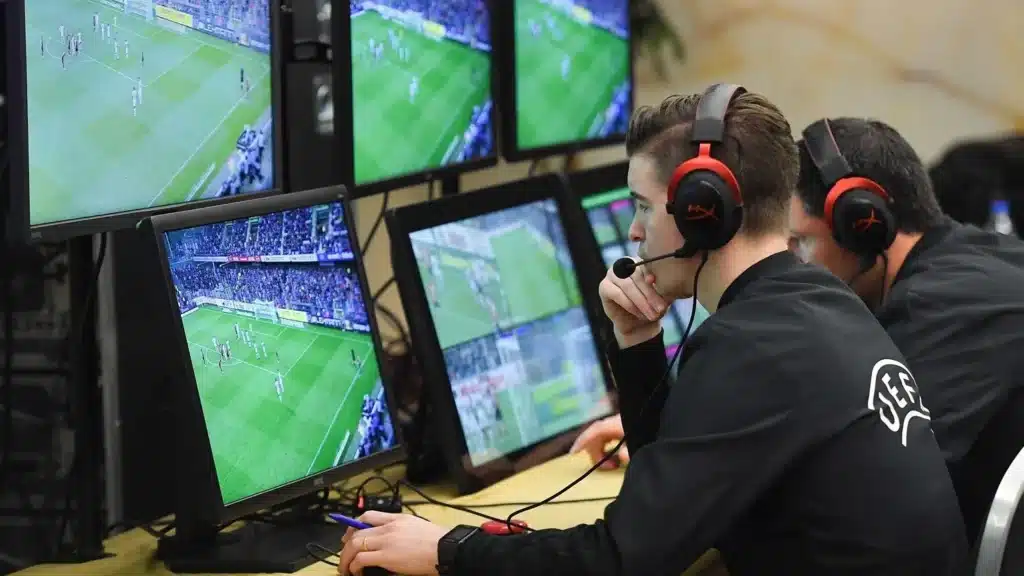
European football is preparing for a different interpretation of VAR after one of the most controversial experiments of the 2026 World Cup.
According to recent reports, UEFA has instructed its video assistant referees not to treat possible simulation as a case of mistaken identity in the same broad way FIFA officials did during the tournament. The reported guidance means that incidents similar to the VAR reviews involving Tim Ream, Miguel Almirón, Breel Embolo and Leandro Paredes may be handled differently in the Champions League and other UEFA competitions.
This does not mean UEFA is rejecting the new Laws of the Game. UEFA’s 2026/27 Champions League regulations still state that VAR may be used in accordance with the IFAB Laws. The disagreement concerns how far video officials should go when interpreting those laws, particularly when a review begins as mistaken identity but ends with a completely different offence being identified.
That distinction is important. The debate is not simply about whether diving should be punished. It is about whether VAR should be allowed to search for simulation during incidents that would not normally be reviewable.
What are the new UEFA VAR rules for 2026/27?
The official changes were approved by the International Football Association Board and took effect for the 2026/27 Laws of the Game.
VAR can now assist with three additional situations when clear evidence is available:
- A red card resulting from a clearly incorrect second yellow card
- Mistaken identity when the wrong player from either team is cautioned or sent off
- A clearly incorrect corner-kick award, when the competition adopts the option and the correction can be made immediately
The corner-kick change is optional. Competitions are not required to use it. The other two changes expand VAR’s authority in rare situations where an incorrect disciplinary decision can seriously affect a match.
At first sight, these adjustments appear sensible. An innocent player should not be dismissed because the referee identified the wrong person. A team should not be reduced to ten players because of a clearly incorrect second caution. An obviously wrong corner can sometimes be corrected in seconds.
The difficulty began when FIFA used the expanded mistaken-identity provision to review whether an apparent foul had actually been simulation.
What does mistaken identity normally mean?
The traditional understanding of mistaken identity is simple.
A referee sees an offence but punishes the wrong player.
For example, two defenders are involved in a confrontation and the referee cautions the player wearing number five, even though number six committed the offence. VAR can identify the correct offender and transfer the disciplinary sanction.
The 2026/27 change expanded the provision so the wrongly punished player can belong to either team. The previous wording was mainly designed for situations where the referee selected the wrong player from the offending team. The new wording covers cases where the referee has effectively punished someone from the wrong side.
The official explanation nevertheless contains an important limitation: only the identity of the offender should normally be reviewed. The underlying offence itself cannot be reassessed unless it is independently connected to a goal, penalty, red-card incident or another reviewable category.
That is where FIFA’s World Cup interpretation became controversial.
Tim Ream vs Miguel Almirón: the first major example
The first high-profile use came during the United States’ group-stage match against Paraguay.
Referee Danny Makkelie initially cautioned US defender Tim Ream after Miguel Almirón went down during a challenge. VAR Carlos del Cerro Grande recommended an on-field review. After seeing the replay, Makkelie concluded that Ream had not committed the foul and that Almirón had simulated the contact.
Ream’s yellow card was cancelled and Almirón was cautioned instead. FIFA later maintained that the new mistaken-identity provision had been applied correctly.
From a fairness perspective, the outcome looked attractive. Ream had been wrongly punished, while the player judged to have deceived the referee received the caution.
However, the legal question was more complicated.
The VAR did not simply identify a different player who committed the same offence. The review changed the complete nature of the incident:
- The original decision was a foul by Ream.
- The final decision was no foul and simulation by Almirón.
- The restart and disciplinary sanction both changed.
- VAR effectively reassessed whether the original foul existed.
That looks more like re-refereeing the underlying incident than correcting a name or shirt number.
Why the Breel Embolo decision caused a larger controversy
The same interpretation became far more significant during Argentina’s quarter-final against Switzerland.
Leandro Paredes challenged Breel Embolo, and referee João Pinheiro initially judged that Paredes had committed a reckless offence. The Argentine midfielder was shown a yellow card.
VAR Guillermo Pacheco Larios reviewed the incident under the mistaken-identity provision. The replay was judged to show Embolo beginning his fall before meaningful contact occurred. Paredes’ caution was cancelled, and Embolo was instead cautioned for simulation.
Embolo had already been booked, so the simulation caution became his second yellow card. He was sent off, leaving Switzerland with ten players for the remainder of normal time and extra time. Argentina eventually advanced after scoring twice in extra time.
The decision was technically consistent with the interpretation FIFA had already used in the Ream-Almirón incident. But its impact exposed the danger of the policy.
A review introduced as a correction of mistaken identity ultimately decided:
- Whether a foul had occurred
- Whether the apparent victim had simulated
- Whether the original offender’s caution should be cancelled
- Whether the opposing player should receive a caution
- Whether that new caution should result in a dismissal
VAR had moved a long way beyond simply identifying the correct player.
Was the Embolo red card correct under the Laws?
There are two separate questions.
The first is whether Embolo simulated. The video officials concluded that he initiated his fall before Paredes made sufficient contact to justify it. Under that interpretation, a yellow card for unsporting behaviour was available.
The second question is whether VAR should have been allowed to investigate the incident in the first place.
That is the more important debate.
IFAB’s current protocol explicitly allows VAR to correct a clearly incorrect second yellow card that produces a dismissal. It even gives an example where a defender simulates, the attacker is wrongly shown a second yellow, and VAR intervenes to cancel the attacker’s dismissal and caution the defender.
However, the Embolo sequence developed in the opposite direction. Embolo had not initially been dismissed. VAR entered through the mistaken-identity provision, identified simulation and then created the second-yellow dismissal.
The final result may fit FIFA’s reading of the amended wording, but it stretches the public understanding of mistaken identity.
A provision designed to correct who committed an offence had become a route for VAR to discover a different offence.
Why UEFA reportedly rejects FIFA’s approach
UEFA’s reported instruction is that potential simulation should not normally be treated as mistaken identity.
Under this narrower interpretation, VAR should not recommend a monitor review merely because an apparent foul might actually have been a dive. Simulation remains a yellow-card offence, and ordinary yellow-card decisions are generally outside VAR’s authority.
There are already legitimate pathways for simulation to be identified during a VAR review.
For example, when a referee awards a penalty and replay clearly shows that the attacker simulated, VAR can intervene because penalty or no penalty is a reviewable category. The penalty can be cancelled and the attacker cautioned.
Likewise, if a player is wrongly shown a second yellow card and dismissed because an opponent simulated, VAR can intervene under the new second-yellow provision and correct the wrongful red card. IFAB’s official guidance specifically confirms this.
What UEFA reportedly wants to prevent is the use of mistaken identity as a general doorway into reviewing an ordinary foul and possible first yellow card.
That position is consistent with UEFA refereeing director Roberto Rosetti’s wider philosophy. Earlier in 2026, Rosetti warned that VAR was becoming too detailed in subjective situations and stressed that intervention should be reserved for clear errors rather than tiny points discovered through repeated slow-motion analysis.
Is UEFA allowed to interpret VAR differently from FIFA?
UEFA must apply the IFAB Laws of the Game, and its Champions League regulations explicitly confirm that VAR operates in accordance with those laws. UEFA cannot simply invent a rule that directly contradicts the official protocol.
However, governing bodies also provide technical instructions to their referees about intervention thresholds and how particular provisions should be understood.
The phrase “clear and obvious error” still requires human judgement. One competition may tell its VARs to intervene only when the evidence is immediately decisive. Another may encourage a wider interpretation of the same provision.
This is why identical incidents can produce different outcomes in the World Cup, Champions League and domestic competitions even though all of them claim to follow the same Laws.
Legally, that flexibility exists. From a supporter’s perspective, it is one of VAR’s greatest weaknesses.
A yellow card should not become reviewable in one tournament and non-reviewable in another only because the competition has adopted a creative definition of mistaken identity.
Can VAR now review every second yellow card?
No.
This is one of the most important points in the new VAR rules.
VAR can intervene when the referee shows a clearly incorrect second yellow card and the player is consequently sent off.
VAR cannot intervene when:
- The referee misses a challenge that might have deserved a second yellow
- A player commits a tactical foul that goes unpunished
- The referee gives only a warning when another official might have shown a caution
- A first yellow card appears too harsh
- A previous yellow card from earlier in the match was debatable
IFAB’s official protocol directly states that a missed potential second-yellow offence remains non-reviewable. The video official can correct a wrongful dismissal, but cannot search for missed cautions in order to create a dismissal.
The distinction is designed to stop VAR from examining every reckless challenge and tactical foul.
Without that restriction, video officials could effectively manage the entire disciplinary process of the match.
Why correcting a wrong second yellow is sensible
A second yellow has a much greater consequence than an ordinary caution because it removes the player from the match.
Imagine that a defender cleanly wins the ball, but the referee mistakenly believes the challenge was reckless. The defender, already booked, receives a second yellow and is sent off.
Previously, VAR could not intervene because the dismissal resulted from two yellow cards rather than a direct red card.
That was difficult to justify. The practical consequence was the same: the team lost a player.
The new rule allows the wrongful dismissal to be corrected when the video evidence is clear. It does not permit VAR to reconsider marginal or subjective cautions simply because another referee might have made a different decision.
Will UEFA review corner-kick decisions?
The 2026/27 Laws allow competitions to introduce VAR checks for clearly incorrect corner kicks.
This is an optional measure, not an automatic global requirement.
The correction must be immediate and must not delay the restart. When the images instantly show that the ball last touched an attacker rather than a defender, VAR can tell the referee that a goal kick should be awarded.
If several angles or slow-motion replays are required, the threshold has probably not been met. If the corner is taken quickly, the decision can no longer be changed.
UEFA’s Champions League regulations permit VAR to operate in accordance with IFAB, but the publicly available regulation does not provide a detailed competition-wide explanation of how often the optional corner provision will be used. It is therefore safer to describe corner review as available under the Laws rather than guaranteed in every UEFA match.
Why corner reviews could become a problem
Correcting an obvious corner is difficult to oppose. A wrongly awarded corner can lead directly to a goal, and the correction may take only a few seconds.
The danger is that “immediate correction” becomes another lengthy review process.
Supporters do not want every corner delayed while VAR searches for a microscopic touch on a boot, shin or fingertip. A system intended to correct obvious mistakes could quickly produce dozens of unnecessary checks.
The proper standard should be:
If the VAR cannot identify the mistake immediately, the original decision stands.
The new power should not become an excuse to investigate every routine restart.
What will not change under the UEFA VAR rules?
The principal review categories remain:
- Goal or no goal
- Penalty or no penalty
- Red-card incidents
- Clearly incorrect second-yellow dismissals
- Mistaken identity
- Optional clearly incorrect corners
The on-field referee must still make the original decision. VAR does not replace the referee, and it should not be used as the starting point for every subjective judgement.
UEFA’s stated direction remains one of limited intervention. Objective situations such as offside can be corrected using technology, but subjective incidents should require clear evidence that the referee’s original judgement was wrong.
Will diving no longer be punished with VAR?
Simulation can still be punished following a legitimate VAR review.
Examples include:
- A penalty is awarded, but replay proves the attacker simulated.
- A penalty is not awarded and the referee cautions the attacker, but replay proves a foul occurred.
- A player is wrongly dismissed through a second yellow because an opponent simulated.
- Simulation forms part of another independently reviewable incident.
What UEFA reportedly wants to prevent is VAR searching for diving during an ordinary midfield foul or first-yellow incident that would otherwise fall outside the protocol.
That is a significant difference.
VAR remains able to expose simulation when it affects a match-changing decision. It does not become a general video disciplinary system for every attempt to deceive the referee.
What does this mean for Champions League referees?
UEFA referees will need to understand a narrow but important boundary.
When the referee has simply identified the wrong player who committed an actual offence, VAR can correct the identity.
When the video official believes the apparent victim may have simulated and the incident is not otherwise reviewable, the VAR should normally remain outside the decision.
The video official must ask:
Am I correcting who committed the offence, or am I reassessing whether the offence happened at all?
If the second question is the real purpose of the review, mistaken identity may be the wrong pathway.
This approach should reduce monitor reviews, protect match flow and preserve the authority of the referee. It may also mean that some incorrect yellow cards remain uncorrected.
That is not necessarily a system failure. VAR was never designed to correct every yellow card.
Why different interpretations damage confidence
The biggest problem is not that UEFA and FIFA have different refereeing philosophies.
The problem is that players and supporters are expected to understand a rule whose practical meaning changes between competitions.
During the World Cup, a player could appear to be fouled, receive the benefit of the referee’s decision and then be cautioned after a mistaken-identity review found simulation.
In a Champions League match, the same incident may remain untouched because UEFA reportedly considers the underlying foul decision non-reviewable.
Both competitions can argue that they are following IFAB.
That is not a sustainable position.
The purpose of the Laws of the Game is to create a common framework. Competition guidance can provide detail, but it should not fundamentally change which incidents VAR is allowed to examine.
The VAR Verdict opinion
The VAR Verdict believes UEFA is right to resist an expansion of VAR through creative terminology.
Mistaken identity should mean that the referee has identified a real offence but punished the wrong person. It should not become a broad mechanism for reopening an ordinary foul and searching for simulation.
FIFA’s World Cup interpretation produced outcomes that could be defended as fair. Tim Ream should not have carried a yellow card for a foul he did not commit. If Miguel Almirón simulated, punishing the simulation rather than Ream appears logically correct.
The same applies to the Embolo incident. If Embolo clearly simulated and Paredes had not committed a reckless foul, allowing Paredes’ caution to stand would have been wrong.
But VAR protocol cannot be built only around reaching the most attractive outcome in an individual incident.
There must be a clear legal route to the review.
When a non-reviewable yellow-card decision is transformed into a reviewable incident by calling it mistaken identity, VAR’s limits begin to lose their meaning.
The more consistent approach would be:
- Use mistaken identity only when a genuine offence occurred but the wrong player was punished.
- Review simulation when it affects a goal, penalty, direct red card or clearly incorrect second-yellow dismissal.
- Do not review ordinary first-yellow simulation incidents unless they belong to another reviewable category.
- Ask IFAB to rewrite the protocol if it wants simulation to become independently reviewable.
UEFA’s reported position therefore makes sense.
However, UEFA and FIFA should not be allowed to maintain contradictory interpretations indefinitely. IFAB must clarify the wording before another major match is decided through the same dispute.
What IFAB should clarify
The governing body should answer one direct question:
Can VAR use mistaken identity to decide that the player who appeared to be fouled actually committed simulation?
The present text is open enough to support FIFA’s interpretation, while the principle that only identity should be reviewed supports UEFA’s narrower view.
That uncertainty is the real problem.
The solution is not another private instruction to referees. It is a public explanation that clubs, players, supporters and broadcasters can understand before the season begins.
Final verdict
The UEFA VAR rules for 2026/27 do not represent a rejection of technology or the official IFAB amendments.
UEFA is reportedly rejecting the way FIFA expanded the mistaken-identity provision during the World Cup.
The new season will still allow VAR to correct clearly incorrect second-yellow dismissals, identify the correct offender and potentially reverse obvious corner-kick mistakes when competitions adopt that option.
What UEFA does not want is for mistaken identity to become a hidden route for reviewing every possible dive or disputed yellow card.
That is the correct principle.
VAR should correct decisive mistakes, not search for a legal excuse to re-referee incidents that fall outside its normal authority.
The World Cup showed that FIFA’s approach can produce a technically defensible outcome while still creating confusion over the limits of the system. UEFA’s narrower interpretation may be easier to manage, but football still requires one clear international standard.
Until IFAB provides that clarity, supporters should expect the same incident to produce different VAR outcomes depending on which competition they are watching.

0 Comments
Join the conversation with respect. Comments are moderated and must follow our community rules.
Want to join the discussion?
Please log in or create an account to comment and reply. This keeps the conversation cleaner and safer.