
More than a month after Spain lifted the 2026 World Cup trophy, the final is producing consequences that could follow several players well into the next international season.
FIFA has completed its disciplinary investigation into the mass confrontation that followed Spain’s 1-0 extra-time victory over Argentina in the World Cup final on July 19, and the punishments are severe.
Leandro Paredes has received the heaviest sanction: a 10-match international suspension and a $90,000 fine.
Nahuel Molina has been suspended for seven matches and fined another $90,000, while Thiago Almada and Spain midfielder Gavi have each received a one-match ban and $30,000 fine. Argentina assistant coach Roberto Ayala has also been suspended for three matches and fined $30,000.
These are not symbolic punishments.
For Paredes in particular, ten international matches could effectively remove him from the Argentina squad for a significant part of the next year.
And when we look at the disciplinary charges FIFA originally opened against the individuals involved, it becomes easier to understand why the punishments are so different.
FIFA World Cup final brawl sanctions in full
FIFA confirmed the following individual sanctions:
Leandro Paredes, Argentina
10-match suspension
$90,000 fine
Nahuel Molina, Argentina
Seven-match suspension
$90,000 fine
Thiago Almada, Argentina
One-match suspension
$30,000 fine
Roberto Ayala, Argentina coaching staff
Three-match suspension
$30,000 fine
Gavi, Spain
One-match suspension
$30,000 fine
The suspensions carry over to the next matches played by the relevant national teams.
That detail is particularly significant for Argentina. These are not bans that disappear because the World Cup has finished. Paredes and Molina will have to serve them during Argentina’s upcoming international fixtures.
What happened after Spain vs Argentina?
The World Cup final itself was already extremely tense.
Argentina were reduced to ten players late in normal time when Enzo Fernández received a second yellow card. Spain eventually broke the deadlock in extra time, with Ferran Torres scoring the goal that secured a 1-0 victory and Spain’s second men’s World Cup title.
But the football did not end with the final whistle.
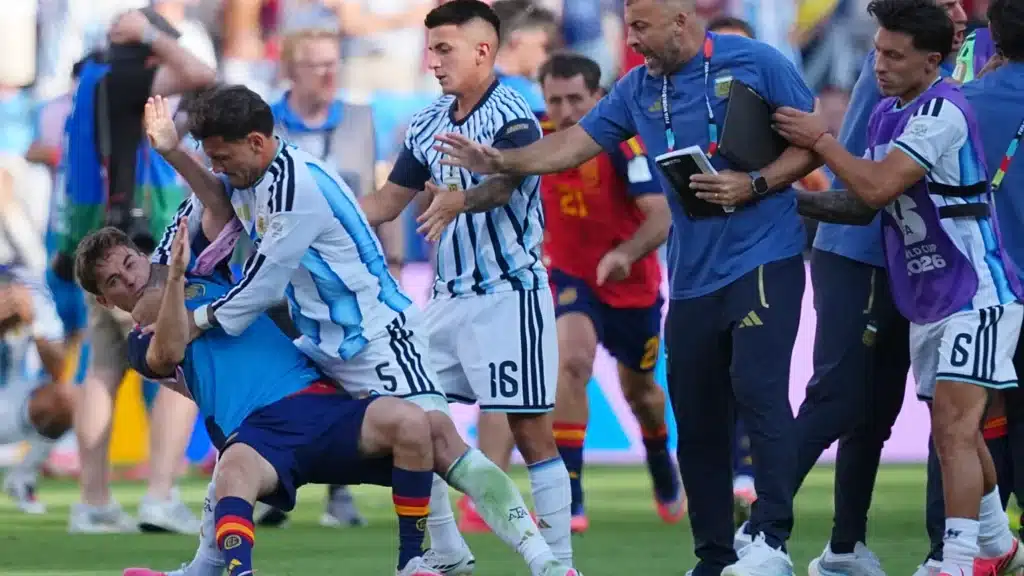
As Spain began celebrating, several confrontations developed between the two teams.
Paredes became involved with Eric García and other Spanish players before the situation escalated. Images showed the Argentina midfielder confronting García and grabbing him around the neck area.
Gavi then became involved and was himself brought to the ground during the confrontation.
Players, substitutes and members of both technical areas moved towards the incident, creating the type of mass confrontation FIFA tends to investigate separately from whatever disciplinary action was taken by the referee on the field.
Paredes was shown a red card after the final whistle, but that was only the beginning of the disciplinary process.
FIFA subsequently appointed a Disciplinary and Ethics Prosecutor to investigate the incidents.
Why did Paredes receive a 10-match ban?
This is the most important question.
Ten matches is an enormous international suspension, especially when the incident occurred after the final whistle.
But FIFA’s initial disciplinary announcement provides an important clue.
Paredes was not investigated for one simple case of unsporting behaviour.
He faced three separate allegations of assault under Article 14 of the FIFA Disciplinary Code.
That changes the situation completely.
FIFA’s disciplinary rules provide for a minimum three-match suspension for assault-type misconduct involving actions such as punching, kicking or striking an opponent or another person who is not a match official.
The three separate allegations against Paredes therefore exposed him to a much more serious sanction than a standard post-match red card.
The VAR Verdict view
The 10-match suspension is extremely severe, but it is not inexplicable.
This was not one reckless tackle committed during normal play.
The confrontation occurred after the match had ended, when there was no sporting reason for physical aggression.
Paredes was also accused of multiple separate actions rather than one isolated confrontation.
That distinction matters.
A player losing control once and pushing an opponent is one disciplinary situation. A player repeatedly becoming involved in physical confrontations with different opponents after the final whistle gives a disciplinary committee far more justification to impose an aggravated sanction.
Until FIFA publishes the full reasoned decision, we should be careful about claiming exactly how the ten matches were calculated.
But the original three assault charges give us a strong indication of why Paredes received by far the biggest punishment.
Our verdict: Severe, but understandable.
Why did Nahuel Molina get seven games?
Nahuel Molina received the second-heaviest punishment.
The Argentina defender was suspended for seven matches and fined $90,000.
Again, FIFA’s original charges explain the difference.
Molina faced two assault allegations, including one completed act and one attempted act, as well as a separate allegation of unsporting behaviour.
That is considerably more serious than the cases involving Almada or Gavi.
FIFA therefore appears to have distinguished between players who became involved in the confrontation and individuals accused of more serious physical actions.
This is exactly what a disciplinary system should do.
Mass confrontations can look chaotic when viewed as one piece of footage, but not every participant has the same responsibility.
One player may attempt to separate teammates. Another may exchange words or push an opponent. Another may deliberately strike somebody.
Treating every participant identically would actually be less fair.
The VAR Verdict
Seven matches is a major punishment, but Molina faced multiple disciplinary allegations.
As with Paredes, we need FIFA’s full written reasoning before analysing the precise calculation.
However, the gap between seven matches for Molina and one match for Almada makes sense when we consider the different charges.
Why was Gavi suspended too?
One part of the decision may surprise Spanish supporters.
Gavi was also punished.
The Spain midfielder has received a one-match suspension and $30,000 fine for his part in the confrontation.
But FIFA did not accuse Gavi of assault.
His disciplinary proceedings concerned unsporting behaviour.
That is an important distinction.
Gavi entered the confrontation after the initial clash involving Paredes and García and then became involved in the wider melee.
The fact that another player may have committed the more serious offence does not automatically give everyone else permission to join a confrontation.
Football disciplinary bodies regularly punish players for escalating mass incidents even when they were not responsible for starting them.
The VAR Verdict
One match is proportionate.
There is a huge difference between Gavi’s sanction and Paredes’ ten matches, and that difference reflects the seriousness of the allegations FIFA brought against them.
FIFA punished Gavi for becoming involved.
It punished Paredes for considerably more serious conduct.
That is an important distinction when discussing whether FIFA treated Spain and Argentina equally.
Equal treatment does not mean identical punishment.
It means judging each individual action using the same disciplinary rules.
Thiago Almada receives one-match suspension
Thiago Almada has also been banned for one match and fined $30,000.
Like Gavi, Almada had originally been charged with unsporting behaviour rather than assault.
Footage of the confrontation showed Almada involved when Gavi became surrounded during the incident.
Again, the one-match punishment places his behaviour in a different disciplinary category from the actions attributed to Paredes and Molina.
That looks logical.
The FIFA Disciplinary Committee appears to have separated the incident into individual actions rather than simply punishing everybody caught in the mass confrontation.
That is the correct approach.
Roberto Ayala banned for three games
Argentina assistant coach Roberto Ayala has received a three-match suspension and $30,000 fine.
Ayala had faced one allegation of assault.
His involvement became particularly controversial because technical staff are expected to help control players during confrontations rather than contribute to them.
Ayala later apologised for his role in the incident.
From a disciplinary perspective, the three-match sanction is important because FIFA is sending a message beyond the players themselves.
Coaches and officials have responsibilities too.
When a mass confrontation develops, members of the technical area cannot behave as though they are simply additional players.
Their responsibility should be to reduce the temperature.
Were FIFA’s punishments too harsh?
This will probably become the main debate.
Paredes — 10 matches
Molina — seven
Ayala — three
Almada — one
Gavi — one
At first glance, ten games feels enormous.
For comparison, many serious red-card offences during matches result in suspensions of around three games.
But that comparison is not completely fair.
A standard three-match ban often involves one act of violent conduct.
Paredes faced three assault allegations arising from a post-match confrontation. Molina faced multiple allegations too.
The context is also important.
This was the World Cup final, one of FIFA’s most visible events.
Players had already been given 120 minutes to compete physically within the Laws of the Game.
The final whistle ended that competition.
Violence afterwards cannot be defended as part of a tackle, an attempt to win the ball or a split-second football decision.
That naturally makes deliberate post-match aggression harder to excuse.
Did FIFA want to send a message?
Almost certainly.
The World Cup final is watched across the planet.
Pictures of players fighting immediately after the trophy has been decided are exactly the scenes FIFA does not want associated with its biggest competition.
Strong sanctions therefore serve two purposes.
They punish the individuals involved, but they also create a deterrent.
A player considering joining a post-match confrontation in the future now has a very recent example of the potential consequences.
A red card might mean three games.
Multiple acts of physical aggression could mean much more.
Paredes now represents that warning.
Paredes punishment compared with Luis Suárez
The severity of the Paredes ban has already created comparisons with some of the biggest FIFA disciplinary cases of previous World Cups.
Luis Suárez famously received a major punishment after biting Giorgio Chiellini during the 2014 World Cup.
Suárez was suspended for nine competitive international matches and banned from all football activity for four months.
Paredes’ punishment is structured differently. His sanction is ten national-team matches rather than a general prohibition on football.
But receiving a double-digit international suspension puts his case among the more severe World Cup-related individual sanctions of the modern era.
That alone tells us how seriously FIFA viewed what happened after the final.
Argentina also hit with huge federation sanctions
The disciplinary consequences go far beyond the five individuals.
FIFA has also fined the Argentinian Football Association a total of $321,000 for several breaches committed during the World Cup.
This point needs to be explained carefully.
The $321,000 punishment is not simply a fine for the final brawl.
It covers several different disciplinary violations during Argentina’s tournament.
FIFA cited breaches relating to:
- team misconduct;
- discriminatory chants and gestures by supporters;
- order and security at matches;
- non-sporting demonstrations;
- other tournament-related misconduct.
The case also included the controversial political banner displayed after Argentina’s semi-final victory over England referring to the Falkland Islands/Malvinas.
FIFA additionally ordered that $100,000 must be invested in an anti-discrimination plan.
Argentina were also ordered to play their next two home matches with stadium capacity restricted to 50 percent, although implementation of one of those matches and part of the financial sanction has been suspended subject to a probationary period.
That means the federation is dealing with a much broader disciplinary case than the confrontation after the final alone.
Can Argentina appeal the bans?
Yes.
And this story may not be finished.
FIFA notified the parties of its decisions on August 21.
Under the disciplinary procedure, the affected parties have ten days to request the full reasoned decision.
Once FIFA provides its detailed reasoning, the sanctions can be appealed under the FIFA Disciplinary Code.
The Argentine Football Association has already indicated that it intends to seek the reasoning behind the decisions and pursue available appeals, with the longer bans for Paredes and Molina expected to be the major focus.
A case can potentially continue through FIFA’s appeal process and ultimately reach the Court of Arbitration for Sport.
So the numbers we have today may not necessarily be the final numbers.
Could Paredes’ 10-match suspension be reduced?
Potentially, yes.
But we should not assume that it will happen.
An appeal does not automatically mean a reduced sentence.
Argentina would need to challenge either FIFA’s factual findings, the legal classification of the actions or the proportionality of the sanction.
The detailed written decision will therefore become extremely important.
At the moment, FIFA has announced the punishment but has not publicly released the complete reasoning explaining exactly how each match of the suspension was determined.
That document should tell us whether the ten games effectively represent cumulative punishment for several separate actions or whether aggravating circumstances also contributed to the final sanction.
Until then, any precise explanation of the ten-game calculation would be speculation.
A punishment that goes beyond the referee’s red card
There is also an important refereeing lesson here.
Paredes was shown a red card after the final whistle.
That did not limit FIFA to the normal automatic consequences of a sending-off.
Match officials deal with what happens at the stadium in real time.
Disciplinary bodies can then use referee reports, video evidence and additional investigations to determine whether further sanctions are required.
This is particularly important during mass confrontations.
A referee and his assistants cannot realistically observe every punch, push or aggressive act when 20 or 30 players and officials become involved simultaneously.
Retrospective disciplinary review therefore becomes essential.
And this case demonstrates that a post-match red card should never be interpreted as the end of the matter when considerably more serious evidence exists.
The VAR Verdict: Did FIFA get the punishments right?
Based on the information currently available, the overall structure of the sanctions makes sense.
Leandro Paredes — 10 games: SEVERE BUT JUSTIFIABLE ✅
Three assault allegations and repeated involvement make this fundamentally different from an ordinary red-card offence. Ten matches is huge, but FIFA clearly viewed Paredes as one of the central figures in the confrontation.
Nahuel Molina — seven games: JUSTIFIABLE ✅
Multiple allegations of assault plus unsporting behaviour explain why his punishment is significantly above a standard suspension.
Roberto Ayala — three games: CORRECT ✅
A member of the coaching staff accused of physical misconduct should face a meaningful punishment. Officials should be helping to end confrontations, not escalating them.
Thiago Almada — one game: PROPORTIONATE ✅
His case was classified as unsporting behaviour rather than assault. A one-match sanction reflects that difference.
Gavi — one game: PROPORTIONATE ✅
Being provoked or entering a confrontation to defend a teammate does not automatically remove disciplinary responsibility. His much smaller punishment correctly separates his involvement from the more serious actions FIFA attributed to Paredes and Molina.
Final verdict
The 2026 World Cup final will be remembered for Spain becoming world champions after Ferran Torres’ extra-time winner.
But for Argentina, the consequences continued long after the final whistle.
FIFA’s disciplinary investigation has now produced one of the most significant sets of individual sanctions following a World Cup match in recent history.
Leandro Paredes faces ten matches away from Argentina.
Nahuel Molina faces seven.
Roberto Ayala has been suspended for three, while Thiago Almada and Gavi each lose one international match.
The message from FIFA is difficult to misunderstand.
The final whistle ends the football. It does not end a player’s disciplinary responsibility.
There is room to debate whether ten matches is excessive, and Argentina are entitled to challenge the punishment through the appeals process.
But there should be considerably less debate about the principle behind the sanctions.
Physical aggression after a World Cup final cannot be dismissed as emotion, frustration or part of the game.
It is exactly the type of conduct a disciplinary committee is there to punish.
The next important development will be FIFA’s full reasoned decision. That should finally explain why Paredes received ten matches, Molina seven and whether aggravating factors were used to increase the sanctions beyond the normal minimums.
If Argentina appeal, The VAR Verdict will analyse the case again and determine whether FIFA’s punishment survives closer legal scrutiny.

0 Comments
Join the conversation with respect. Comments are moderated and must follow our community rules.
Want to join the discussion?
Please log in or create an account to comment and reply. This keeps the conversation cleaner and safer.