
The Premier League has published one of the clearest examples yet of how a referee decision can be wrong while VAR can still be correct not to change it.
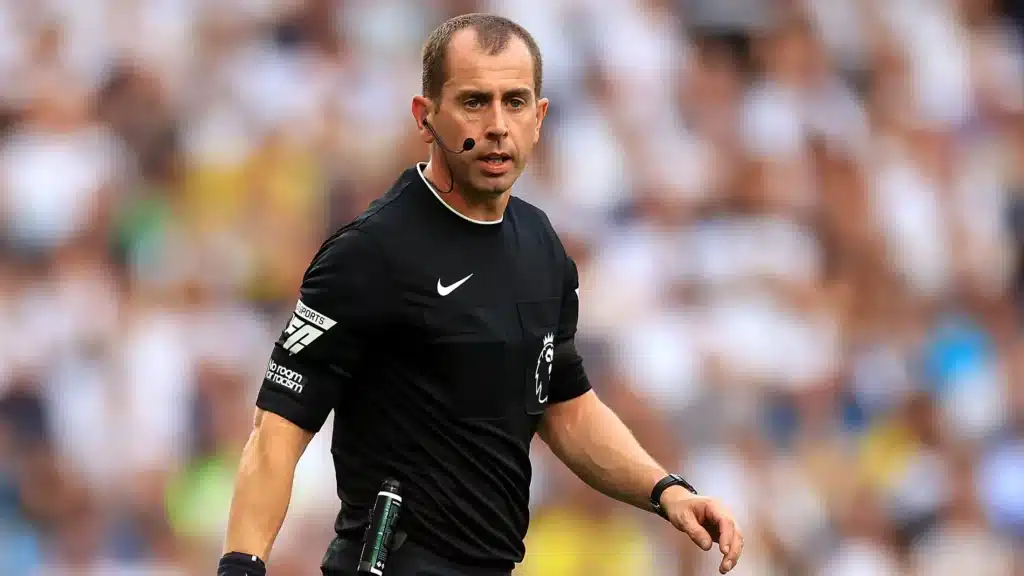
During Brighton’s match against Aston Villa, referee Peter Bankes did not award a penalty when John McGinn challenged Ibrahim Osman inside the area.
The Premier League’s independent Key Match Incident Panel has now reviewed the incident and concluded that Brighton should have received a penalty.
But there is an important twist.
The same panel also decided that VAR Matt Donohue was right not to intervene.
That sounds contradictory.
It is not.
And it perfectly explains one of the most misunderstood parts of VAR.
What happened in Brighton vs Aston Villa?
The incident occurred in the 79th minute.
Osman received the ball inside Aston Villa’s penalty area and McGinn stepped across to challenge him.
McGinn made contact with Osman but did not play the ball.
Bankes allowed play to continue.
VAR checked the incident but decided not to recommend an on-field review.
The match continued without a penalty.
The Key Match Incident Panel has now assessed both decisions separately.
Premier League panel says Brighton should have had a penalty
The panel voted 4-1 that Bankes’ original no-penalty decision was incorrect.
Its reasoning was straightforward.
McGinn stepped into Osman’s path, made contact and did not win the ball.
The majority therefore believed a foul had occurred inside the penalty area.
That means the panel’s preferred on-field decision was:
Penalty to Brighton.
So from a pure refereeing perspective, Bankes got the incident wrong.
But VAR was still judged correct
This is where things become interesting.
The panel then assessed Matt Donohue’s decision not to intervene.
The vote was 3-2 in favour of VAR.
In other words:
Referee decision: ❌ Incorrect
VAR non-intervention: ✅ Correct
The reason is the Premier League’s clear-and-obvious error threshold.
The panel believed a penalty would have been the better decision, but the majority did not believe Bankes’ no-penalty call was so clearly wrong that VAR was required to overturn it.
How can the referee be wrong but VAR be right?
This is the most important point.
VAR is not supposed to ask:
“What decision would I make if I were the referee?”
The video official is supposed to ask:
“Is the referee’s decision clearly and obviously wrong?”
Those are different questions.
Imagine a challenge where six referees think it is a penalty and four think it is not.
The preferred decision may be penalty.
But if both interpretations are reasonably defensible, VAR may still be correct to leave the original call alone.
That is effectively what happened here.
The KMI Panel preferred a penalty.
But it did not believe the no-penalty decision crossed the intervention threshold strongly enough.
The VAR Verdict: Referee wrong, VAR defensible
Our view is very close to the panel’s.
McGinn does not appear to win the ball and steps into Osman’s path.
For us, the better on-field decision is a penalty.
Peter Bankes: ❌ Should have awarded the penalty.
But once Bankes decides there is not enough for a foul, VAR enters a different test.
The footage shows contact, but it is still a subjective challenge rather than something completely indisputable such as a defender clearly kicking through an attacker without touching the ball.
That gives the VAR a difficult decision.
Would we support a penalty?
Yes.
Was Bankes’ no-call so obviously wrong that VAR absolutely had to intervene?
That is less clear.
Matt Donohue: ✅ Non-intervention is defensible under the current threshold.
This is why VAR decisions frustrate supporters
For supporters, this distinction can feel absurd.
If an independent panel later says:
“The referee got it wrong.”
The natural response is:
“Then what is VAR for?”
The answer is that VAR was never designed to correct every mistake.
It was designed to correct a smaller category of major errors that meet a high intervention threshold.
That distinction is deliberate.
If VAR tried to correct every subjective decision that another referee might judge differently, video officials would effectively re-referee the entire match.
Every tackle, handball and piece of penalty-area contact could become a prolonged video review.
The Premier League wants to avoid that.
The clear-and-obvious threshold explained
There are broadly two different types of VAR decision.
Factual decisions can often be resolved objectively.
Was a player offside?
Did the foul happen inside or outside the penalty area?
Did the ball cross the line?
Subjective decisions are different.
Was contact strong enough for a foul?
Was a tackle careless or reckless?
Was a hand position unnatural?
Did a defender hold an attacker enough to materially affect him?
For those decisions, VAR normally needs a clear and obvious error before recommending a review.
The Premier League has repeatedly emphasised that the on-field referee remains the primary decision-maker.
The Premier League is publishing referee assessments for the first time
The McGinn-Osman incident is also significant for another reason.
For the first time in the 2026/27 season, the Premier League is publishing its Key Match Incident Panel results every week.
The KMI Panel has existed since 2022/23 but its detailed evaluations were not previously published in this format.
It is an independent assessment body made up of three former players or coaches, one Premier League representative and one Pro Ref representative.
The objective is to provide greater transparency around penalties, red cards, offsides and other major refereeing decisions.
How accurate were Premier League referees in Match Round 1?
The first published report covered 21 key referee incidents.
According to the panel:
90% of the original on-field decisions were correct.
After VAR involvement:
100% of the final decisions were judged correct.
There were two actual VAR reviews during the round and the panel concluded that both overturns were correct.
One of those came in the same Brighton-Aston Villa match.
João Gomes kicked out at Georginio Rutter after losing possession. Bankes initially allowed play to continue, but VAR intervened and Gomes was eventually shown a red card for serious foul play.
That gives us two very different VAR examples from the same game:
Gomes red card: VAR intervenes because the error is clear enough.
McGinn on Osman: VAR stays out because the no-penalty call does not cross the required threshold.
Is the VAR threshold too high?
This is where there is a legitimate debate.
A higher intervention threshold has major advantages.
It keeps the referee in control.
It reduces unnecessary reviews.
It prevents VAR from becoming a second referee searching for another interpretation.
It also allows more football decisions to remain with the person actually managing the match.
But there is an obvious downside.
Some decisions that the league itself later considers wrong will remain unchanged.
That is exactly what happened with McGinn and Osman.
Supporters therefore have to accept a strange reality:
VAR can operate correctly even when the final decision is not the decision experts ultimately prefer.
Does this damage trust in VAR?
Potentially, but transparency may actually help.
The worst outcome would be pretending that every VAR-supported decision must therefore have been the ideal refereeing decision.
That is not how the system works.
The Premier League openly publishing:
“On-field decision incorrect, VAR intervention correct”
is actually useful.
It tells supporters what VAR is designed to do and, equally importantly, what it is not designed to do.
VAR is not a guarantee of perfect refereeing.
It is a safety net for clearly defined major mistakes.
Should VAR have intervened anyway?
Our preference would have been a penalty on the field.
McGinn does not play the ball and his intervention appears to prevent Osman continuing normally.
However, once Bankes sees the incident and decides the contact does not justify a penalty, we can understand why Donohue did not send him to the monitor.
This was not a completely inexplicable decision.
It was a subjective judgement that the independent panel narrowly believed was wrong.
That is very different from a defender clearly punching the ball away or making an obvious studs-up challenge that the referee completely misses.
Final VAR Verdict
The Premier League’s first public KMI report has produced an excellent example of why VAR remains so difficult to explain.
The independent panel says Brighton should have received a penalty after McGinn challenged Osman.
On-field decision: ❌ Wrong, according to the panel.
But it also says VAR was correct to stay out.
VAR decision: ✅ Correct under the clear-and-obvious threshold.
Both conclusions can exist at the same time because the referee and VAR are being judged against different standards.
The referee must make the best decision.
VAR only intervenes when that decision becomes clearly and obviously wrong.
That means VAR will not eliminate every refereeing mistake.
It was never supposed to.
And if the Premier League continues publishing these panel decisions every week, supporters may finally get a much clearer picture of where the line between “wrong decision” and “VAR error” actually sits.

0 Comments
Join the conversation with respect. Comments are moderated and must follow our community rules.
Want to join the discussion?
Please log in or create an account to comment and reply. This keeps the conversation cleaner and safer.