
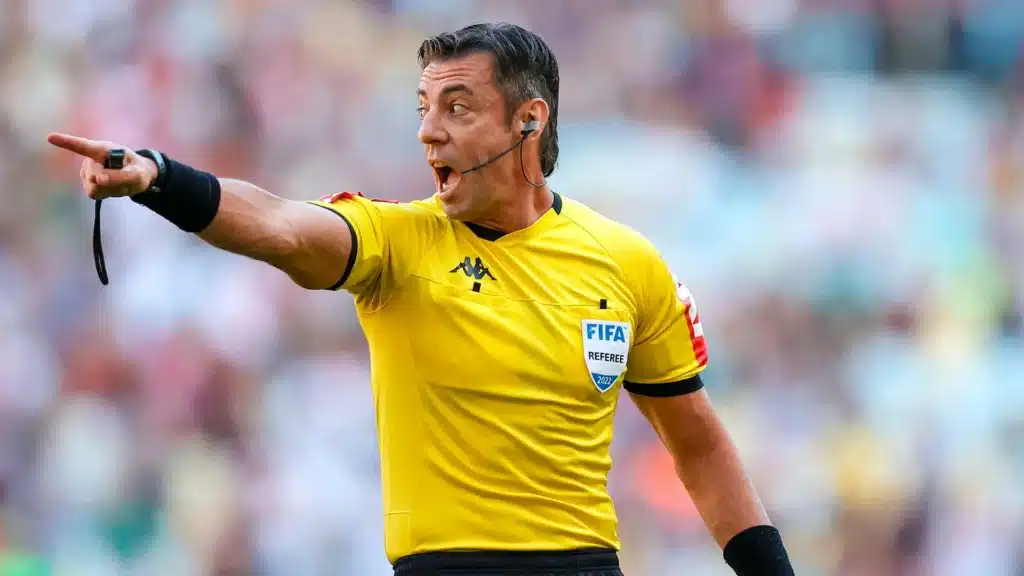
FIFA has issued a rare public statement in support of Brazilian referee Raphael Claus after United States President Donald Trump questioned the official’s integrity following Folarin Balogun’s controversial red card at the FIFA World Cup.
The incident has become one of the biggest refereeing stories of the tournament, moving beyond football and into the political spotlight. While debates over individual decisions are common at every World Cup, it is highly unusual for FIFA to publicly defend one of its referees during an active competition.
What started the controversy?
The debate began during the United States’ Round of 32 victory over Bosnia and Herzegovina. After a VAR review, Raphael Claus upgraded Balogun’s challenge on Tarik Muharemović to a straight red card for serious foul play. Under Law 12 of the IFAB Laws of the Game, a tackle that endangers an opponent’s safety can result in a direct red card, regardless of whether the contact was intentional. The decision automatically suspended Balogun for the next match.
However, FIFA’s Disciplinary Committee later suspended the one match ban under Article 27 of the FIFA Disciplinary Code, making the striker available for the Round of 16 clash against Belgium. That decision immediately triggered criticism from Belgium and became one of the biggest talking points of the World Cup.
Trump’s criticism
Speaking after FIFA’s decision, Trump confirmed that he had asked FIFA President Gianni Infantino to review Balogun’s suspension. He also criticised Raphael Claus directly, describing the Brazilian referee as “very suspect” and questioning the original red card decision without providing evidence to support those claims. Those comments quickly spread around the football world and placed additional pressure on one of FIFA’s most experienced officials.
FIFA’s response
Rather than remaining silent, FIFA issued an official statement backing Claus. The governing body described him as one of the world’s leading professional referees and reaffirmed that he remains a valued member of FIFA’s elite referee group at the 2026 World Cup. Referees Committee chairman Pierluigi Collina also expressed confidence in Claus and his performances. Such public support is relatively uncommon during a tournament, highlighting how seriously FIFA viewed the criticism directed at one of its match officials.
Was Raphael Claus’s red card correct?
From a refereeing perspective, the discussion should remain separate from the political debate.
The VAR review concluded that Balogun’s challenge endangered the safety of his opponent by making forceful contact with the ankle.
That is precisely the type of incident that Law 12 identifies as potential serious foul play.
Referees may disagree on the threshold for excessive force, but the decision itself was supported by the VAR process and fell within the framework of the Laws of the Game.
The later suspension of the automatic ban was made by FIFA’s disciplinary authorities, not by the referee or the VAR team.
That distinction is important.
Raphael Claus applied the Laws of the Game during the match.
The disciplinary committee later exercised its own authority under FIFA regulations.
Why this matters for referees
Referees are expected to make independent decisions without external influence.
When political figures publicly criticise individual officials, it can increase pressure not only on the referee involved but also on the wider officiating community.
FIFA’s statement appears intended to reinforce a simple message: referees must be judged on their performances under the Laws of the Game, not on political reactions or public opinion.
The VAR Verdict
The controversy surrounding Balogun’s red card has now become much larger than a single refereeing decision.
Raphael Claus fulfilled his responsibility by applying the Laws of the Game and using VAR to review a potentially serious foul play incident.
The later suspension of Balogun’s ban was a disciplinary decision taken away from the field.
By publicly defending Claus, FIFA has sent a clear signal that it continues to trust one of its leading referees despite the intense criticism.
Whether supporters agree with the original red card or not, protecting the independence and credibility of match officials remains essential for the integrity of the game.

0 Comments
Join the conversation with respect. Comments are moderated and must follow our community rules.
Want to join the discussion?
Please log in or create an account to comment and reply. This keeps the conversation cleaner and safer.